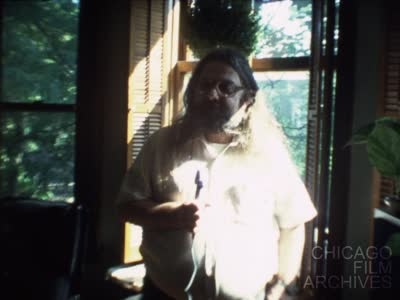
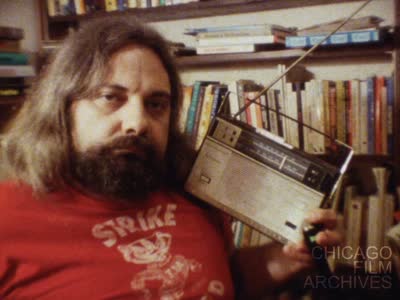
I'm Chuck Kleinhans, I'm making this film.
Yesterday, March 30th, President Reagan was shot and wounded.
And yesterday, my doctor told me that I had carpal tunnel syndrome, which is an inflammation of the wrist muscles in both of my hands, which constricts the nerves.
Essentially, because of this, I'm unable at certain times to close my fist.
And this is a chronic disease which is now being treated with medicine, which I have to take three times a day.
The pills I have to take, I'll take them right now.
I'm supposed to take this with milk, but I'll take some milk right afterwards.
And if it's not treated with, treatable with medicine, the next step is to inject steroids in my wrists.
And the step after that is surgery.
I'm having a hard time getting the pill down.
Okay.
This is really the first time that I've had to deal with the possibility of having a chronic illness.
And that's a very sobering thought for me.
I guess it makes me think that I'm approaching middle age.
Let's see.
And I'm going to have decided to make this film and to record some of the events in my life.
This is where I live and work during the day, Annie Mae Swift at Northwestern University, which is the School of Speech's building.
And the people who are helping me make this film are some other filmmakers, Rob Sabal, who is operating the camera, and Courtney Newman, who is filming us time this film.
Courtney? I don't know if you can be seen.
I teach film criticism theory and filmmaking at Northwestern.
And that's about all that I'm going to say at this time.
You'll start flexing things you never even knew you had.
Okay.
What about the out -of -focus shot? I think you should leave that in because it shows a certain amount of fundamental development in the person shooting it.
Okay.
What do you think of the out -of -focus shot? I don't like anything out -of -focus.
You don't like it if it's out -of -focus? Okay.
How do you feel about it? I think it should be taken out.
If the shot doesn't have a reason to be in like that, it adds nothing aesthetically.
I don't think it should be allowed.
Okay.
Thank you.
Your opinion? I think I'd have to see the whole picture.
Okay.
Safe view.
Okay.
What do you think? I think it would be easy to redo.
Easy to redo? Yeah, but it's the wrong date, right? I think you should leave it in.
I'm glad you made it through the shot with all the pills.
Okay.
What do you think? I think it's good.
It helps your audience soften the reality of this chronic illness.
Soften it.
Okay.
I think someone said fundamental.
Okay.
Rob, we want to ask you.
I took the shot.
I know the motor vehicle.
I think it helps to show everybody that may see the film that you are just a little bit human.
Okay.
Just a little bit.
Leave it in, definitely.
But also leave the wind in.
That adds a lot.
You like the wind, too.
Okay.
I don't know.
Should we let these filmmakers do anything? Well, listen, Rob.
You are the cameraman.
Defend yourself.
Well, I was trying to show the background more than you because the film is about the difference between where you live and where you work up here.
So I thought scenes of the building and people passing by would give more information and be a whole different level than just having you talking and having the background out.
That's not just some kind of elaborate excuse.
That's not an elaborate excuse.
Actually, I think part of it was that I was having trouble with the diopter, but knew that when I zoomed out I would...
Yeah, we've heard that you used that diopter problem before, right? That is, you know...
Well, what do you think about the shot, Jack? I think I should leave it in because even though it's going to be real irritating for people right at the beginning of the film, it also shows a certain, I think, humorous ineptness.
And I don't mind.
I don't...
I got out of graduate school.
I got my PhD in comparative literature in 1973, summer of 73.
And then I came to Chicago.
I didn't have a job, and at first I was driving a school bus for handicapped kids.
That was the first job.
And then I started working with a thing called Citizens Action Program, which was a community organizing project, going around different neighborhoods, door to door, talking with people about issues and trying to organize them.
And then I got a job at Chicago State, which is a school, college on the south side of Chicago.
And after that I was teaching at Northeastern, which is on the northwest side of Chicago.
But those were part -time jobs, so I really never had any security from semester to semester as to whether I was going to work or not.
So it was really great to get to Northwestern and to get that job.
The summer before I came to Northwestern, I received a visit from a representative of fraternity.
He showed me pictures of nude women from the fraternity party the year before.
I thought it was really great.
He told me that Northwestern had the prettiest coeds in the Big Ten.
He told me that Northwestern was the harbor of the Midwest.
When I got here, I found out that all those beautiful coeds were the daughters of Midwestern Chevrolet dealers.
Boy, was I disappointed.
Why don't you stop? My name is Randall Wesley Haun, and I'm a radio, TV, film student and theater student.
And actually I don't pay too much to go here.
They pay me grant money and stuff like that.
The education I'm getting here is probably the best in the country.
And what else? Why is it the best in the country? Well, because we've got the top professors here and the top classes, and I learn more than I would have, I feel, in any other type of college situation.
Especially since I'm away from home and it's a better atmosphere.
If I were just a commuting student, I would feel like I was still in high school and I wouldn't be able to get into college as much.
Hi, my name is Jim Hanson, and I'm a film student here at Northwestern.
Chuck's a professor for an experimental film course I'm taking, and he's asked me to comment on what I think of Northwestern students.
All I've got to say is this place is too much.
Hi, my name is Keir, and I'm also a student here.
I'd like to say that most Northwestern students aren't like me.
That's about all I can think of.
Hi, my name is Gail, and I'm also a student here.
And I think that most Northwestern students here are pretty much students.
Very into being students.
Hi, I'm Jim Hanson, I'm a film student here at Northwestern.
Chuck's my professor for an experimental film course.
It's a really good course, I recommend you take it.
It'll do you right.
And he asked me to speak about Northwestern students.
Yeah, Northwestern students are alright.
You know, they get along.
The place is doing it.
My name's Keir, I'm a student in political science here at Northwestern, and I think Northwestern students are pretty run -of -the -mill as far as students go.
My name's Gail, and I'm a comm studies major here at Northwestern.
And I still think the students are pretty much into being students and studying and all that kind of stuff.
What separates Northwestern students from other students? Just being out in Evanston probably makes a big difference.
Why? Because it changes the way they look at the school, I think.
It makes them more into studying.
More into studying? Okay.
Three, two, one.
My name's Liz Schillinger, I'm a graduate student in the film department, Chuck's my teacher.
And the way I would characterize Northwestern students is very fashionable.
Very chic.
Overall.
You know.
So, that's it.
Okay.
I'm Ray Narducci, and I'm a father of a ten -year -old.
I've been to, I've been going to Northwestern for about eight years.
I think the biggest characteristic I would say about Northwestern students is a great degree of conformity.
They like to conform in fashion and style, and in the way they attack classes, too.
Hi, my name is Phil Stamborski, and I'm a speech senior here at Northwestern.
I'm majoring in radio TV film.
One of the things that I think that characterize students here at Northwestern is that they're fairly conservative.
Many of them come from very conservative backgrounds and somewhat sheltered.
But another thing that I find though is they are very ambitious and hardworking and a lot friendlier.
So I transferred here from U of I about two years ago.
I think the main difference is that people here are much more talented and much more ambitious.
I can't think of anything else to say.
Gretchen Bisslingha.
I am an author.
I'm a grad student at Northwestern.
And Chuck Kleinhans is a friend, and he's my dissertation advisor.
Northwestern University students come to the University because it's the heart of the Midwest.
And I think that's their attitude, and I think that's what characterizes them.
Yes, hello.
My name is Ed Ditmars, and I work here at Northwestern University, and Chuck has asked me to be in his film.
And I believe the question he asked me was how would I characterize Northwestern students? Well, I hate having to work with the generalization or any type of word that's supposed to put human beings, which are so diverse, into a category.
But I'd say first of all you have to have either a lot of money to get here or some form of scholarship, which makes you, I think, automatically a form of an elitist.
And I think the students here are all trying to get an education so that they can be, let's say, elite or above other people in whatever field they have chosen.
I think a lot of the school is almost a little snobbish, while I think other people are constantly fighting the snobbishness.
I think that, not much, no, I do think, but now I don't know exactly which students he's talking about.
Now, if he was talking about me when I was here as a student, I'd say they were very intelligent, witty, clever, very sophisticated.
Now, if you're talking about some of the people I've had to deal with here now, well, I'd say, gosh, crass, rude, nasty.
So I'd say that, to best fit this description, I'd say that they're, at least they're all human beings, you know.
And I'd say that they have to work hard to, they have to work hard to.
One thing is no one ever listens to them, or they listen to them, but they don't really pay enough attention to the students that are talking here.
I wish people would pay a little more attention.
Any questions for Ed? Who? Virginia.
Good question.