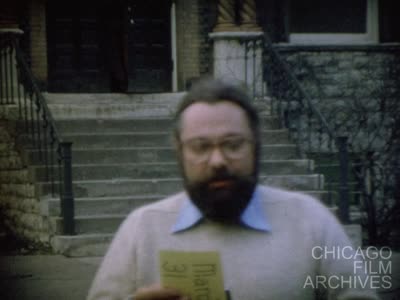
Any flickering? Okay, it's September 21st, 1982, and I am about to go off to Northwestern to, for my first official act of the new school year, counseling freshmen about what courses to take this afternoon.
And so it's sort of a circularity here of coming back to where I was in one of the first shots of the film.
I was talking about starting a quarter and here I am starting again in a different place, something like that.
At that time my wrist was giving me a lot of problems and it was keeping me from doing things.
And it was the symptom, I think, of where I was at at that point.
It was sort of a metaphor for what was happening to me.
I really felt like my hands were tied about doing anything at Northwestern.
I think that problem has sort of gone away with getting tenure and with the stress going down and staying away from school this summer.
Right now I have another problem though.
I got hemorrhoids.
And so I think, and I have to put this cream, anisol, rectal cream with hydrocortisone acetate, and soak my rear end.
And so I can really sort of say that at this point the symptom, the metaphor, is different.
It basically comes down to being a pain in the ass.
So that's a different place to be.
And it feels good to be in a different place.
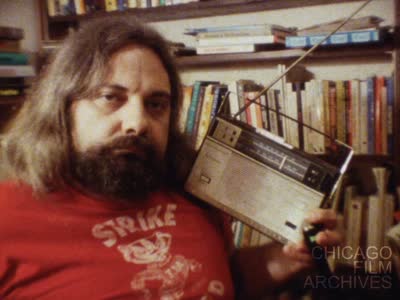
My name is Tom Anderson.
I live in Milwaukee.
I'm known for my truck since the release.
When was it that you came to Ann Arbor? 1972, 1971.
1971 in the fall.
And that was the last year I lived in Ann Arbor.
And I got to know him as a neighbor.
And it was a small court that we lived on where there was closed off to traffic.
And there were eight houses there.
And whether you wanted to or not, you ended up knowing everybody in the court.
Chuck was moved on the scene and was a real interesting person.
And I got a chance to talk to him about his work a few times.
And I have a real vivid memory of Chuck wanting to really go over in detail issues that happened in the course of his organizing work, especially situations where he was criticized politically by other people that he was working with.
What kind of issues? I remember a time when you drove your own car in a snowstorm and assumed that you were going to drive it.
And were criticized later for being a male showman as a pig for assuming that you rather than the woman who was with you should drive the car.
But there was a sense of conscientiousness of wanting to really take whatever might have been legitimate in the criticism and take it seriously and not to be condescending.
And then also a feeling of being hurt by a criticism and obviously that someone else did feel upset about something, whether it was your fault or not.
And a very direct emotional response and a real strong feeling of a need to work it through and to really process the whole experience in some way.
And I remember the setting of the conversation being a very small study that one had to stand in the door, sit on the bed, if one wanted to talk to Chuck.
Five, four, three, two, one.
It's the 9th of June, 1982, and I'm standing in Braun Court in Ann Arbor.
And about 11 years ago I lived here.
I lived here at 315 Braun Court with Carolyn Winter and her son Lainey Vanderslice and Joanna Hammond and her daughter Lori.
I lived here for about six months when I was basically a paid outside agitator sent to Michigan by a political organization that I was working for, I was on the staff of, called New University Conference, which was sort of a post -graduate SDS.
And I was sent to Michigan to stir up all kinds of trouble and to organize in higher education, particularly around community colleges and so forth.
And so it's a little nostalgic coming back here and seeing that it's not changed all that much.
And the reason I'm in town is visiting my old friend Martha Vasinas, who was my political mentor and dear close friend.
And so that's what I was doing back then.
And there's just as many dogs and animals here as there used to be when I lived here.
I used to live here, I'm just making a movie about my past and that's why we're here.
I lived here 11 years ago, across the way.
Nostalgia.
Oh, that's a nice little bark.
And so we're just having fun today, we're just relaxing.
And there's lots of old memories here.
It was really lots of fun to be here.
And those were interesting days.
Julie is really good at this, she knows just when to draw in on somebody.
5, 4, 3, 2, 1.
I'm Tommy Anderson, I'm an old friend of Chuck's.
I lived in Milwaukee, I worked in Milwaukee since 1972.
But the year before that I lived in Ann Arbor and I was a house away from Chuck.
And I remember real vividly, my most vivid memory of him at that time is inside a study on the second floor of a house.
And it seemed that any time that I talked to him there, I was standing up the door, he was sitting at his desk working real hard and having to take some report out about his organizing work, getting it back to the authorities or the central committee or whoever it was that he had the report on, his organizing.
And I remember the place being filled with books.
And I was a little amazed.
It was a real working scholars and organizers sort of office.
And it was very cramped and you couldn't get too far away from Chuck if you wanted to talk to him and he was in there.
And I remember the rest of the house being real dark, usually in the evening, and this room very, very, very light.
And him sitting at the desk and then he talked real earnestly and especially if he had a problem with his organizing, he'd been criticized for someone, for being a male showman, a pig, for making some arbitrary decision.
And he'd go over the scene in detail with me and tell me everything about what the person did and what he did.
And it wasn't what he did, actually pretty natural.
And he wasn't really trying to offend anybody.
In fact, he was trying to be helpful.
And he just couldn't, he didn't understand the person that ever said anything about this criticism in person.
But then it was written up later, he found out three weeks later that he really offended someone.
What the hell is going on here? And we talked, I remember some of the first serious discussions I had about Marxism in that room.
And again, it was a question of getting a lot of information and thoughtful analysis, but he was also...
In 1901, the Asian organization called and organized the...
was a plan and an analysis of how higher education functioned.
And analysis which included an analysis of racism, of sexism, and was essentially one of the best, I think, and most sophisticated analyses of a large -scale...
Alright, Chuck, what do you think that you should do for yourself that you haven't been doing? I think I should go to the dentist.
How long has it been? What's the dentist? Well, last time I went to the dentist was in Bloomington, Indiana, so that would have been 1973.
And before that? 1972, I don't know.
No, I don't think so.
I think you were in the Navy before you went to the dentist.
No.
Okay, well, why haven't you gone to the dentist? Well, I don't know.
I think it's...
Well, first of all, you have to have money to go to the dentist.
No, you've had money now for years, five years.
You've had that insurance.
Typical political cop.
Well, no sympathy.
I had a bad experience with my last dentist.
What happened? Well, I sort of got emotionally ripped off by this quack, I think.
Did he do bad dental work? Yeah.
I ended up with a real aversion and a real fear of dentists after that.
Was there physical pain in the rocks? No, it was this real super hippie dentist who was supposed...
and you were supposed to really groove on all this wonderful natural thing and taking care of your body and everything.
But in fact, the whole thing turned out to be a real ripoff, I think.
Why do you want to go back to the dentist now? I think my teeth need to be worked on.
Are you planning to go to the dentist? Yeah, I'll go to the dentist.
Yeah, I'm going to go to the dentist.
When? Before my birthday.
So it'll be recorded on the film whether I win or not.
That's a promise.
What else do you think you should do for yourself? I think I should pay my income tax.
I haven't paid my income tax in a long time.
I mean, they take it out of my check.
I've never filed the forms.
You might get some money back.
I might.
I can think of something else you should do for yourself.
Uh -oh.
What's that? Get your boilo camera fixed.
The film Thighline Liar Triangulum.
Oh, what do I think of that? I think that film is, I think it's realistic.
Why? Why? I think it's realistic because it portrays a real event even though it changes it through scratching on the film.
What, and the distortion didn't do anything to the realism, you don't think? I think it's emotionally realistic.
On the part of the wife, do you think he realistically portrayed her experience or his own observation of it? It portrays his version of life.
That's enough.
Okay, let's back it up.
Alright.
Great.
Okay.
In June 1977, I was appointed for one year at Northwestern.
They'd opened up a permanent position finally and I would have it for the next year while they conducted a search.
So I was called right the night before I was leaving for my usual visit to California and John Hess to work on Jump Cut to a curriculum meeting, which Patty Winnell called, the division chairman called at night at his house over dinner.
Well actually, Stuart Kaminsky didn't show up, he stayed at home and sent a memo, which was his usual procedure.
Jack Ellis showed up after dinner and we sat there with Dana Hodgson and there was lots of drinking going on and I felt like I was supposed to get into the drinking and become one of the boys in that way.
And as it went on, there was a very clear humiliation that was taking place in which Patty was basically producing Jack Ellis the Tears and treating him in a really horrible, shabby way.
It shook me up so much.
It seemed so, like I was being brought in like the new man in town, men who couldn't deal with their muck and just attacking each other and fucking each other up.
I left, I went to California and the next few days when I was in California I was just really shook up and people recall me and know me.
I just, I didn't want to work with people who treated each other like that.
I needed them and I ended up signing a one year contract and going in and working with them, it's kind of a boys club in the coming.
Happy birthday to you, happy birthday dear Jack, happy birthday to you.
Alright, alright.
Moment of truth.
Woo! Let's see it.
Oh.
Oh my.
Good, excellent.
You have to say to the camera.
Oh.
This light is fluid in the rest of the room.
I like the fact that you're producing.
Yay! That's not all, there's something else in there.
Oh my goodness, save the box.
Do I have to open the can? No.
It's a beautiful box.
Is there more in there? Yeah.
Don't put the box in the can.
The field is into their intelligence.
The box is in their intelligence.
Woo! Here, I'll open this.
Ice cream.
What is the hand that you're playing with? She's got a can, I love it, she's got a, do it already.
Turn around, turn around in the camera.
Oh.
Here's for my last show, isn't it? Oh.
Right.
Yay.
What a wall.
Yay.
I've arrived on the west coast.
Look at the cake.
I'm trying to get an ocean floor down this time.
Try to tell us your cake is nice.
Edgy.
Edgy, no.
And Chuck will now retire to read listening music.
Hey, you got your name, Chuck.
Hey.
I got my name already.