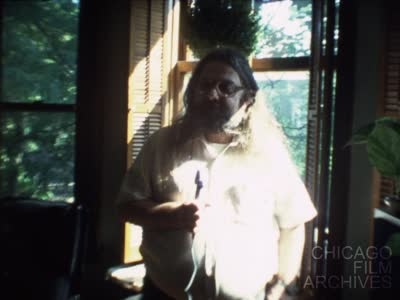
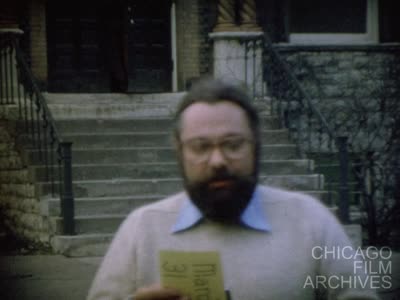
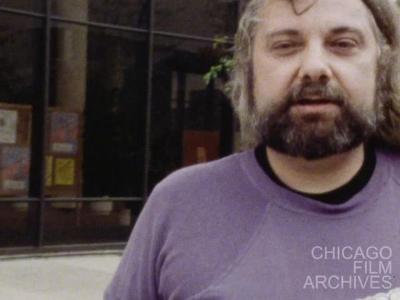
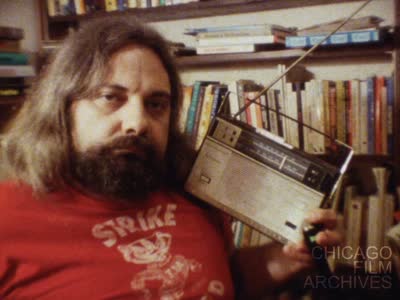
Who are you? I'm Debbie Holdstein, and I'm a college teacher right now at the Illinois Institute of Technology where I teach English.
And you went to Northwestern, Debbie? Yep.
From 1971 to 1973, I was a transfer student, and I transferred from Carnegie Mellon University.
And what was it like for you there as a woman and as a student? What did you think of the education? I'm a lot kinder toward Northwestern now than I used to be.
I look back and realize that my education was pretty good.
I think what bothered me the most about Northwestern was that most of the women there who sought to find their own identities sought it through the sorority system, which was extremely, even when I was there in the early 70s.
And women were identified that way.
Everybody was extremely money conscious, which put me off because I was kind of an average middle class kid from New York City who had gone to an average kind of middle class school for my first two years.
Then I came to Northwestern where people would complain about not having any money all the time and then drive off in their Maseratis down Sheridan Road.
And you were a commuter as well, right? I lived right near campus on Foster Street.
And a lot of my friends were the kind of people who weren't really interested in getting an education.
They were kind of interested in getting good grades, getting a piece of paper, and making big bucks and would do their best to take as many Bergen Evans type courses as they could get away with, not go to class all semester, borrow notes for the midterm and final, and ace the course, not having learned very much except for some crash memorization types of things.
And I found that a little frustrating.
What about you? You turned out pretty well.
Lucky.
What kind of room was there for any kind of radical thought or questioning of the system? I found very little room.
I found that it, maybe this was because I was a transfer student and what I'm feeling may be unfair and not taking it in all points of view, but the people who professed to be radicals were not.
They were the ones in the Maseratis who had their blue jeans expertly, perfectly faded before they bought them by a boutique down on Rush Street.
And that kind of, I wanted to say dualism, more like hypocrisy kind of bothered me.
Okay, hi.
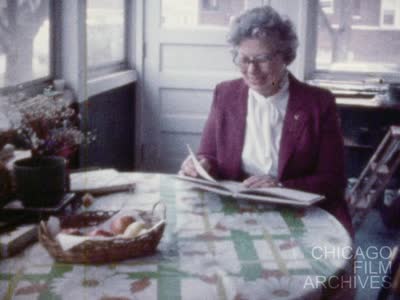
Would you introduce yourself? I'm Marion Fisher, graduate of Northwestern, class of 34.
Class of 34.
And what was it like as a student, Marion, when you were there? Well, it was pleasant, rather hard, but not too hard.
And I had classes that for the most part interested me.
I did that work and I belonged to a sorority.
What sorority was it? Delta Zeta.
And we had many good times at the house, as sorority girls do.
And I think we did many of the same things that girls do today.
We had our weekly meetings, we had tea's, we had dances, we went out for homecoming, we made floats, everything of that sort.
We had a lot of fun.
And studying too.
And you studied for your career, which was? I majored in English and in Latin.
And had a minor in German, in education.
And you ended up teaching Latin, most of your, most of your, and English.
Latin and English both for many years.
And the last six years I taught the class of German also.
And was department chairman at our high school.
Was a department chairman.
And now you live both in Park Ridge and in Florida.
Yeah, six months each place and I enjoy that.
I like the summers up north and the winters in Florida.
Okay, thanks very much.
My name is Lisa Lewis and I went to Northwestern for graduate school for one year.
Before I started graduate school at Northwestern I was unemployed for about four and a half months.
And I didn't know what I was going to do and as a last ditch effort I decided to go back to school.
And I was getting unemployment checks, I had to cancel the unemployment checks in order to begin going to Northwestern.
So consequently I had no money when I went to Northwestern and borrowed everything.
And the result now is a series of payment booklets.
Which I got independently through a bank.
My parents co -signed the loan so it's impossible to default.
And these booklets tell me how much I have to pay over the course of ten years.
I started paying in February and the total amount is $10 ,311 .60.
That's for one year of school.
For one year at Northwestern.
So these booklets you can go through and see how much you will owe at particular dates in your life.
For instance, on June 7th, 1983 I will still owe $8 ,936 .72.
April 7th, 1984 I will still owe $8 ,077 .42.
March 10th, 1985 $7 ,132 .19.
They go on.
July 2nd, 1985.
Is this your only loan? This is one of my loans.
This is through the private bank.
When will you be all paid up? Well, let me put the end here.
My name is Judy Whittaker and this is my apartment.
This is my kitchen table right now.
Chuck said he was coming over to film me this morning so this is what he gets.
The reason I understood he was choosing me for this film was that I went to Northwestern.
I am one of the proverbial graduates of the Northwestern Finishing School for Girls.
I graduated from Northwestern with a BA in history in 1966.
With an average of 2 .00001.
I made it out of there with a scan of my teeth.
Not that I was stupid.
But anyway, I say in defense.
Anyway, I was thinking about what do you want to hear about Northwestern.
I went to a girls boarding school, Catholic High School, and I got to Northwestern and it was a real blast in the head.
In my freshman year I gave up Catholicism and I gave up girls and I took up boys.
I gave up girdles that was.
I wish I had taken up girls.
I took up boys and was always out.
I managed to have a lot of fun.
Got cut from Rush my freshman year.
I tried but I can remember crying that Pi -Fi didn't want me.
I was pretty upset.
In sophomore year I moved into what my father called Northwestern Hilton.
New apartments.
I got to admit, this is almost a little embarrassing.
I was living pretty high on the hog.
My parents were paying all that tuition plus $100 a month.
So I got to admit that things were pretty easy.
My junior year I went through Rush again just because I was living with sorority people and they were all moving in the house.
I pledged but the same year I also dropped out and went home and wanted to get away because I thought the whole thing was ridiculous and stupid.
My parents said go back and get the degree so I went back and got the degree but I also got a psychoanalyst.
By the way, the reason I graduated with a zero point point is that I had a very hard time writing papers.
So here it is, 1981.
I graduated in 1966 and this is a paper in progress.
Anyway, I'm doing it for a course but I'm doing it mostly because I want to do it.
When I got out of Northwestern, I went along with all the glazes, sorority parties and all that kind of crap.
But basically what was happening to me inside, I was so goddamn confused and alienated and messed up inside that I didn't expose much of myself in the glaze and the parties and all the crap.
So I got out and my father stopped supporting me and it was kind of like I was facing everything.
I was facing who I was which I hadn't really looked at or felt real scared to expose it and I was facing economic stuff, teach and that kind of stuff.
So it was the year after I got out that I really came to terms a lot more with who I was than I ever did at Northwestern.
There was just no way.
I was just too locked in, I was too scared, nobody was pushing me to really deal with inside except the shrink that I had and that wasn't enough.
I came to terms with things a little bit more politically too and started dealing with what Northwestern was.
And I'm still dealing with what Northwestern was and what the whole middle class bourgeois trip is.
I mean I haven't worked through all that.
What do you see when you go back to the campus? I feel like it's South Africa.
I go up to the library and it's so white and it's so suburban and living down here in the city I feel like I'm walking into South Africa.
You know I'm not kidding about that.
It's so suburban.
It's very strange to me.
And I don't see how anybody can learn up there.
You know and I know that people supposedly do but I would think that it would be very suffocating.
They don't know how much people live.
No, but the interesting thing is that even if you refuse to join a sorority, to say I refuse that you're going to put a label on me based on how much money my father makes.
What they do then is they label you as an independent.
Which means you're too poor to be in a sorority or you're too weird to be in a sorority.
And that's what the whole value system was based on.
And that permeated into the whole school.
It's so like you felt like you were a walking piece of plastic.
That's why I said that Evanston is like being in Marshall Fields all the time.
Yeah.
Because? Because you're just living in this world of values that's completely alien.
But some people like to be in Marshall Fields.
I mean some people think they're happy doing it, right? Yeah, but I wasn't.
I don't like to go to Marshall Fields.
I think they're selling all this stuff and it really shouldn't cost as much.
It shouldn't be this much up at anything.
But it's only because you're in Marshall Fields and there's little crystal chandeliers that they charge ten bucks more for the clothes.
And that's kind of what it was.
It was like at Overland, people did not go to school to get married anymore.
That was passe, you know? People used to do that back in the 50s, but people don't do that anymore.
Wait, was the girls still majoring? Oh, you better believe it, you know? Did the girls go for that or just the guys go for that? The girls go to get married.
They want to go catch themselves a lawyer.
So they become psych majors, you know? Do psych majors get lawyers? I didn't stay there long enough to find out, you know? Why did you get out? How did you get out and how did you change? I had a bad dream one night.
No, I'm not kidding.
I really did.
I had this dream about being in a house.
And I was behind a fence, a big, tall kind of stone wall fence.
And I could see into a window, into a house.
And I could see right in because it was backlit.
And I saw a man come into the house and there was a child lying on a bed.
And the man was sneaking up and he was going to kill the child.
Which you will conform to, right? I mean, it's not like you have to do certain things.
Yeah, but it's pretty uncomfortable to be in the role of a weirdo in a straight school.
Because people, they're uncomfortable having you there.
You're not supposed to be there.
You're supposed to be at one of the hippie schools.
You're not supposed to be at a country club school.
That means you must be a techie.
And everybody knows that all techies have bad breath.
People who are into the sciences and the technical areas, well, they can be a little bit weird.
They all have short hair and have a slide ruler here.
And smell.
So it's like, I was, you know...
I wasn't a techie.
I took some, I took Russian.
Techies don't take Russian.
You know, I mean, that's...
They take physics and...
Why did you go to Northwestern? Originally.
Because it was not the U of C and yet it was close to Chicago.
Does that make any sense? No, because it was supposedly a decent school.
And it was in Chicago and I knew I could get into it.
You wanted to be in Chicago.
And it didn't matter that...
Yeah, because I wanted to go ride horses in the summers.
That's what I did all year.
Go to school during the week, come home on the weekends and go riding.
And it was actually kind of good that I don't think I would have lasted the whole year.
Otherwise, if I had to stay there on weekends...
When was this? Seventy...
Three seventy -four.