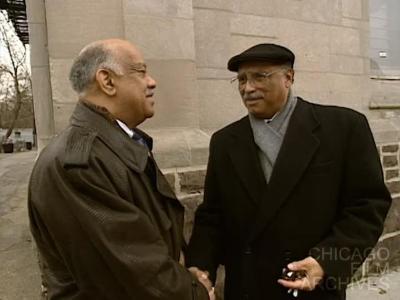
Tell me when you're ready, Steve.
Okay.
Can I ask you something? Yeah, sure.
Go ahead, Paul.
Chuck, can you tell us again what you were talking about, about why you shouldn't do stuff with the ministers? I mean, you shouldn't talk about them? Well, because...
It started as if you didn't hear my question, so you need to introduce what you're talking about.
Okay.
I was saying that the candidates, those people who voiced their objections to the ministers making their endorsement, were kind of not...
They were not astute in doing this.
They weren't wise in making that decision because they're going to be running for other positions, and it's not the right thing to do to be on the wrong side of the ministers, even though they might not be for you at this time.
There will be other things that they will be asking for support in doing, and I wouldn't want to be on the wrong side of ministers for the future because you never know.
This is a business that you shouldn't make enemies in because the ministers can remember and to say, to call them names and so forth, it's just not the right way to go.
Is this where we should park? Yeah.
Steve, you want to...
The wire? The about...
Bishop? Bishop? Mrs.
Williams? Yes, sir.
How you doing? I will get to it.
Don't I have something after the class every Sunday evening? Just a couple people want to see it.
Do I have anybody to confirm? No.
Because grass feeds there.
This is how the pastors connect with the city.
This is networking.
Sitting there and they're working on my calendar right now and so forth.
Concern about the whole man, which will be ministers.
This is a great responsibility and obligation because it is more holistic now than it has ever been at the time of it.
That's the bottom line.
Doctor? Yeah.
This is the so forth and how we...
You said it.
All right, now.
And how we get together and do that.
I'm not sure we should give them all of our secrets.
I'm not sure.
I'm just sure that if it works here, it will work anywhere.
Dr.
King was all...that was his bottom line.
That if we can get Chicago going because that's such a metropolis, a mixture in Chicago, it will work in New York and Detroit and California and Florida and Memphis and everywhere.
For Chicago, it's a very unique city.
We're located right on Lake Michigan, but also it is an intersection for cross the country and travelers.
You have to come through Chicago, I think, more than any other city that I know of, wherever you're going, north, south, east or west.
And it is situated kind of what we call Midwest.
It's some of everything in Chicago.
I could have come...I had the opportunity to go to St.
Louis when I left Brownville, Tennessee.
Brownville, Tennessee.
And I had the opportunity to leave when I got to be 21.
My parents had kin folks in St.
Louis, but somehow or another my spirit led me to Chicago because like most black people in the South, we're looking for greater opportunities.
Doors open.
And I came here in 45.
So you know what was going on at that time.
And I really came to Chicago to be a mortician.
I hadn't thought about being a preacher.
And the Lord called me into this.
But in the meantime, I found out that there's so much in Chicago, whether it's good, bad, right or wrong, negative or positive, and it's left up to you to choose.
Somebody have called this the melting pot in Chicago.
And if there's any talent, any gifts and whatnot that you have at all, you can make it in Chicago.
If you can't make it in Chicago, you can't make it anywhere.
So I decided to let down my bucket right here in Chicago as a minister.
Not only is it good for ministers, but good for politicians, good for business people, good for professional people, I'm telling you.
And it's left to you whether you take the low road or the high road, and either one of these professions.
It wasn't something that I chose as a ministry.
And I said like very serious, I'm commissioned by God, by God.
And to me, that's the greatest height, greatest calling station that a man can be, is to be called by God.
Because in this profession, I've learned that I can, maybe a doctor, lawyer, politician, and they're only interested in a certain phase, certain part of man.
But in my profession, and it is they call it, I'm concerned about the whole man.
We call it many times a holistic kind of gospel.
It's not just pie in the sky, and I do believe that there's something beyond the sky, in the sky.
You don't have to do away with that.
But we got to walk some golden streets here, got to be able to eat some steaks here, got to be able to wear some robes here.
Now, the old people, they had the right kind of thinking, and it had to be God to do that.
That even when we were in slavery, they were saying those songs, When I get to heaven, gonna put on my robe, gonna put on all over God's heaven.
When I get to heaven, gonna put on my shoes.
And heaven to them, as we just got through observing the documentary, was coming to Chicago, coming north.
You hear what I'm saying? So I'm involved in that kind of thing, though.
We're not doing away with pie in the sky, but we cannot also forget about the old preacher that gave them hope during slavery and kept more families together and did so much good.
Now, in this modern time, though, we have to be concerned about where our children go to school.
Got to be concerned about education.
Got to be concerned about where we live.
All of these slum houses and communities, if you're a real church, and the church is the greatest institution that we have in the world, black folks, for I always say that there are five institutions that run our country.
That's the home, church, school, education, business, and government.
Everything else can just about be summed up in it.
And a long time before we are heading the businesses, a long time before we could get into government, for we were locked out for a long time, we had a home and a church.
The church is the church.
Politicians have found that out, and that's the reason why they flocked to our church during election time, trying to get us to vote for them and so forth.
For we have a gathering every Sunday, every Sunday, every Sunday, that politicians couldn't gather in six months.
So we have our finger on the plus of the community, the plus of what's happening.
And in the black community, if you don't come by the church, you're missing something that is very, very, very important.
Out of our churches, come some of our greatest, where you know all of the civil rights and most of them were led by preachers and come out of churches.
But when you go into the theatrical world, their background was the church.
And it's just so important, and I guess that's the reason why it's so important, that I, along with others, are so interested in politicians to see to it that the right kind of people are elected.
We are the ones that hold the barometer, as to whether they have morals, integrity, honesty, whether they are committed.
And I think we ought to make them accountable to us.
So the more people, I don't care whether they're teachers, whether they're doctors, whether they're lawyers, whether they're politicians, if they're Christians, if they have a church background, they're much better.
I feel more comfortable in that presence.
My doctor, if he's Jewish, whoever he is, if he believes in God, I can feel a little more comfortable.
If it's my lawyer, my teacher, my mayor, my governor, for it does say something about that they have some principles, some morals, some ethics.
They must be ethical about them.
So that is a reason why I think that we've had to break out of these glass -stained windows and these painted walls and become involved in the community.
Everything that goes on used to be time we can't just stand by.
And I think Dr.
King helped us to kind of understand that we had to get out from behind these painted wall glass and hit the street and be concerned about as we pick cotton.
And they would say, what, picking presidents? And so forth and so on.
So I'm not apologetic about being involved.
I think it's a mandate.
It is my duty, local, state, national, whatever.
It is otherwise I'm being negligent when I don't get involved in this whole system.
And that's where I stand.
Thank you for the question.
Pastor, you're the leader of the clergy for a better Chicago, United Clergy for a Better Chicago.
And in that capacity, we called a meeting of the clergy that endorsed the mayor.
And have you received any flak from that endorsement? And if so, how have you dealt with it? Check.
Yes, definitely.
That group is made up of into denominational, not just Baptist, Church of God, apostolic, spiritual.
Also the West Side, South Side, North Side, and Old Side, which brought together a group, not from any particular location or denomination.
I think that that was a wonderful move that was made to unite endorse.
All of them would have done it singly.
It's a matter of choice.
And if we saw fit to do it that way, it just showed more unity and more strength.
Certainly since then, I have received some intimidation.
I have received some very negative.
Well, when we went in that day, they was calling us chicken eaters and judicers and betrayal of 30 pieces of silver.
And just no good, and so forth and so on.
But that's really why you have to have a conviction and stand for something either for or for nothing.
Just let me know.
When it comes to two or three things in life, and I advocate that, see, I walked these streets too long and boycotted and demonstrated for our freedom to let anybody take that away from me.
Anybody, anybody free to choose.
That's all it is.
And anybody said to me, you can choose, but I can't choose.
Something's wrong with that.
So if you choose different from the way that I choose, you're wrong.
That don't even sound right.
You ought to be free to choose, and I'll fight just as hard for you to make a choice.
But you must let me make my choice.
And I'm saying here, when it comes to free to vote for whoever you want, whatever you want, you ought to have that, and it's personal.
And sometimes it's so private that you won't even tell anybody, but if you see to tell somebody, it ought not to be offensive.
Now I say that to everyone.
Number two is, let me give you just two freedoms.
Who you marry, who you choose, is your companion.
Now it may be somebody that your friend, your sister and brother and mother approve, and it may not be, you know, but that's personal.
You can't afford to give that up.
And the third one I would name to you would be the freedom of your religion.
And you would hope your friends would approve if you're a Baptist, a Catholic, a Methodist, but if not, that is their personal.
So some of the things that, that's what, that's been the bottom line as far as I am concerned, is that you're not supposed to be free to choose.
And therefore if you don't choose like I want you to, I'll picket your church.
I'll get on the radio and say a lot of things, call you a lot of names.
I have held that, I've held that very proud for.
My first time I was a parent, I don't have to defend, and I don't want nobody trying to defend me.
And the one thing you can do is defend a principal that he has a right, the freedom to select.
Everybody, don't try to defend me.
The, you know, defend the principal that every man, every woman has that freedom without it being taken away or threatened.
So what I have done in that I've just taken the high road and kept on stepping because this will be over after a while.
And you know I've had to do that when I ordained the first woman.
I've had to do that when Dr.
King came to town, you know, I was ostracized and criticized.
I had to do that even when Jess was joining the people in the room.
So I mean I faced one right after another.
And as I told somebody the other day, when this one was over, another one come, let it come.
Also be aware that all men speak the way I love you.
Is that right? They're supposed to.
And every time it just boosts me more.
I didn't know I was that important.
Well you know I was in, I was at Revenniti's church on Friday night and I was at Bishop Jones' last night.
And both were giving sermons and spoke about the same thing that you're talking about, the freedom of choice and the right to defend the freedom.
And I think that to be honest with you it probably would not have come up had it not been for that situation.
So what's happening is there's being more conversation from the ministers now saying, you know, I have that right to make that decision.
And I am the leader and I made that decision based on my conviction.
Even if it's wrong you still have the right to make it.
I don't say go and make all the decisions without being advised.
I listen in about it.
But in the final analysis who are you going to vote for that's pressing you to make that.
And you don't have to make it about somebody pressuring you.
Who are you going to marry? Who are you going to be your companion? If your mama don't like it.
I said mama don't like it.
That still ought to be yours.
I got some children.
I won't say I agree.
You know what I mean? But that's debilitating.
Don't take that away.
You know I get very sad about that kind of thing.
And whether you want to be whatever your religion is.
You exercise that right.
And I won't let nobody take that from me.
We had some altercations.
It wasn't on as friendly terms as I am with his son.
His philosophy was a little different.
Because when King got ready to come to town.
And this was his philosophy.
King never moved into a town without being invited.
He said you don't move in on other people turf without them inviting.
So myself and a few others did.
Well at that time his father, Daly, and the city council and what not said.
That there was no segregation here.
No racism here.
Houses were open.
Schools were open.
Jobs were open.
And they took that stand.
Because Chicago has always been a great city.
And you know how the old man felt about it.
The best in the world.
He said he wouldn't let nobody cast a reflection upon Chicago.
That there was prejudice and all that kind of thing.
And I contend that it was.
Because I just left Tennessee.
I left Tennessee during 45.
It was brought up down there.
Nobody meant to be segregated against by white folks.
And going to other bathrooms and going behind to get some lunch and all that kind of thing.
Couldn't come in to eat.
So it was a kind of thing that even if you couldn't see it.
You could smell it.
And you could see some of it right here.
So when I was one of the ministers to answer your question.
Who said come.
Naturally there was hostility.
There was resentment.
And it was that kind of thing.
But isn't it a marvelous thing.
That after years of generation.
Here come the sun.
Along.
We the best of friends.
The best of friends.
It just shows what can happen in the providence of God.
In God's grace.
How it can.
And it is God's grace that I don't hold against the sun.
The tension and the problem.
That the father and I had.
This is a different time.
A different age.
Different circumstances.
And I started to say I'm a Christian.
Which I am.
But people don't understand that.
But it is God's grace that will allow me to.
Rise above certain things.
How can I go around with hatred.
I call myself a preacher.
And taking out on the sun.
What happened back there.
And I saw an old man coming from it at that time.
And do you not know.
That even then.
I had the greatest of respect.
From him.
He gave me.
And I walk in and so forth.
He operated in a different kind of way.
Even though we disagreed.
You know.
Other fellows were.
Whatever you know what I mean.
That kind of thing.
So that was a relationship.
And the relationship today.
It's simply beautiful.
I think he's done a marvelous job.
Now on Sunday in the pulpit.
Will you encourage your.
No I've already said what I had to say.
I don't have to tell them anymore.
And so forth.
So I won't be.
Just about.
You know if you all know where I stand.
They know where I stand.
So just go on and do likewise.
And keep on standing.
I'm a preacher about Jesus' name.
You know.
Yeah the job is already done.
I would hope so.
Anyway.
See I'm not a politician.
I'm a preacher.
And there is a different.
I know some of my politics like I know some business.
But number one I am a preacher.
Joe was here the other day.
Made his announcement.
The opponent who's running.
And it's a strange thing.
And people have forgotten.
But Daly came.
Made an announcement here when I was not supporting him.
And it was understood.
And he took it in the best of light.
The Reverend Evans was not supporting me.
He put on a hard hat over somebody.
And you keep on stabbing.
They make no bones about it.
So Joe was here the other Sunday.
He knew that I'm not.
If you play it up here not down here.
And it is just a much better game as far as I'm concerned.
And I must always maintain some principles.
Some ethics.
Mr.
Bowen could you ask one question of the minister.
Just what he thinks this is going to be like on election day.
How Daly will do in this area.
Okay.
Pastor what's your opinion of how the turnout is going to be.
And what do you think that the mayor will.
What kind of percentages of mayor will come out with out of our community.
I think he did about 35.
Or something like that of the voters that voted.
35 % of the blacks went for him.
I don't think it will be any less.
I think it will be very, very good.
Very good.
And I think they're going to go to the polls this time.
And I think they're going to go to the polls this time.
Okay.
What about the politician.
Yeah I would say that it is.
This is a church town.
And this is a good town for politicians.
All the way in the new way.
That's right.
It's just a good town.
Well naturally for me to say it.
I guess you go to New York they say the same thing.
How you go to Jacksonville Mississippi they say the same thing.
But that is the way that I feel about it.
What other ministers have you interviewed? We talked to.
I set up Buzzio on the west side.
Or Williams on the west side.
He or Shelvin whichever one was in.
Because I know they're going to go by my house now.
Oh.
Got an eye.
Bad eye.
Is that him? No no.
Okay.
All right.
They're having a breakfast or something.
I think they're going to start to work on getting it.
Okay.
I need a lease of $1 ,000.
Because they want to do more than that.
On a man's day? All right.
Was there anything I should know about from that first long phone call back to the office? Yeah.
Okay.
You can come on up.
Okay.
When you're ready.
And you're going to close? Turn the power off now.
Road does not close.
Go minutes other than so silent and Keep going.




![[Bowen + Ministers I]](https://collections.chicagofilmarchives.org/media/cfa/images/7/4/53988_ca_object_representations_media_7426_medium.jpg)