[Bowen + Ministers I]
Don't you think so? Come in and I'll explain to you who these people are.
I'm going to check you on some damage.
Why don't you sit over there, Reverend.
I don't know nothing about this.
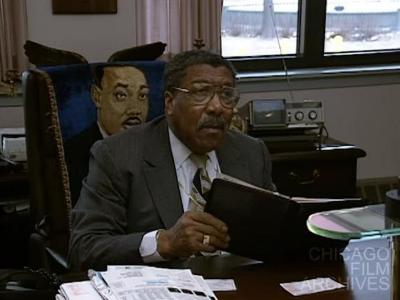
And Reverend Williams is the President of the Baptist Ministers' Conference of Chicago and Facinity.
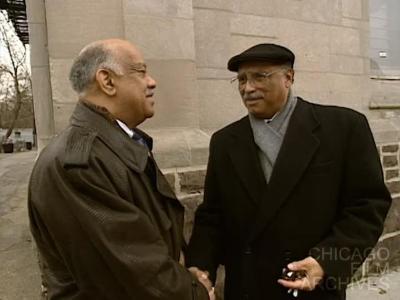
And this is Reverend George Butler.
And Reverend Butler is the pastor of this church where the Baptist Ministers' Conference meets.
The Baptist Ministers' Conference of Chicago and Facinity is actually a conference of over 500 churches.
Come first when we're talking.
The very first thing that we do is, of course, come to the conferences.
The Baptist Ministers' Conference of Chicago has seven major conferences.
Well, no, seven AME Ministers' Alliances and so forth.
So the conferences, even though all the ministers might not come to the conferences, most of them belong to the conferences.
And if you're going to do anything in the conference, the very first thing to do is to talk to the president of the conference and get his blessings that you're going to do this.
And then if he is cooperative, he then will let you know what ministers you might want to contact and let you come and speak here to the conference and ask permission to come into the churches.
That's kind of the way it starts.
And of course, Reverend Butler is the host pastor and has been the host pastor now for the last couple of years of the Baptist Ministers' Conference of Chicago and Facinity.
Thank you very much for letting us in, President.
General, we talk about everything we're going to talk about on the telephone.
Well, we can talk about anything.
Reverend, what? The mentoring program, trying to get that off the ground in terms of the churches participating with after school activities in cooperation with the city to give kids a place to go after school, safe places where they can study.
And we can provide the locations, just as we do with the summer program, we provide the location and the work experience in the summer program.
And for the mentoring program, we can provide the places for them to come and if it can be staffed, possibly by the city through the block grant situation or human services or whatever.
You're talking about a winter addition to what we have in the summer.
It should be a 12 -month fine.
And if we could, we foresee getting two or three entities involved, like the libraries and the schools, maybe the Park District and the churches along with the city departments to cooperate because the Park District can provide like a recreational component.
You know, if kids are, I don't want to use the word station, but if kids are located at a church, if there's a problem there, and if there's a cooperative effort between the schools, the Park District and the churches in the city, the Park District can help to provide some of the recreational out there for the kids.
And the schools can help with referrals and this type of thing.
Did you find that during the summer program, do you think that we took, what do you think it was, it was enough to take some of the kids out of the street? Oh, yeah.
It was one of the things that we found about, now, the city wanted to do some things and we wanted to do some things differently than the mandate from the federal government would allow.
You know, this year there was this thing in the summer program where each program had to have an educational component.
They wanted us to do what the schools, they wanted us to do in a month and a half what the schools had not done in seven or eight or nine months, whatever the case may be.
This year -round program, if it could be a mix of things, it could be a tutorial and work experience and recreation, all, and it would accomplish the purpose of keeping the kids out of the street, keeping them safe from the gang element and influence, and then for some kids, that's key.
I'll be talking to the head of the budget department to find out where we are with that because we had a meeting about two weeks ago and it was something he talked about getting on track at that point.
And so I'll be talking to him and make sure that we get something like that underway.
Let me just kind of switch for a minute.
Coming into the political season now, I know you had candidates here yesterday with the conference and so forth.
Have you had many candidates coming? Over the course of a year, we haven't had a whole lot because our scheduling and our positioning of although we have a real commitment to provide information and opportunity for persons to come, any member of the conference who's in good standing can request an opportunity for someone to come and speak and be heard and present their credentials.
But we have a very involved kind of situation.
Anyone who applies to come before us has to go before the PEAP, what we call the PEAP committee.
That's political empowerment, education, and participation, P -E -E -P.
That committee listens to what the person has to say and reviews their credentials as to who they are, their track record, who is recommending them, some of their proposals, what kind of program that they are advancing and that type of thing.
And then if the committee decides that that person can come, we will grant them an opportunity to come and give them about five to eight minutes to make a presentation to the people, any handouts that they have, give them to the secretary.
And then questions and answers and we go over that.
The conference cannot endorse anybody, per se, quote unquote, because we're a not -for -profit organization.
But we can let people know that we are predisposed to this person's agenda and that we thank a lot of them.
And if we could endorse, we would endorse that person, you know, but we can't endorse them.
But everybody will know that we are of the mindset that if we were an endorsing body, we would endorse, but since we can't endorse, we don't.
Well, what's the climate right now? We're coming up to a week before the election period.
I will be going to some churches on Sunday just to hopefully spur up and get the vote out, more or less.
Just kind of say a word about the election, because obviously we need to get into the mainstream stuff.
You'll be here Sunday, right? Be here Sunday.
And so that I can just give a word, you know, about encouraging people to get out to vote.
But what's the climate right now? Well, the climate is sort of a...
Because, you know, one of the things I don't think that people have really had an opportunity to appreciate that the political climate and the emphasis and mindset has changed because you're going to have some residual fallout from the national and the state situation, because things have turned very conservative in terms of goods and services, well, services, I should say.
As it relates to the poor and the indigent and this type of thing.
And it was interesting to me to note that when the legislature changed the...passed the law to change the welfare thing, that that particular program that they changed affects the poor.
But the program that would affect the middle class, and that's the program that Medicaid and the program for people in nursing homes, which is something which is just a fraction of that, they didn't bother that program.
You know, that's in place because these are middle class people who vote, you know.
But the people who are affected by the poor and the indigent, these are the people, the homeless, these people are really affected.
So, and I don't think, and I think apathy, whereas we just figured that things are just going to continue to be the way that they are.
Now, one crowd that is anti -administration is seeking to stir up interest by the, you know, by charges and counter charges, by innuendo and a lot of things that really, I think, are going to be counterproductive to the whole thing.
Because they're trying to recreate a kind of spirit that existed 12 or 13 years ago.
And the variables are not there.
Byrne was mayor, she was the incumbent, she was, she made everybody mad.
She had some enemies on either side and it was, you know, it was a kind of a thing that she was no respected person.
She was the person that everybody wanted to hate.
And so you had one crowd that was supporting Mr.
Daley on one hand and you had another crowd that was supporting Mr.
And so she just had just a core group in between there.
So people were almost evenly divided.
So then people who were black and who were kind of traditionally put into a coalition, blacks, Hispanics, Jews, academics, you know, whole nine out of the lakefront, they were in one crowd.
And you had some people on both hands with Mr.
Washington who were in those crowds.
And so everything and then you had a massive awareness on the part of people that this was the light at the end of the tunnel and that we could possibly do this.
And all the variables were there because there was a massive voter registration drive.
The black community was almost solidly behind one person.
And then other people were providing along with them were providing money and support.
You have an incumbent that's reasonably popular with all segments of the business community and just about everybody.
And then when you look at Chicago, I've had the opportunity as past pastor to go around the country to other cities.
You know, you see that Chicago is not as bad off as people would like for you to think that it is, you know, and even as bad as some of the services are, you know, for instance, public transportation.
I was in Dallas, Texas, sometime ago and after about eight o 'clock to put the bus to stop running, you know, until about five, six o 'clock in the morning.
And Dallas is really spread out.
And you go to some cities like in Baton Rouge, there are no taxicabs.
It's hard if you get a taxicab and this type of thing.
The downtown areas in most of these cities, St.
Louis, Kansas City, Detroit, other places, after five o 'clock, they close up.
So Chicago has a lot to be, and I'm not saying that this is because of exclusively the present administration, but I certainly think that a lot of things have changed to the extent that we are coping better.
And there are problems here, some basic problems.
But some of those problems cannot be solved simply by changing the administration until people's minds are changed and their attitudes, you know, that you can have, Jesus could be mayor and some people would not be, you know, disposed to do it.
And Chicago's tradition had been a city of neighborhoods of specific enclaves.
And whether we were aware of it or not, people did not journey or venture too far from their neighborhood.
When I came along, my parents and grandparents had lived in the same general neighborhood for about 30 or 40 years, in about 15 to 20 blocks.
You know, we went to the same school that our parents went to.
But so it was that kind of thing.
That's the way that it happened.
So I think now that they're trying to, I was listening to some of the people, and some of us have been have been villainized by people because we have made certain commitments and said certain things.
And I think that some of the persons who are trying to engender some activity are going about it in the wrong way by using innuendo and a whole lot of stuff that's not really healthy for debate.
But only until there is, only until the real brunt of this social change in terms of the politics of the contract with America and that, only until that really becomes apparent, I think are you going to see a real kind of arousalment? And that won't be felt, I don't imagine, for about the next six months or a year when this stuff is supposed to come about.
When it starts to take effect.
Could you? Reverend, what do you think the mayor will do on election day? How do you think the? I mean in terms of his total? Right.
First I'd like to ask you how you think the mayor would do it and Reverend Butler, I'd like to talk about the turnout.
I think borrowing it now, you're speaking now about the February election.
I think in the primary he's going to do well because I think that all of the, he has, unless something monumental happens, based on what I've seen I think he's going to do very well.
And I think, I would imagine that in the black community he'll get about maybe 30, 30 to 40 % of the vote maybe.
Reverend, you've been here in politics so long and in one ward here, in the eighth ward, you've been so visible and your church has been so visible.
What do you think the turnout is going to be in this area? This is one of the largest voting African American areas.
I believe that the turnout will be very good in this area.
In the eighth ward, I'm sure it would turn out tremendously good.
In the eighth ward, that's the only ward I can speak of.
I like with Lorraine Dixon, Storges, and this eighth ward is a very strong ward and the eighth ward will turn out heavily.
Yeah, I want to get back to that school as we go back.
We were talking about the school being after school program, after school hours.
As you know, I'm a retired teacher.
You can see by my degrees on the wall.
I was an excellent teacher, but we was graduating from the eighth grade.
Boys and girls were the second grade reading score.
We're putting them into a society that they cannot cope with.
We need to get to the basics of the problem within the community, and that's education.
We need to teach our children how to read, how to write, and we have to get them at an early age, like K through three.
The voucher system is kind of a controversial thing.
Now, do you see that as being a viable alternative to public education or is that something that you...
I'm glad you asked me that question.
I'm totally against the voucher system.
The voucher system is another form of segregation.
The voucher system where your parents will get so much money, you take it to a school and say, I want my child in there.
I can very truthfully say that, and I don't know how this will come out, but I've never been anti -neighborhood school concept.
I think there's a controversy in Evanston now about busing some children.
The things that we learn in neighborhood schools with teachers that were there and if you could not read, you will not pass to another grade.
This business of social promotions because somebody said that psychologically this kid will be damaged if he is not with his peer group.
I think that sometimes in our quest to be so correct and so perfect, we've actually done more damage to children because if he can't read and he goes out into the world, he can't count.
How can they? And then many of the machines and stuff.
This thing was designed for failure of the schools.
How can you get people who have no basic skills of education, put them over a million dollar budget and tell them here, run this school? Totally agree with you.
How can it be not? It was designed for failure to bring in the voucher system.
Some neighborhoods can do this.
But how can you go in other neighborhoods and expect these people to mandate, I mean, carry out the system whereby they have no training? Okay.
Like, let me tell you something.
For instance, in our school system, the principal have no hand of doing anything.
You know, I'm sitting here listening to this.
But why don't we do something about that? That seems to be a kind of a burning question.
Why don't we get all the conferences and all the presidents of the conferences together? And why don't we come up with a committee on education and formulate some paper on a position paper on the educational system? And let's sit down and let's have it with Arthur Johnson.
We have, and Pastor Butler is one of the members of that committee.
We have some retired and former persons from public education on the committee.
One of the things I think that has been, you see, everything in Chicago, whether we like it or not, has a political bent, a political flavor, a political orientation.
This business about the local school council and the concept of local control and this type of thing, it all goes back to money, handling the budget and awarding contracts and this type of thing.
And it's a kind of a situation, whereas, you know, you have to have, there has to be, you have to kind of moderate it where you have, you know, some local control, but at the same time you have some professional help.
You have to put both of them in the foot of the hat.
Well, that's why I said maybe what we should do is...
Put the parents in the pocket, put the community in the pocket, put the churches in the pocket.
We have universities throughout this city that would be glad to let their students come out and tutor the children.
But if we call together the conference, all the conferences together, then we'd have a lot more clout to do that.
There is a kind of political bent to that, you know, the politics of who's going to run it, who's going to run it, who's going to run it first, you know, and this type of thing.
And then, you know, a lot of us have some other motives because we have people in our churches who are part of the LSC, have people in our churches who are on the school board and who are principals and who are teachers.
So you've got a whole, this whole thing.
Every year there is this problem of opening the schools.
This year I think the deficit is $294 million.
Everybody has passed, and I think there has to be a realization that nothing from nothing leads to nothing.
The funding of the school system is inadequate.
And I think what's going to have to happen here is what happened in Texas, where you go into court and a judge says that you have to have a kind of funding program that is equitable for the rich and poor district.
And until you have that across the state.
Gwinn, let me ask you a question.
When this lottery first went into operation, wasn't a certain amount of money in that supposed to be allocated for the Board of Education of a school? Right.
And now it goes to the general fund.
And it's up to the state of Illinois to fund the city's schools.
This is something that, if you're going to get this money earmarked for education, let it go for education.
Our children need to be educated.
Someone said that they earmarked for education, but what they did was the money that they had been taking from the general fund, they stopped taking that.
They just used this in place of that.
It was not in addition to, but it was in place of that.
I'm going to work on the school across the street.
He said also, as we were leaving, he said you knew what he had talked to you about.
Got some interest in something across the street.
Oh, he's talking about, Reverend would like to have a daycare center and an evening school here at his facility.
He's got a, as you can see, he owns a facility over here to your, over to our left here.
What can you do about that? Well, we can put it into the Department of Human Services and try to facilitate them coming out, taking a look at his facility, telling him what he has to do to qualify.
Then we need to help him with his application and we will get him as much expert advice as we possibly can as to what he needs to do in getting that done.
It's almost like you're replicating that sort of stuff that the precinct captains and the aldermen used to do, that you're helping people out with things that they need.
It hasn't changed at all except this is more from a governmental standpoint.
It's a thing of service, taking the service right to the individual rather than him having to come to City Hall and going through a long process of people to get it done.
So I should ask you first before I ask another question, where am I going right now? Okay, 67th Street.
We're going to go all the way.
Can you describe to us what it is that you're doing today, what these visits are, who you're meeting with and what you're trying to accomplish? Hold on a second.
Is this okay for you? Well, today I'm going to be talking to several ministers about their efforts to get out the vote on Tuesday.
And I would just be asking them, and not only that, but to see what the climate is like for the election and if there are any special needs that they might have in terms of transportation or people to come and have food and that sort of thing for election day, some of them.
Can you tell us that again and say who it is that you're working on behalf of? I work on behalf of the mayor of the city of Chicago.
So, Chuck, if I could just ask you again, what are you doing today? Well, today I'm going to be on behalf of the mayor.
I'm going to be going to several ministers and asking them if I can have an opportunity to come to their church for four or five minutes during the service and try to rev up the people in order to that they would get out the vote on Tuesday on behalf of the mayor.
And that's what I've been doing.
So that's what I'll be doing this morning.
Plus, I'll be asking what's the climate like, if there are any special needs that the ministers have to have in their areas where their churches are, if they have senior citizens.
We have churches that own senior citizens complexes or that they administer to senior citizens complexes and basically the only way to get to these complexes are through the churches.
So you have to ask permission in order to work these areas.
And that's a very important area to work.
Yeah, they turn out to vote, don't they? They do.
What kind of influence do the ministers have on the community in terms of politics? Well, in my opinion, in the city of Chicago, the political organizations have basically all dissipated in our communities over the years.
The church is the only institution that remains where somebody is speaking to thousands of people on a Sunday morning at 11 o 'clock.
The pastor is in command at that moment.
So you have to try to talk to them.
And so therefore the church has become the conduit for the community to stay focused in government, really.
And anything that the church is involved in, and the church is involved, is so diversified now.
They are into community activities, after school activities.
They are into education, as you could see from the last stop we made.
It's not just a...the church is just not involved in coming on Sunday and having some singing and praying.
They are involved in a lot more than that.
Of course, that is their main thrust always, and that is saving souls.
But they also...they're a holistic ministry now and trying to save people while they're here on earth as well, trying to make life better for them.
So these ministers know a couple things about politics, too? Well, a minister goes left here.