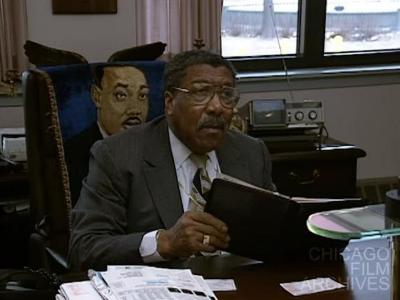
Bowen + Ministers II: Rev. DeVille
Okay, Paul, what was the question you had asked? I was just curious, you know, one of the really interesting things, Chuck, was listening to the ministers talk about just what's going on in the city, you know, in terms of politics, they're really knowledgeable.
The ministers are not just ministers, they are businessmen and they are community leaders as well.
And in Chicago, I guess Chicago is a major league when it comes to politics.
And if you're going to be involved in anything in Chicago, you have to know something about politics.
You at least have to know who the players are and what the climate is like, you know.
Everybody's trying to do something and they need to know how do I get this done.
And that's what the ministers in Chicago are about.
They want to know what's happening and how to get things done.
And they want to do for their congregations.
Now, how do you decide, there's ministers of big churches, small churches, all different kinds, some of them are, you know, probably more respected than others.
So how do you factor all that in? How do you figure out who are the ones you want to try to get in your corner? Well, first thing is you want to get all the ministers in your corner.
And one of the ministers says to me, there are more ants than there are elephants.
And which is a very true saying.
But you have to remember that it's a very delicate balancing act that you have to do.
And I try and have always tried to not ever discriminate between big church and little church.
I think that's a, you're toying with a very sensitive issue when you start to talk about that.
I give as much time in reality to small churches as I do big churches.
Obviously, it's important that a man like Bishop Ford, who's the leader of nine to ten million people, who is the international bishop of the Churches of God in Christ, when he calls you, you obviously jump, you know.
Reverend Clay Evans is the head of two powerful ministerial organizations in the country.
The ministers in Chicago basically engineered, were very helpful in the election of Dr.
Lyons, who is the president of the National Baptist Convention.
So, and Reverend Shelvin Hall, who is on the west side, former state president and very powerful minister on the west side.
You have to make sure that you, you know, you know all of these men.
But then there are the guys like the Reverend Williams, who is, does not have a large church, but a very, but he's a very influential minister, so influential that his, his, the people who are with him, elected him to be president of the Baptist Ministers Conference of Chicago and Facility.
Straight over, he's over about two, about three blocks now.
On the left hand side? On the left hand side.
Coming up right now, you'll see it.
So, tell us quickly who, who are going to be seeing this.
Reverend DeVille is just newly, just in the last couple of years, taken over this church.
Reverend DeVille is an activist in his own right.
He's a member of Operation Push and very active there and is very active in this, in this particular community here in renovating this community.
Does he have a dream project? Yes, he has a day care center here as well.
Oh, see, you, you got him right on time.
You're the latest person in the world.
I always said you was the fastest person.
No, I said you're the slowest person.
Well, listen, I got tired of Reverend Richard Williams.
He was, he was, he was talking about his, his favorite topics, man.
Talking about politics in Chicago.
This is, this is a film to speak to the people about getting out to vote on Tuesday, how important it is to get out to vote, you know, not.
You want to go in? Huh? You want to go inside? Should we go inside? Oh, yeah.
I figured you had got time for somebody else.
Don't go, this is good for my needs.
I ain't gonna get to the conference, man.
Huh? I ain't gonna go to the conference, man.
I'm in trouble, huh? Meet up with Cozy.
He has, he's got to do a feeding program on Tuesday.
And I usually meet with him because I have a senior citizen program on, where is this? Where is it going to be? You're going to be at his church? Yeah.
You're going to meet with him at his church? Uh -huh.
You want to sit here? Wait, where do you want to sit? Reverend? Be here a little bit longer.
Now, basically we want to, I want to know if I can have a few minutes on Sunday, about five minutes to come by and more or less ask that the people come out and to vote on Tuesday and also to find out from you if there are any special needs that you might have here in the neighborhood to.
Are you going to be doing anything? Is there going to be a polling place here in your precinct? No, they won't have it here.
They don't, they usually don't have it here.
They have it over on the hostage.
I would have no problem with it, but that is one of the things that I am definitely trying to do, tell the people to please get out.
And that's something we really need to do into this community for some reasons.
I don't know our, all of us has not really been pushing very hard.
I see they put some signs all up outside over the weekend, but there's been no real publicity about the folding, no more than what I've been doing inside.
And I've been giving out some brochures downstairs with the parents that's coming in and out for the kids.
So the parents are in and out constantly all day.
And Friday we are going to have a little program with them.
I hope to have all of the parents present.
And that's one of the things I want to push to them.
The importance of this election.
It's important that we get out to vote in every election really, you know.
Every election is very important because we look at the situation where over history, where many men's and women's has given up their blood.
I mean, they have just given it up, not shared.
They gave it up for our rights in order to vote.
It's important that we do vote.
And that's something that I really dwells on because we cannot do anything in our communities.
Because most politicians look at numbers.
And when the numbers are not there, there's no need to really worry because it's not enough to hurt them.
But when numbers began to climb, then they pay close attention.
And we really need it in this community because this is one of the greatest communities that was in the city.
It was the second best community in the city of Chicago.
And we've got to revitalize that.
We've got to build it back up.
Is there anything that you need in doing your program to get the vote out? Is there anything that I can help you do? There's a lot you can help to do.
You can help campaign the streets.
We've been doing pretty good because most of the people here know that I've always been involved in politics.
I came up in a family of politics almost.
My whole family has always been involved in politics.
And to me, it's always been a fascinating thing.
And so I'm constantly preaching voting, not just during election time.
I'm talking about it even during the off season of me voting because even during the time of our census was one of the things I really campaigned hard on trying to get the people to really make sure that when the census came around that they would fill out their forms and send it back because it was very important.
You find that the lack of interest, as you say, is that carrying over into the mayoral campaign or is that just for the aldermen? I think it's basically just the aldermen and even some with the mayoral election because there's been so much confusion going out with the mayoral election.
You know, one of the things we have hollered over the years of racism, and the more I look at it today, the more I would have to say that we are more racism than a whole lot of other nationalities because everything has to go our way and that's not life.
I don't think it's really generated a lot of heat, although it's generated some heat on me, about endorsing Mayor Daley over Joe Gardner.
And I've known Joe Gardner for long, many, many years.
But I'm looking more at than just color.
I'm looking at what the person has to offer.
What's the program? The things that we need in our community.
What are we going to be able to get? Not just to put someone in the office that say, well, he's black and he's in the office.
And I know they compare that with Mayor Washington, but Mayor Washington had many things on the ball that I don't see today.
He was an administrator and all of those things.
And I don't quite see that in Joe.
But most of all, the work that Joe has done has been behind the scenes.
He's not been out front and he's not that well known.
And I just think Daley has done a good job.
Mayor Daley has done a good job.
And I know people are saying that he fired a lot of black people.
But we have to understand when Washington became mayor, Washington fired a lot of people.
And if I were to become mayor, I'm sure I would do the same thing.
Because I want people around me that I can work with, that I can trust, and that's going to do what I want done.
And that's just, that's an ending job.
Can I just ask you a quick question? You said you were getting some heat.
What's been happening? Well, behind this last election, I'm the coordinator of the concerned clergy of the South Side.
I think my name is on there that states about the letter that we was endorsing Mayor Daley.
I've had Cliff Kellers try to get me to come on air.
But I, well, at the time he called me, I was tied up.
But I don't think he really wants me on air because I'm like this.
They're saying that we are the leaders and we have let our people down.
If I'm a leader, then don't try to tell me how to lead you.
See, they want to tell us that we are leaders.
And after they tell us we are leaders, they want to say, well, you are to lead this particular way.
And the other part is those persons that's creating the problem with us are the same people that divided our community with Mayor Sawyer and Tim Evans.
Those same people, those same people that is boosting now saying we want a black mayor, the same persons that endorsed Governor Edgar over Roland Burroughs.
See, so that they inconsistent with their commitments.
And I just can't follow a person of that nature.
Do you think there are a lot of black voters in Chicago feel the way you do? Yes, there's a lot of black people that feel the same way because those persons, except for Joe, Joe has always been in the community.
He's been a community organizer.
But when you look at Luke Palmer, when you look at Cliff Keller, when you look at a lot of these other fellows, Roland Burroughs has not been in the black community other than the time that they need a vote.
That is where the black people began to look more than just at the color.
Because where were you at when I needed you? Roland Burroughs has been a state official for how many years? For quite some time.
And all of those times that he was treasurer, he never was back in the black community.
When he was a general general, he never really was in the community.
He stopped by once in a while at his advantage and gone to buy his business.
Well, we've had to have someone that's more consistent in what they're doing.
And if I'm going to vote for Roland Burroughs for governor, I don't see why I would not have voted for him for mayor.
If I'm going to push for him for mayor, I should have pushed for him for governor.
What's the difference? He was black when he was running for governor, and he's black running for mayor.
So what is the difference? If I'm going to pick a white man over the black man for governor, what's the difference between me picking a white man over a black man for the mayor? So it's inconsistent.
Do people come and seek out your endorsement or your support as a minister? Yes, I've talked with quite a few politicians.
Some I...those that I feel that I can work with, those that I feel that it's done a good job and it's going to do a good job, I have no problem with.
Those that I feel that is not in the realm, I am very personal, whereas that you will never have to guess where I'm from.
I will let you know that that's not my thing.
In fact, I just had a person approach me Sunday night.
I was at a visit in church, and they're running for an automatically seat.
And I'm not even concerned about the one that's in there.
In fact, it would not be my choice for that particular person.
But I have to be honest with them and let them know, number one, they don't have a ghost of a chance.
And number two, for me, just to put something out there, I don't know anything about them.
You know, I would be lying, and I hate to just tell, mislead somebody, tell them, vote for this person because they're all right and I don't even know them.
Usually I try to know something about the person that I'm going to back.
Yes, in some cases, I tell them who I'm voting for.
We have to understand when a person go behind the curtains, they're on their own.
No one knows how you vote once you go behind the curtains.
Most of the people, if you're not leading them down the wrong trails, they know what's going on.
And many times they will follow their leader.
They're dedicated to their leader.
They're not the persons that's on the day and off tomorrow.
They will follow their leader.
And so far, I have not, I've tried to be honest with them because even, when was that, Sunday evening after service, we had a talk, some of the deacons, they wanted to talk with me.
Because there was a letter came out with my church name that they're going to, that they're sending some of the deacon boards of the church's letters to recommend your pastor and hold your tithes.
When we look at our streets today in our communities, the black church is the only thing that has kept our communities together.
So in other words, it's the black preacher that has kept our community.
And when someone on the outside write a letter to your church and tell your members, you ought to recommend your pastor and you ought to not pay your tithes and things of this nature, that's way off the bat.
So my deacons were concerned about that.
So one of them said that, I don't see how they can say, Daly has not done a good job.
He's reached out to the community.
What we have to understand is many times our aldermen, and most times, and I'm sure Chuck can attest to that, the mayor tries to work with the aldermen because you have, how many aldermen? 50? 50.
50 aldermen in the city and each one of them has a territory.
The mayor's not just going to jump in their territory and do things without consulting with them.
So what we have to understand, many times we don't get things in our communities because of our aldermen.
It's not necessarily the mayor and it's not necessarily the races.
So those things we have to look at and consider.
So he was saying, I think Mayor Daly's done a pretty good job and I'm with you.
And whatever they send, whatever letter they send out, I'm not going to be a part of it.
And he says, I want to, in fact, he says, if you ever go down and make a statement, I want to be with you.
But there's a lot of churches that have received letters that they're trying to send them to the deacons, to the chairman of the deacon board.
But in my situation in this church, all mail comes to my desk.
And whatever's in the mail, if it's a mail to the deacons, I will let them know and the faculty will give it to them.
What does the letter say? It's not clear to you? Well, it's saying that they should not pay the tithes.
Because your mayor is misleading you.
And one of the things that I really, really detest is the idea of them putting in the letter that your pastor is saying God told him to endorse Mayor Daley.
We endorse Daley from our own conviction, not from what God said.
God is not basically that interested in politics where you're going to come and say, well, I want you to do this.
But God gives you a conscience.
You have a sense of ability to do what is right.
What will you, if I need something in this community, I can call Chuck, who is our liaison person, to the mayor.
Chuck, I need such and such a thing.
I'm not saying it would not happen with someone else, but this is the first time that we've really had access to the mayor's office without going through a lot of changes.
I mean, even with Hale Washington, we had to go through changes.
Because we had to go through this department, go through that department, this person, that person.
And by the time you get there, you're disgusted.
Now we have a different change.
We have a change now, whereas I can call Chuck.
Chuck, I need such and such a thing.
And I need to meet, we need to meet with the mayor.
And we've not had any problems.
We have not had to go through all of these things, writing the letters and doing this and doing that, which I suppose is important.
But if you can use me or want to use me with my parishioners and you want my endorsement, then somewhere down the line you have to open the doors for me.
If I'm going to open my doors for you, then you open the doors for me.
And this is what we have today.
I think this is the way to go out of town.
Huh? That was a pretty good visit.
Now it's interesting hearing what he's talking about, but there's a lot of likely you were talking about in the car about what...
You're going to find that everybody that you talk to basically is, you know, they're going to be saying basically the same kinds of things.
It's a matter of service and how sincere you are in taking care of these people.
You can't just sit up in an office and think that everything is going to work out for you.
And these people don't want to see you just at election time.
You got to be out here all of the time.
I mean, I go to...I make it a habit.
I stop at four or five churches almost every Sunday.
You know, they want to see you when you don't need them.
Anybody who does that is out of the box automatically.
This is a...politics is a 365 day a year business.
It's not just for the short run on an election day.
Well, now, Reverend Evans, you know, to give you a little background, Reverend Evans is like the...
How do you say it? He's kind of like the godfather of the ministers in Chicago.
He is the...probably the most active political minister.
And what makes his activity so, I guess, so pronounced is the fact that here's a guy who was in the civil rights movement with Dr.
I mean, he led the civil rights movement here.
He...when Operation Red Basket started, which was the predecessor of Operation Push, he was in the forefront of it.
He, I think, is the chairman emeritus of Operation Push.
Daly went through a battle for him to build his church.
I think it was four or five years that nothing he had to wait for permits and so forth in order to build his church.
And yet he has become the strongest supporter of the mayor based on the fact just that he believes that the mayor is doing a good job.
And he says whatever he wants to say when he wants to say it.
Nobody that I know tries to stop him.
And he has very frank conversations with the mayor about things that he thinks, but he's earned that right because he's given that kind of support to the mayor.
And the mayor, you can see it when he comes in.
Everybody knows that he is definitely a friend of the mayor's, and they treat him accordingly.
And he is certainly a very good friend of mine.
Now, I assume that as your position as the mayor's liaison with African Americans, that when one of your ministers comes to you and says, we really need to talk to the mayor about something, then it's your job to get them on the agenda, right? Well, that's what the whole process is about.
And one of the things that the mayor has done is he's opened up that avenue.
And every people, Hispanics, blacks, Polish, everybody wants to have access to the mayor when they think that when they have a problem, they have a concern, they want to be able to say to somebody, hey, get me in.
I need to talk to the mayor about this.
And that's what the ministers do.
And like I said before, we have some very big ministers in the city of Chicago.
We've got guys with Bishop Brazier, can probably count 5 ,000 people at two services on Sunday.
That's a lot of power, a lot of power.
Now, you did something last week which was quite a coup for the mayor.
Just tell us very briefly what happened.
We put on an endorsement session for the mayor last week, and we had about 150 ministers to come to an endorsement session for the mayor.
And it was the same kind of thing that we've done in other elections.
Well, only one other election for the mayor.
But the ministers came together and they endorsed him by putting up the reasons they were endorsing the mayor, and several of them spoke and so forth.
And it was a great cross -section of ministers that made that endorsement, not just big ministers, little ministers, not just Baptists, Methodists, and all other kinds, spiritualist ministers, across the board.
And it was a great endorsement session.
Can you interrupt for a second? Sure.
It seems like I should go across the bandwagon.
He'll walk across the field in front of the glass.
So we've got to go all the way down, across this light to the next light, to make a left turn.
So across this light to the next light.
We've got signs and buttons from 25 states now, Chuck.
My wife, she had been wanting to come back to the area there for a long time.
We raised our children out in Marynook, which is out south.
And it was a political decision for me.
I would have lived in a matchbox to come back to the Second Ward.
But she wanted to come back to that house.
And we went down to South Commons and looked at a house.
And a lady down there, she really got my wife out of the notion of buying a house there because she said to us, she says...
So they all, the ministers came out, they endorsed the mayor.
What kind of fallout was there when that happened? Well, the people who support the opposition, they cried foul because they felt that the ministers should not have endorsed the mayor.
It is the largest institution we have in our community.
And they felt that it was a kind of a blow to them to have their ministers to come out.
Even the man where we're going now is the opposition's pastor.
And they felt that as kind of a blow to them in doing that.
I felt that it was the right thing to do.
These men support the mayor and they have every right to support the mayor.
And that's what they exercise that right.
We can go over left if you want to.
Here, we don't have to go all the way down to 40.
So, but it was the kind of thing that you expect in an election time.
I mean, they have a right to protest and to utilize it in any way they want to do it.
If it had been me, I would have been trying to go out and organize my group and trying to...
But I wouldn't have been talking about the ministers making their endorsement because every politician has to understand that the next right appears, next life.
That there's another election coming behind this and you don't make enemies of pastors by talking about them.
That's not the way to say everybody's got a right and you move on.
![[Bowen + Ministers I]](https://collections.chicagofilmarchives.org/media/cfa/images/7/4/53988_ca_object_representations_media_7426_medium.jpg)