Give us your name.
Now? Jose Guerrero.
Date? October 29, 1988.
And then say this is, what's the name of this mural? Smash Plan 21.
So this is real one for Smash Plan 21.
Audio tape.
Thanks.
Well, I think if you just say...
Just say Jose, that's all.
Roll one...
Well, say...
Say, yeah, give the date.
Say it's 1029.
Say Jose describing Plan 21.
Smash Plan 21.
Roll one.
Say when.
Hello, sister.
Okay.
Are you rolling? Make me...
Okay, so later.
10, this is 1029.
This is Jose Guerrero talking about Smash Plan 21.
This is roll one.
Okay.
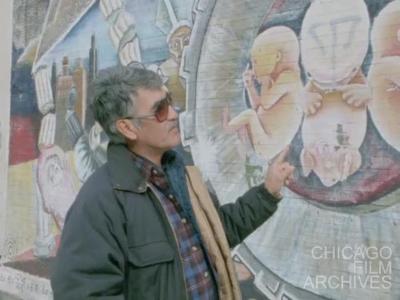
So can you tell me a little bit about this mural? Can you describe the composition a little bit? The composition? Like what are these babies in here? What's this? Well, see, the babies actually come less because that's...
This is showing like the people pushing the wheel this way.
And the city hall pushing this way, see? How did you decide to paint this mural? Because during that time they were talking about...
They had a suit against the plan, you know.
A lot of people had a suit against it.
And the plan was to dislocate people from the area, as they're doing now, and replace them with upper middle class people.
So that's where we got the idea to do the Smash Plan 21.
So how did the...
how did the...
how did the images in here...
What's your message? Well, the message is that the people, not all of them, but a large group of people are still fighting to keep their neighborhoods, see? And of course the money people fighting to renovate the area.
And also, you know, dislocate the people that live here.
Like happened over at Truman College where they...
at Uptown, they built a college and dislocated about 1200 units of housing for the poor.
And they're doing that here too, see? So whatever happened with Plan 21? It's...
it's worse, I know.
It's still in effect and people are moving.
See, the reason people came to this area, like in the 50s, they came from the...
from the South, Appalachia, and blacks, Hispanics, and people from Puerto Rico.
This was the area that they settled in, see? Let's stop here for a moment, because the sun has changed.
Also, I want to make sure...
let's not get too general about Plan 21, because that...
you know, we can do that once longer.
Okay, so we need to talk about...
We really need to talk about the images and had you really...
Somebody wandered off.
They have...
they look at this and they go, I have not the faintest idea what any of this...
Okay.
Yeah, so can you tell me what this is about? Well, see, the image is actually...
it shows the people from the neighborhood, working class people, struggling against the people from City Hall, you know, like the realtors, and the money people.
And of course, that up there, that tarp over there, we got that from drawing that one up there, see? We drew it and then painted it there.
It symbolizes the plan, you know, instead of drawing a lot of plans, we do the...
that is a symbol.
The people back in the plan, you know, like the politicians, the police, the clergy, not all the clergy, you know, but some of them.
And then of course, the wheel, it indicates like something spinning.
In other words, it symbolizes also like machinery or working class, a working class symbol, I would say.
And then the people up there on that side, pushing, you know, like a struggle.
And hopefully, like the other guy said, the other artist that worked with me, says that from that struggle, that maybe new people, you know, come out of this, you know.
And then it shows a little girl there planting a tree, because they had mentioned they were going to plant trees here, but that was ten years ago.
And I guess they did plant some, you know, but she had one there.
At that time, there weren't any sidewalks here.
There was just this one here and a bunch of parking meters.
And she's about to plant a tree, and then there's people coming out of school, you know, because education is part of, you know, struggling against whatever, you know, whatever the thing is that they're fighting.
Well, the star, you know, they got their politics, and the people here got theirs, you know, like a bright shining star.
And then they got a banner that says, Save Our Homes.
In other words, not to be dislocated, but they want to stay here.
You know? Take three.
Did you hear that snap on his mic? Better do it again.
Okay.
Take three.
Okay, so we were talking about the big heads, I think? Talk about the big heads a little bit? The description? Well, like I said, the description is that, the description is that that wheel, and this was some of the guys that sponsored the group, not them, you know, but some of the, some of the, what do you call them? Ancestors, whatever.
Anyway, the wheel indicates, you know, like a symbol of working class people, see? And the people over here are the people of the neighborhood.
Of course, they're more advanced because they're the ones that are doing the fighting back.
And they're pushing the wheel, and these people over here are pushing it back, see? Those are the people, the realtors, or the money people.
And like I said, that top over there represents like Plan 21.
Well, see, the other guy was two guys working, me and this other man, and other people helping, of course.
I was doing mostly the bottom part, and he was doing the heads.
And he says that the head symbolizes use rising up from the, from what's going on now, you know, to a better living conditions.
That's the way he put it.
But other people said, you know, that, that they thought that it represented, you know, girls having babies.
What about this writing down here? Well, I asked him this morning the same thing, but I already knew, but I told him that somebody had asked about it.
And he said it leads to nowhere.
He just put it there so people would ask or get close to the mural, you know, to bring them from across the street and start trying to figure it out.
Well, like I said, we didn't prepare it that well, you know, as we do now.
We do a better job on them now.
But basically we just put some base paint.
We didn't bother too much to scrape it or anything, you know.
We clean it off and then put the base paint on it, started drawing on it.
What part came out? Well, first we did like this, like the circle.
And then we started putting the figures on the, you know, the figures on the wall there, on both sides.
And then we started doing the dots.
And he started doing the, you know, the figure of the girls there.
So let's see.
What are some of these, like, what's that swastika doing down there? Well, that's due to the fact that a lot of the planners, since they're trying to separate people, we figure that they were those type of people, you know, that they were racist.
And that's how we use, well, I use a swastika a lot of times, you know, to represent racism.
And then who's this figure here with all the muscles? That, the other guy, Martinez, Oscar Martinez, he works in anatomy, you know.
So he started doing the, he did that one with the muscles, you know.
He likes going into stuff like that.
And where did you get the idea for these different characters? What about the businessmen? Well, they represent the different people that they associate with each other, you know.
For instance, like the politicians or the realtors or the people who own the buildings.
And then, of course, the, you know, people from, that have a lot of money, they invest, you know, for the...
The man with the woman? The woman, she represents like some high society woman, yeah.
And then, of course, the police, the companies on the back that tend to gain from taking over the area, standard all commonwealth and the telephone companies and whatever, you know.
I noticed you have the Sears tower and the J &M.
Why did you put those in there? Well, like I said, it represents, you know, people from downtown.
It represents people that got money, you know.
Because also the people that, actually, the middle class people is the one that they want to bring back to this area.
And the people from here are supposed to move down to, further down, you know, into already crowded areas over there now, Sears and Berwyn.
Mm -hmm.
That's okay.
I can't think of any more questions.
We're getting to the rail.
Okay, go ahead and sleep.
Olga, November 13th, scene one, take one.
Yeah.
Okay.
Okay.
Okay.
Where do you want to go? To the aquarium.
We said we're going out to see some things around the neighborhood, didn't you? Okay, you want me to move the car? That's where I want to go.
Okay.
Okay.
Open up the door enough that you can see Julie.
Hey, picture.
Okay.
Okay, slate.
Be sure to say take two.
Okay.
Olga, November 13th, take two.
Let's try to go to Gabriela.
Okay.
Okay.
Where do you want to go? No, aquarium.
I told you I was going to take you around to the neighborhood and show you there.
So, we're going to go in this car.
Okay.
Olga, November 13th, scene two, take one.
Okay.
There's bats.
There's a little one.
Are they the same way? Okay, let's go.
Okay.
I want to show you these.
Hi, can you hear me? Or not? Because there aren't.
Wait, talk again.
Alright, well.
I think I've got you, yeah.
I can't think.
There are a lot of cars out here, but it's really lovely.
The weather's really very nice.
We're so lucky, in fact, that it's so warm today, but it's so pleasant.
It's expected to be sunny all afternoon.
Get your audio slate first, and then do the clap for the very last thing.
Okay.
Okay, roll audio.
We're rolling.
Okay, slate.
Scene two, take two, Olga Nuno, November 13th.
Okay, thank you.
Thank you.
Okay.
Very good.
He's an awesome Indian warrior.
And see that eagle over there? That eagle? What? That one that kind of has like little, over there.
Right by the man with the green shirt.
Green shirt.
Yeah.
Well, that's the symbol of Farmers' Union.
And it's red and it's black, the eagle.
Uh -huh.
And, what's the word? What is that? Hmm? Those are houses.
Because one of the things that people feel that we need is housing for people so they can live and not be crowded.
And...
What does it say? It's in Spanish, but read it.
It says what? In English? No, the top.
Educacion.
Educacion para los...
You're making it up.
Educacion bilingue y bicultural.
No.
Un derecho a un privilegio.
That's what it says.
She still makes up words when I ask her to read.
She's real smart because we're teaching her to read.
I'm moving it.
What do you think it means? Notice how it's delayed now.
That's the playback.
So just do that every now and then.
No.
What do two hands grasp together mean? Friends.
You got it.
You got it.
That's what it means.
It also means being together.
I think it's...
Ready? I want to...
Olga.
Olga, November 13th, scene 3, take 2.
Okay, this time.
Action, yeah.
Okay, Olga.
Okay.
Well...
I don't want to go there.
What did you say this meant? Friends.
Yeah, and the two hands together with the map of the Americas.
That's what it meant.
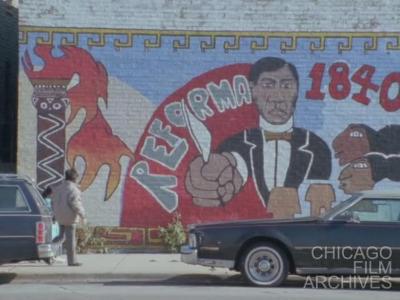
And this is one of the biggest heroes of the Americas.
He was the first...
The first...
President.
You get it.
You get it.
The first president of Mexico that was an Indian, as opposed to one of the big sheds of the Americans.
He led a revolution, too.
Because in the movie I saw...
You saw the movie with him? No.
But I remember a young man that...
He got the flag and he rolled down with the flag.
Yeah.
This is another big hero.
And see how big the face is? It's part of it.
This is so people know that they were important.
So they paint him very big.
And this one especially, like the big hands breaking the chains.
That meant to us that we would no longer be oppressed.
That's a big word, right? You know what that means? Well, that people felt like they were in chains and they couldn't move.
They couldn't go anywhere and they couldn't speak their mind.
So that represents breaking the chains.
That's what it represents.
That you were free again.
And like the fire, too.
That's another symbol of strength and that we were able to move on.
What does this mean? The eagle.
You've seen the eagle? Yeah.
You've seen it in the flag, haven't you? Yeah.
But what does this mean? That man with the tiger.
The man with the tiger.
He's a warrior from the...
It would either be Aztec.
And they would put on, before they went to fight, they would put on their favorite...
Suits.
Suits.
How do you do that one? And they try to...
Scare the other people.
Yeah.
That's what it was for.
That was their...
By doing this, they would look fierce and strong.
More scary.
More scary.
That's right.
This is the eagle that's in the Mexican flag.
And you see it in other flags.
And also, that's a symbol of strength.
And sometimes they're crowned.
Sometimes they have a crown, yes.
Depending what it is.
And that's another warrior behind you.
Behind that is the...
Also an Indian warrior.
And they all look brown, because that's what we look like, right? Looks great.
Okay, good.
We're done?