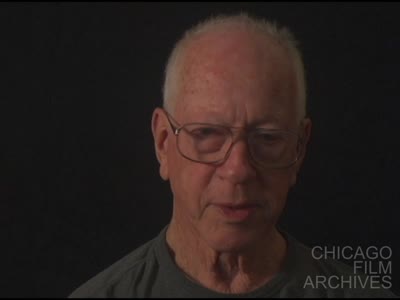
Alright, my name is Jack Behrend, that's B -E -H -R -E -N -D, and I came into the film business when I got out of the Army in 1953.
My dad had a small store where he sold used theater equipment to movie theaters, and an occasional box of carbons or whatever.
Could I interrupt? I'm sorry, I'm afraid you've gone too far.
Is there any way...
Do you want to see the monitor? Yeah, that I'd be able to see the sound of it.
Yeah, we can move it.
Let me...
I find that there are black bars on this side, so...
Right.
Okay.
Okay.
Alright, Jack, I'm sorry about that.
Alright.
So, could you again give me a thumbnail of who you are and...
How you...
let's say how you've been remembered.
My name is Jack Behrend, that's B -E -H -R -E -N -D.
I came into the film business when I got out of the Army in 1953, and was pretty active in it for about 50 years.
How did you get into it? Well, my dad had a motion picture theater equipment business, mostly used equipment, used seats.
In those days, most theaters weren't air conditioned yet.
And so, there was a big active business in taking the seats out of the theaters, storing them in cold storage over the winter to kill the bedbugs, and putting freshly upholstered seats back in the theaters once a year.
Every theater had to have a complete change of seating.
We also sold what they called theater spray, which is where the ushers, there were ushers in every theater, would go down the aisles between features and spray cans of flit to cover up the smell before theaters were air conditioned.
We had three kinds, rose, lilac, and lavender.
And it came by the gallon.
Did you work for your dad? Well, I was about to get out of the Army.
I was an engineer, or at least that's what my degree said.
And he made me an offer.
He had enough money to pay me for six weeks, 75 bucks a week.
And if I would come with him, he'd make me a full partner.
And so I knew I'd never have an opportunity like that again.
And I jumped at it.
I got very lucky.
Just when I got out of the Army, a 20th Century Fox released The Robe, which was the first film in CinemaScope.
And so every theater in the country had to put in a new screen, new lenses, larger lamp house to get enough light to fill the larger screen, new sound system.
And so there was a huge opportunity to sell equipment to theaters that had really not done anything to improve themselves since the Depression.
So I jumped on that and over a couple of years did a lot of traveling, measuring for new screens, figuring out lenses.
And it was a pretty good basic education in the way theaters operated.
After a couple of years, it seemed like there wasn't going to be much more growth in the theater business.
This was 20 years before Multiplexus.
What year? From 1953 until roughly 1970.
So after about two years, we decided to sell the theater equipment business and concentrate on television.
And we set up a company called Television Equipment Company, which concentrated on production equipment, lighting, sound, editing, all the kinds of equipment needed for producing films.
Of course, this was 25 or 30 years before videotape.
Let's back up a little bit.
What were some of the theaters that you and your dad serviced? And when you went around starting to kind of re -outfit these theaters, could you talk about some of the theaters in this region, in the Midwest? Yeah, very few of them are left.
We normally went for independent theaters, not the big circuits.
Bellabit and Cats were a giant circuit in Chicago.
And we didn't try to pierce that.
We mostly concentrated on small circuits and independent theaters.
So I remember the Clark was always my favorite theater at Clark and Madison.
Bruce Trends ran that theater.
And he also ran the Four Star Theater on West Madison Street.
In fact, the Four Star was the first theater in Chicago where I installed the equipment.
And it was a learning experience.
It brought me head to head with the Projectionist Union, which really determined how a lot of things were done in the city.
Where was it, Four Star? On West Madison Street, in the heart of Skid Row, which doesn't exist anymore, of course.
But there was an area maybe three quarters of a mile long on West Madison Street that was one gin joint after another and flop houses and movie theaters for people that couldn't afford a flop house.
The Clark Theater was open 22 hours a day.
There was another theater, the Astor, that was open 24 hours a day.
Interesting when you think about the cleaning problem in a theater that's open 24 hours a day.
What was it about the Clarks? You said that was your favorite theater.
Well, Bruce, first of all, it was an old opera house.
And it had, as I remember, it had two balconies.
And so the upper balcony, you're looking down at the screen at a steep angle.
And Bruce Trins was just a brighter than average guy.
And he evolved a theater that, as I said, was really a sleeping place for people that couldn't afford a flop house.
They would go in there.
They ran triple features.
And generally, they ran very old movies.
It was a third run theater.
Film distribution was organized, first run, second run, third run, fourth run, sometimes fifth run.
And first run would be the downtown theaters where films would open.
Second run would be suburban, good suburban theaters.
Third run, you came back into the city and got into smaller theaters.
And then fourth run would be smaller theaters in the burbs and outlining city.
Fifth run would be drive -ins.
And there was a real strong pecking order.
Sorry, could I interrupt? Are you here to sit the chair, Swiggy? No? Okay, sorry.
So you and your dad service primarily the third run? Third, fourth and fifth.
Yeah, some second run.
So you outfitted some drive -in theaters? Yeah, drive -ins were kind of fun.
And you have to understand the context of where drive -ins fit.
There was cheap land in the suburbs.
There was automobiles were available after the war.
And kids were taking driving lessons in high school.
And it's important to remember that in the early 50s, cars had, what would you call it, couch type seating.
They didn't have bucket seats.
And so kids needed a place to park where they would not be harassed.
And drive -ins were a perfect answer for that.
So the drive -ins while they were marketed as family places where you could load up a couple of kids in the back seat and not have to pay a babysitter, what really was happening was that kids were going to drive -ins to make out.
And it became obvious to anybody running a drive -in that it didn't matter what film you were showing.
They got the same kind of traffic whether it was a first run release or a fifth run release.
So what they needed was cheap movies to show.
And so they would take films that had been shown everywhere else, fifth run, and they would show those.
The films they concentrated on were short films so that they could get in two shows generally before 11 .30.
A lot of kids had to be home by midnight.
So they wanted them out of the park by 11 .30.
And they couldn't start showing, of course, until it got dark.
And in Chicago, that meant about 8 .30 in the summertime.
So you wanted a film that could run in less than 90 minutes.
And so they would actually take reels of feature and just leave a couple reels out so that they could get people out of there.
And nobody knew the difference.
They didn't lose continuity at all.
And then along came people like Herschel Lewis that started making films to play in drive -ins that were cheap.
And that had enough action going on in them.
So if somebody blundered in there by mistake looking to see a movie, they would have some sort of plot line up there that they could follow.
So there were film producers around here that actually produced films specifically for drive -in shows.
Sure.
For that kind of market, yes.
And they tended to, there were two paths that they followed.
Plot paths.
One was action horror and the other one was action girls.
And some of them probably overlapped.
But those were the specialties.
Yeah.
Little niche markets.
And they could make a feature for under $20 ,000.
We're talking low budget here.
So this was the kind of Roger Corman.
Oh, no.
Roger Corman did some interesting good stuff.
Let's not downplay Roger Corman.
I respect him.
And a lot of people started with him that did really good stuff later on.
No.
Herschel Lewis.
Herschel was one of the brighter people I've ever known.
He had a master's degree from the University of Chicago.
He was a master bridge player.
Very bright guy.
And he figured out this drive -in market.
And that they needed cheap features and so he knew how to do that.
He could, the first thing you do, you don't have talent that you have to pay.
So that was something that Herschel mastered early on.
The second thing was you get a low shooting ratio where it was common in Hollywood to have shooting ratios 25, 30, 40, 50 to 1.
Herschel would do a 2 to 1.
Sometimes there'd be flash frames on the screen.
Made it a little more exciting.
You could call it lightning.
Throw in some thunder and who knows.
No.
Where did Herschel learn to make films? I really don't know.
My guess is that he probably taught himself.
He was bright enough to do that.
Did he use your film equipment? Well, yeah, we sold him some film equipment.
Not a lot.
Not much.
I don't know where he got it.
But knowing how he operated, I don't know where he got it.
Backing up a little bit to the drive -ins that you were talking about around here, do you remember some of the drive -ins around in the Chicago area? Well, I lived in Evanston then, and there was one out on Milwaukee, on Waukegan Road at Gulf where Avon built a huge plant later on.
There were probably 20 drive -ins around the city.
There was one out on Milwaukee Avenue in, well, where would that be? That'd probably be in Palatine.
Not Palatine, no.
Northwest side.
But they were all over.
There were probably 20 in the Chicago area.
There were probably 4 ,000 or 5 ,000 around the country.
So there was a huge market for these kinds of films.
All right.
Where, by the way, was your film equipment house located? South Wabash.
Before I joined my dad, they were at 9th and Wabash.
And then when I joined them, they had moved to 13th and Wabash.
And the whole, there was a whole film community there at 13th and Wabash.
All of the distributors were within a half a block of that corner.
Fox, Warner Brothers, MGM, Buena Vista, which was a Disney distribution arm, Paramount.
They were all there.
And four equipment shops were there.
What were some of the other equipment shops? One was called Abbott Theatre Supply, National Theatre Supply.
Movie Supply, which was ours.
And Gardner Theatre Supply.
Abbott and National were very big organizations.
National was partly owned by Chase National Bank.
Rockefeller money behind it.
What years? Can you give me a...
Oh, they were, well, they were long established when I came in.
So they probably started in the early 20s.
And they were still going strong when I left that neighborhood, which was in about 56, 57, something like that.
And then where'd you go? Well, we set up our place on Grand Avenue at St.
Clair, block east of Michigan.
And at that point, we were called Barron's Inc.
And we were selling all kinds of production equipment.
Cameras.
I sold the first Aeroflexes in the Midwest.
Probably the first.
I sold the second one in the country.
So I was...
I fell in love with the Aeroflex when I first saw it.
And knew that we had to do that.
And so we had Aeroflexes.
We had MagnaSync recorders for sound.
MagnaSync was a 16 millimeter magnetic recorder.
And it was the first, let me say the first popularly priced professional quality recorder.
You could argue about how professional the quality was today.
But at that time, it wasn't bad.
The closest thing to it was a Westrex machine, which probably cost $5 ,000.
And at that time, that was a lot of money.
MagnaSync field recorder, oh, it was in the neighborhood of $1 ,500, $2 ,000.
So it was a lot less money.
And the only way you could shoot sync sound then was to have a 16 millimeter magnetic recorder that was driven by a sync motor.
And a camera that was driven by a sync motor.
And that was...
And then you use clapstick for a start mark.
And that was the only way sync sound could be shot.
Very cumbersome for shooting in the field where you had to have alternating current.
You couldn't run on batteries.
And so you think about that.
And it was a real restriction in the way any film could be shot.
It was a tougher restriction for documentaries.
Well, okay, so we're talking...
You moved over to that St.
Clair area in around 56, 57, somewhere around? Yeah, and I could be lying by a year or two.
Who were your clients there? Who were the filmmakers that were around in this area then? And what types of films were they making? Well, let's talk about categories, I guess.
The TV news crews, as I said before, videotape was 25 or 30 years away.
And so everything was done on film.
The television stations each had some kind of crews.
A typical crew was four people.
Cameraman, soundman, lighting guy, and a grunt.
Because there was a lot of equipment to be moved.
And so a lot of the stations had more than one crew out, just covering the local news.
Two things that they didn't have.
And it's interesting to think about how they operated.
They didn't have cell phones.
They didn't have walkie -talkies.
There was no possible way to be in immediate contact between a news director, for instance, and the crews in the field.
So if a plane crashed at Migs Field, which was an active airport then, nobody knew.
Until somebody called into the station to find out what their next assignment was.
And then the station would give them instructions.
All right, so there was news.
There were films being made for the new television industry, which was brand new.
Our first sale with our new company was to NBC, setting up their television station in the Merchandise Mart.
They called one day and said, do you guys make house calls? And said, yeah, come on over and tell us what to do here.
And we went over and they had stacks of films on the floor, going to the ceiling.
They didn't have shelving to put them on or racks.
They didn't have splicers.
They didn't have rewinds.
They just had films and they would take a can off the stack and throw it in a machine and put it on the air.
Which station was this? WMAQ.
And that was the first one in the country.
And it took them a while to get organized.
I'll never forget when they did their first test color, narrow cast to New York, just to transmit to New York so they could see if they could actually get a cross -country feed.
The guys in Chicago, this was long before they had a peacock.
They took a bowl of fruit and had a camera looking at it and they painted the banana blue.
And sent that to New York.
Because New York, there was always a competitive thing between New York and Chicago.
And so they thought they'd give the guys in New York some fits.
So that was the first television studio in Chicago? Yeah, in the country.
In the country.
Was that WMAQ? No, there may have been some lab kind of studios.
I'm sure that Western Electric Bell Labs may have had a test facility.
RCA certainly did.
So there were all kinds of test facilities.
NBC Chicago was the first commercial studio.
You're talking about content.
One of the aims of this was to create content for television.
Right.
So they had studios.
Do you remember what type of programming? Could you also throw in dates? Approximate dates? Yeah, they have to be very approximate.
We're going back 50, 60 years.
There were a lot of kids shows.
I remember more kids shows on WGN than the other stations.
And I really have trouble with the dates.
There are Kukul, Fran, and Ali is one that everybody remembers that's over 30.
Bozo Circus.
That was on channel, I think that was on ABC, channel seven.
Time for me to do this without just throwing stories in here and there.
The Bozo Circus came out of what is now the, or was then the Daily News Building.
They had a studio on the top floor.
And there was one show they did there where they had elephants.
And it's an interesting thing just to think about getting elephants to the top floor of the Daily News Building.
Where was the Daily News Building? On Wacker Drive.
You walk through it to get to what was then the Northwestern Station.
They had a policy where if you wanted to rehearse an act, you had to get approval from the operating manager of the studios.
And he had a sort of a knack for asking for kickbacks for acts that wanted to rehearse.
If they gave him, well I guess a polite word is bribe.
If you gave him some money, he would slot time for you in the studio that you could work with.
And if you didn't, then you may get to follow the elephants.
And that could get dusty.
There was a small act, a man and woman that did a dance thing and they come down from Milwaukee.
And they didn't know the system so he assigned them the studio where the elephants had just been to do their dance number for rehearsal.
Some of the other categories of films that were being made, heavy industrial, many companies knew what business they were in in those days.
And so they didn't mind making films that talked about the corporation.
They called them corporate image films.
And so you had United Airlines making films, Allstate Insurance.
I think the biggest ones around Chicago were International Harvester and Allstate.
Sears Roebuck had their production unit.
Yeah, Montgomery Ward's had theirs.
Standard Oil.
You pick a big company and they almost certainly had a film producer on staff.
Some of them had more than one.
Link Belt had a production unit.
Illinois Central Railroad, Pennsylvania Railroad.
So were there then outside studios and makers that were hired by? Yeah, there was a whole category of outside studios.
The largest by far was Wilding on Argyle Street.
During the war they had over 800 people on their payroll.
After the war, when they weren't getting government contracts anymore, they had to mostly, they did a lot of car stuff.
I know Chrysler was one of their major accounts.
Later on, Fred Niles Studio opened up.
There was Dallas Jones, Sarah Studios.
Who were some of the people associated? Back to Wilding, could you go, how far, do you recall how far back when they first opened? No, it was before my time.
Before your time, okay.
So that might have been in the 30s.
Well, they took over the old S &A Studios that got famous for Charlie Chaplin and Gloria Swanson.
I think Chaplin shot three films there and those were all two wheelers.
They were not features.
Do you remember any of the people back early, I mean like that, that were associated with Wilding Studios? I really don't.
The people that I knew at Wilding really were 10 or 15 years later than that.
Some of those people were, do you remember? Sure.
Frank Hobbs was head of the Studio Mechanics Union for a while.
He was a business agent, but he worked at Wilding before that.
Lutz Hopke, he came much later.
I know he was there.
Lutz was a cameraman.
A cameraman.
Yeah.
When I first knew Lutz, he was partners with Ernie Lucas and Bill O 'Connor.
Bill O 'Connor was talent on both radio and television.
Ernie Lucas was a director and Lutz was a cameraman.
They set up a small production company with the three of them.
Bill O 'Connor dropped out and Ernie and Lutz went their separate ways.
They were very active for a while.
Making corporate films? What everybody did was look for clients.
That was always the hard thing.
You get the money and somebody will make the movie.
Getting the money is the hard part.
I believe that hasn't changed.
It was hard then, it's hard now, and I think it'll continue to be hard.
But there were hundreds of small producers.
The big dividing line was whether it's union or non -union.
Wilding was union, Fred Niles was union, Sarah was union, Dallas Jones.
I think Vogue Wright was a union shop.
Where were Dallas Jones and Vogue Wright? They were all on the north side.
All of the studios were north side.
Wilding was on Argyle.
Fred Niles was west.
West Washington Street at Morgan.
It's now Harpo Studios.
Dallas Jones was around Division Street on the north side.
Vogue Wright was east.
They were on East Ohio Street.
I may be missing this a block one way or another.
If you can't improve on a story, you don't have any right to tell it.
Who else? Sarah was on Ontario at about State Street.
They all had niches that were...
Each studio had really its own niche.
Wilding went for larger productions.
When they went on location, they had three semi -trailer trucks that pulled out of the studio.
One was just full of cable.
One was a motor generator set.
It took a lot of light.
In those days, the ASA rating for film was 10.
It took an enormous amount of light to shoot a movie.
They would have probably a thousand kilowatt generator.
To get enough power to turn the lights on.
You couldn't go into an industrial building or an office and expect to be able to plug in and get enough light.
You had to bring your generator with you.
The camera was in a blimp, which was a soundproof housing to keep the noise of the camera out of the microphone.
Cameras were noisy and it took a lot of soundproofing to dampen out that noise.
You had a recorder that was itself noisy.
16 millimeter recorders were not quiet.
The recorder had to be kept in a different room from the studio where they were shooting or from the area where they were shooting.
It was a tricky operation and it needed a lot of people.
It was not unusual to have 20 people go out on a shoot without talent.
Just your electricians and gaffers and crew for setting up.
You had the big studios, Wilding and later Fred Niles, that did that style of production.
Sarah specialized in commercials.
Almost everything they shot was within their own studio.
They did very little location shooting, comparatively.
Vogue did some of each, but most of their stuff was shot in their studio.
They were doing a lot of commercial work.
Was this out of agencies out of Chicago? This of course was feeding the television, which had an enormous appetite for commercials.
All those commercials had to be created and shot.
Most of them were shot here.
There were a lot of agencies here and there were a lot of clients here.
You'll always find a lot of agencies where there are a lot of clients.
That was the upper range of studios.
Then from there you went to non -union studios.
There were a lot of good size.
Good size, I guess I've got to put that in perspective.
Not good size compared with Hollywood or New York.
But good size for Chicago, where you'd have eight, ten people working in a place to make films.
I think of pilot productions in Evanston.
I'm having trouble with...
Well, was Dallas Jones, was that a union house? Yeah.
It was fairly good size.
There were probably 20 people working there.
We're talking about 16 millimeter.
Except commercials were 35 at that? Yes, they were and it depended on the nature of the beast.
Who was doing the educational films? There were two big studios.
Encyclopedia Britannica Films was the top quality.
Then there was Coronet Films in Glenview that did...
They did good films and there were a lot of good people there.
Their films seemed to be to me more didactic than the films that Encyclopedia Britannica made.
Britannica used both inside and outside producers to do their films.
For instance, they did many films that today I guess you'd call them travelogues.
But they were how people live in Spain or whatever.
They would send an outside producer to do those kinds of films.
They operated in Wilmette.
They had what used to be the Wilmette Theater was taken over as to be a studio.
I've got something twisted and I'm trying to untwist it in my head.
There were over 50 film labs in Chicago at that time and Coburn Labs was one of the larger ones.
It was I think the only lab that also did production.
There was a time when Coburn took over the Wilmette Theater as their studio.
That was operated by Coburn Lab.
John Coburn operated that.
I'm trying to remember which came first.
Whether Encyclopedia Britannica ran that studio and then it was taken over by Coburn or the other way around.
I don't remember.
Anyway, those were the two large educational producers.
Then there were maybe 20 small producers.
Mostly a single person or a team of two people that would shoot educational films.
Usually under contract to Encyclopedia Britannica.
A few.
There was a guy named Maury Frank in Elkhart, Indiana.
His brother Bill Frank was on television.
He did mostly sports.
Oh boy.
It'll come.
How about the documentary? Let's say we're in the late 50s.
Yeah.
That was a big time for documentaries.
Mostly industrial docs.
Gordon Weisenborn did a lot of those.
His wife Selma wrote many of the scripts.
Oh, could have been any industrial company.
I remember one film that Gordy made for Michael Reese Hospital.
I think of those kinds of films as industrial.
It's just a different kind of industry.
Gordy had a rheumatic fever when he was young and created heart problems.
One day he had what they called a rheumatic stroke, which was really a heart valve that was creating problems.
He passed out and woke up in Michael Reese Hospital.
His wife was a nurse as well as a very good writer.
She noticed that the pills, the medication that they had brought to him, were the opposite of what he should have been taking.
In other words, after a stroke they did not want blood clots, so they would give medication to thin out the blood.
And instead of that, they were giving him a medication to thicken the blood.
She figured if he took those, it would kill him.
She called a doctor, got that straightened out.
When Gordy came out of his coma and heard about this, he went into a rage, which Gordy was famous for.
And went to the head of nursing at Michael Reese and asked them, how dare they hire people that are this stupid? The head of nursing said, well, we're sorry, we're trying to hire bright girls, but they all want to be legal secretaries these days.
He said, well, what is your budget for increasing the IQ of your nursing staff? That made him take a step back.
He walked out of the hospital with an $80 ,000 contract to increase the IQ of the nursing staff.
And made a film, Andy Costikian was the cameraman, called A Cap for Kathy.
And it was how a girl from a farm in southern Indiana came to Chicago and went through their nursing school and got a nursing cap.
Just at the beginning of that story, I thought you were done.
It's just the beginning of that story, we heard the truck backing up.
Yeah, okay, thanks.
That, in a way, that was a settlement.
Oh yeah, sure, sure.
It was, yeah, it's blackmail money.
Yeah, it's a wonderful film.
Yeah, we don't have that at CFA, but it has been requested.
And Andy Costikian.
He's the cameraman.
Andy and Gordy made a lot of really good films together.
How about Life on the Miss...
People Along the Mississippi.
Yeah, talk to me a little bit about that film.
We do have that film.
Gordy was the cameraman on that.
Could you repeat the title of it? People Along the Mississippi.
It was made for Encyclopedia Britannica.
At that time, Gordy was a staff...
What do I call him? Filmmaker, I guess.
Because he would do a number of things.
He directed, he operated the camera sometimes.
He wrote, he edited.
Very versatile guy.
And he and Andy were both at Encyclopedia Britannica.
Many of the filmmakers around Chicago really got their start there.
And what you need to remember is that there was no Columbia College then.
For film.
There was no place to learn the craft.
The unions had an apprentice system that worked pretty well.
For them.
Meaning that how to get to be an apprentice within the union structure, there was only one way.
And that is if your father was a union member.
There was no opportunity for people unrelated to get into the business at all.
And so you realize that what you're dealing with here is a system, if you want to call it white supremacist, okay.
But you didn't find people of color at all.
And a very narrow range of people coming into the business.
It was a good system for people to learn the craft.
It was a terrible system to broaden out the craft so that new kinds of people could come into it.
And so I think Columbia College, if it hadn't been there, it would have had to be invented by somebody because the whole film world was expanding.
And the unions really saw it as a necessity to keep the labor pool small.
That's how you get rates up.
You can't charge a lot for your work if there's a lot of people competing for it.
So Andy was union, right? Yeah.
Not when he was at EB.
EB was not a union shop.
But he decided to leave EB and join the union.
Can you tell me a little bit about that movie that Andy and Gordon, people on Mississippi? Andy didn't do that.
Gordon did it with John Barnes.
And John Barnes was, I think he directed it.
They set out with a Cine Special, which is a camera that Kodak made, essentially for the semi -pro market, 100 -foot rolls of film.
I think they made a 200 -foot magazine so you could put a 200 roll of film on it.
And that means you could shoot up to five minutes of film.
Before you had to reload.
It was a very noisy camera.
It was spring -wound, no motor.
My memory isn't that good.
Seems to me you could shoot 13 feet of film on one spring wind.
And so you're limited how long a take you could make.
If you're shooting something that takes time to happen, with the idea of cutting into it on the editing table, very difficult.
So you would tend to not do that kind of a shot.
I'm talking about if you want a shot of a train coming around a curve.
No, you wouldn't do that with a Cine Special.
So the choice of camera limited you a lot to the kinds of filming you could do.
One story about that film.
Somehow Gordy was loading the film and he noticed that the pressure plate had fallen out of the camera.
And was lost.
And the pressure plate is what holds the film in a nice plane so that you get a sharp image.
So they were in a farm in Arkansas or someplace and there was no hope of getting a pressure plate or getting another camera.
So they just went ahead and kept shooting.
And the film all turned out perfect.
And nobody can understand why.
They were out for a long time shooting that film.
I'm going to say six or eight weeks.
Just the two of them.
Was it along the river? It was along the river.
It was a story line.
It's an old story and there have been many variations of it.
An Indian kid up in Minnesota puts a boat in the water.
A little model of a sailboat.
And it floats down the river.
And you follow the boat.
Until it goes out into the gulf.
And so it's just a mechanism for finding your way down the river.
And who the people are that you meet along the way.
There was one shot in the film sequence of a farm kid in I believe in Mississippi.
Who has a good friend who's a black kid.
And they are very close friends.
And then they have to go to school.
And they're segregated schools.
And so they go their separate ways.
And it shows what tearing the kids apart did to them psychologically.
And that film was put into the film collection of the U .S.
Office of Information or something like that.
But it was a system of film libraries that the government ran all over the world.
In connection with the consulates.
And it was the most popular film that they had.
Because it wasn't just telling about how America is more wonderful than any other place.
It really pointed out problems that we had.
Other films, other documentaries that were being made.
Howard Auk.
What do you remember about him and Ed Bland? Well Howard Auk was sort of a wild man.
He started a nightclub in Chicago called the Gate of Horn.
And he was very much into...
I think it was the bear was his.
Oh the bear? Yeah the bear.
Okay thank you.
He was very avant -garde.
Light years ahead of his time.
He was into drugs before other people were.
And very creative guy.
Just creative in every sense of the word.
I liked him a lot.
He had no tolerance for mainstream folks.
He just didn't.
His cousin by the way was Bruce Trins that I mentioned before.
He ran the Clark Theater.
They didn't have a lot to say to each other.
Howard liked to go to the Clark and watch movies.
It was the best place in town to do that.
Do I remember correctly that Howard...
He worked on some corporate films.
Yeah sort of kicking and screaming.
He didn't like it.
To him it was sort of prostituting himself.
And it's interesting how that worked.
Andy Kostikian was probably one of the major players in corporate films and commercials.
He would not do a cigarette commercial.
He absolutely refused.
And lost a lot of money.
Because cigarettes paid the bills for a lot of the early stuff that was done.
So you're actually talking about Andy and that story.
Was there starting to become a certain amount of social kind of regard in terms of making films at that time? Because you were a little bit cynical earlier about first you get the money then you'll decide how you make the film.
Yeah you can't make the film without the money.
That's just real.
Unless you work the way Herschel Lewis did.
Where you make the film and then forget to pay people.
That is a way to make a film without getting the money.
Not necessarily...
Let's say I was in the business.
I needed to get paid for equipment and stuff.
And that was not my favorite way of funding the production.
So Herschel would hire the handicap literally.
He would get people that couldn't speak to run errands.
So that if you got into a discussion with them about where's the money they couldn't answer you.
Yeah Herschel was good at that.
So what is this then you're talking about? Then you are talking about kind of Howard and Andy within a same kind of thought.
I'd be willing to bet that they never worked together.
They were two different kinds of people.
But was there a certain social consciousness that maybe was starting...
That cigarette thing is definitely an epic.
Sure it is.
I'd put it this way.
The process of film production, first of all it's very collaborative.
And you tend to get bright people doing it.
I don't say that they're brighter than other people.
But you get people that read a lot.
Gordy and I would have lunch together a couple times a week.
And we would get into all kinds of conversations that you just don't hear much around now.
He read everything that Kant wrote.
He read everything that Freud wrote.
He read everything that...
I don't know.
He was just well read.
I think there's...
I just think of people that I've known in the film business.
They're a bright bunch.
I just remembered.
Michael Birch is the producer that did educational films under contract from Encyclopedia Britannica.
Michael Birch and his friend Dodi Folley worked with him.
And he later ended up at Leo Burnett as a producer.
I mention Michael Birch because I'm thinking of bright people that I knew in the business.
And he certainly was one.
Mort Goldschall is another, and Millie.
Mort went through the School of Design at what is now IIT.
And he worked with Maholi Nagi.
Or as a nudge.
I never have known how to say that.
But he came out of the Bauhaus and started the Institute of Design in Chicago.
And Mort went through that program and had a lot of industrial clients that he made films for.
Champion Paper was one beautiful film that he made for them called Imagination Ten.
Just a wonderful film.
We have that.
From the Goldschall collection.
What are some of the other ones at the Goldschall that you recall? Are there any other particular titles that you recall that you thought were? Well, first of all, Mort and Millie, they're both filmmakers and did entirely different kinds of things.
Mort did corporate films.
He did films for corporations.
And I'm having trouble remembering titles.
Millie did personal art films.
And that was another whole category.
And I would say Millie, Helen Morrison that did dance films.
She had a friend, Sybil Shearer, that was a wonderful dancer.
Helen recorded her dance.
And I would say that's an art.
I would put that in the category of art films.
Could you tell me more about Helen Morrison? Helen had a studio.
Well, actually it was their studio.
Sybil used it for dance and Helen used it for photography.
And she was a wonderful still photographer.
And then somehow got into film as a better way of documenting Sybil's dance.
And she just had...
And I worked with her in developing a camera to be able to do that.
What she needed was a camera that had the sound on film, sound on film, S -O -F.
And that was very unusual at that time to be able to record sound in the camera.
And so there was a camera that the newsreel people used, Oricon, that could record optical sound within the camera.
And what we did was use an Oricon and put a big magazine on it so that she could record up to a half an hour of film without stopping to reload.
And she wanted to be able to do that so that Sybil could do whatever her dance required.
And so just adapting a big magazine to a conventional camera was a big deal.
And it's kind of funny because later on we did some things that were very interesting.
Anyway...
What do you mean we...
My company.
We build a film, we build a camera for Fred Niles to use at the New York World's Fair to do a 360 -degree film that they made for the Port Authority in New York.
And so that was just a fun project.
So what we did was lash, as I remember, nine cameras together to look in 360 degrees and do it so that you didn't see the dividing line between images.
It was kind of tricky.
And I went on a lot of the shoot with that.
So I have fond memories of flying under the George Washington Bridge, for instance, where we hung the camera from a helicopter.
That was...
I can't imagine a better way to make a living.
Thank you.
Did we miss anything? How do you mean, like, sound -wise? No, tape -wise.
Tape -wise? No, we're still rolling.
Okay, cool.
How are you doing? Do you want some water, some more coffee? I guess some coffee wouldn't hurt.
Do you guys want anything? Two and a half.
Are you sure? One of my tonsils is dusty.
Yeah, black.