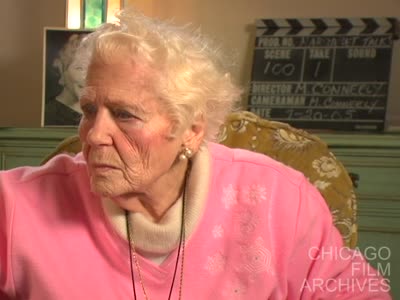
Margaret Conneely (Tape 1/2) November, 7 2005
Okay, Margaret, do you want to just say your name so we can hear out the sound levels? Margaret Keneally.
How do you spell that? Margaret? Keneally.
How do you spell it? C -O -N -N -E -E -L -Y.
Margaret, why don't you? Can I keep this or not? Oh, sure.
You know, if you could, why don't you tell me about when you first got into the film business and what you were doing, what the rest of your life was at the time when you first got into the film.
You know what? I can't hear you too good, Nancy.
When did you first get into film? When did you first begin getting interested in film? By moot.
Do you remember what year it was? About 1949.
What were the circumstances? What were you doing at the time? Well, I was walking along the street to come to a movie store where I could buy a movie camera.
So I went into this Bell and Howell place.
And I got a $25 Firestone 8mm camera.
And as I was waiting for it to be wrapped up, I happened to see a Metro movie club newsletter.
And I asked the girl if I could have one.
She says, oh yes, by all means, you'll learn a lot from that.
So I looked at it and I wanted to come to that movie club.
So I hurried home and got a babysitter for my two boys.
And luckily, my husband worked evenings and that was when I would go to the club.
And I did that for about six months.
Margaret, why were you interested in the club? Why were you going to get a camera in the first place? Do you remember? Oh yes.
When I was very young, like about fifteen, I happened to have a boyfriend who invited me over to his home on a Sunday afternoon.
And the mother and the father were, oh they were so nice.
The father had a library that was put by three different walls just all full of books.
And he said to me, is there anything you'd like to know more about that you don't? I said, oh yes, lots of things.
And he said, what? For instance, I said, well I'd like to know more about tigers.
But most of all, I'd like to know more about a movie camera.
And he says, you would? I said, yes I would.
So after we had dinner, he said, how would you like to go to the Museum of Science and Industry? I said, I don't know, but it sounds pretty good.
And he said, well we're going to go there.
The father, the mother, and the boy, his name was Jack, and his sister's name was Dorothy.
And mostly, right away, he took me into a Paris exhibit where it had all different kinds of movement of cameras.
And I was just utterly fascinated by it.
And then Jack's father said, okay, we go home now.
And he said, you stay a little later because the sun is out.
And I didn't know what he wanted the sun to be out for.
But he said, he came down and he had a camera.
I didn't know why he put it on the tripod, that he didn't want the camera to move.
And he lined all his family up.
And he said, now you take the camera, and you look through here, and then you push the button.
And I thought, oh, I must be taking a picture.
And so I took a couple of pictures.
Then they started to walk around and come frontwards this way.
As they come to the camera, I could see the picture was getting bigger and bigger and bigger.
And I said, hey, it better stop.
But they said, no, turn it the other way.
And then after that, he said, well, that's enough for today.
Then I remember I kept thinking about it all the time.
I was wondering when they were going to ask me to come back.
And here it was, people moving and doing things.
I said, boy, that's what I want.
So that was why I was here this day, to buy.
I had my money saved up to buy a movie camera.
And I was going to take movies of my two sons.
And that was about, well, now one of them is 64 and one is 62.
But then I decided with what I found out about the movies.
But now I was going to be in charge of making my own movies.
And I wanted to make it so that everybody else would like.
When were you in charge of making your own home movies? No.
When was this? Was this when you went to get the first film? To the movie club.
Tell me a little bit more about the first, when you bought your first camera.
Well, when I bought my first camera, I knew what kind of movies I wanted to take.
Because I saw the same kind that was at the Metro movie club.
If you have to stop and pause and think about it a little bit, that's actually better.
We're not looking for you just to say.
So tell me again about the first time that you went to get your camera.
What was going on? I went to get my film.
When you went to get your first camera? Oh, well, when I first went to get my first camera, oh, wait a minute.
You were saying you wanted to shoot your kids.
The Metro News that I was looking at had a program on that Wednesday night.
And it said that Stan Yazbek, who was a friend of mine that I hadn't seen for many years, he was putting on the program.
And I just wanted to go so bad that I hurried home, got a babysitter, and went to the club.
And here I saw the kind of film.
It was even better than the one that I had seen on that Sunday afternoon at my other friend's house.
And he had made a story of his little girls and his wife and his sister.
And it was a beautiful make -believe story.
And I thought, oh, wouldn't that be great? I have two handsome young sons.
And I'm sure they'd like that, too.
Can I ask you something? Who were the people that, when you first went to the Metro Club, your first time you went to the meeting, who were these other people? Their names? No, not their names, but were they just? The young people that I had met, the Stanley Yazbek who was going to put on the program that night of a story film with his family, these were the same kids that I went to high school with.
And it was a pleasant surprise when I saw the kind of film he made.
It was the kind that I would just dream about.
And on the way home, I was thinking about, how would I use my boys in a story that they would like, in a story that other people would like, a story that they would let me show at the Metro Movie Club, and one that I could enter in contests and just see how good I was.
Because when you entered in the contest, you always got a jury seat that told you what you could have done better, what you shouldn't have done, what you should do.
So it really was a good experience to get a film on the program, and a better one, when you had it judged as one of the winners.
So my first film that I made to show anybody else was called Safari.
And we had gone to the, I really shot two films.
And the big thing was it had to be inter -edited.
With one film that we shot when we went to the Brookfield Zoo and met the director, who was most cooperative, and he sold me about 10 or 12 hats that the hunters wear when they go on Safari.
And the kids were so delighted.
Everybody wanted to be in it, but we could only let 10 people, 10 children in.
So I had two of my YASBIC friends, little girls.
They were very pretty, and they looked very nice in these hats.
And so then there's a couple of kids that were in school with John, a couple that were in with Jim, and then the rest from our neighbors.
And everybody wanted to be in.
So we would take them not only for a picnic and bring them all lunch and everything, and if we didn't pay them, that's what they got paid in.
And then also their mother and father got a copy of the film after the film was finished, which was maybe six or eight months, because I wanted to get everything in it.
And at that time, even in the big theatrical theaters, they didn't have sound.
People couldn't talk and make the sound.
They had to make titles, black and white titles, and in between and say what the stars were saying.
And it took longer to make the titles than it did to make the film.
But then I would have to take another film.
We took another day, and we had to go out in the Forest Preserve, which was close to our home.
And we had another picnic in the woods.
And then we went shooting with toy guns and toy cameras.
And so first they would try to shoot.
When they would hold up the gun and shoot, then I would cut and put a line or a couple lines or something on the other end from the other film.
And then when you come, you see the monkeys dancing around, see the elephants.
The director had let us take out the baby elephant.
Only one girl was brave enough to want to get on top of the elephant.
None of the boys wanted to do it.
But this girl, she was a pretty forward girl.
And today, or many years later, she became the mayor of Gary, Indiana.
What was her first name? What? Kathleen? Let me ask you something.
At that time, when you were making Safari, did you edit in the camera? Or did you take your shots and then edit later on? Oh, no, we edited it.
Well, we edited the camera as far as we could.
But the real good editing was done through a little movie editor and cutting and intercutting the films.
And also, not only the film that we shot, but the titles.
The titles were pretty important because there was no narration over.
We had to do the same as the theatrical people.
And I think it was Al Johnson or somebody.
He was the first guy that really put the sound on while he was acting by singing.
But we had to do that with our amateur films, too.
That was one of the first ones.
But after that, later on, they had sound on the camera with magnetic sound.
And once they got that, every one of my 16 -millimeter films, which I had gone to, I'd become a sixth.
By this time, I had won enough awards and got enough experience that I had now had a Bollocks camera.
Well, OK, let me take you back a little bit.
So you made your first film, Safari, for the Metro Club, right? Yes.
How did it go over? I first prized in an 8 -millimeter class.
Then they had 16 -millimeter class and 16 -millimeter sound.
Were you surprised? Well, I was surprised.
But I tried real hard because I wanted to make sure I was important in this club.
And I wanted to do it as good as they did.
Some of them, there was one man who was really great.
And he was about the best 16 -millimeter film.
And then Stan Yazbek, my young friend from high school, nobody could touch him with the 8 -millimeter.
But when I was going to go to 16, to shoot 16 -millimeter, he also wanted to go to 16.
It was this time it was about $700 for a new projector that would play the sound.
And then all he had to do for the sound was shoot it and turn on the.
It had a track, the track that would run.
And then here on the other side was another, a brown magnetic tape.
You had to have a magnetic sound tape and a tape reader on your projector as well as your camera.
And it was great because you didn't have to make any more of those titles.
So you actually wanted to prove yourself with.
Pardon? You wanted to prove yourself with the Metro Club, right? I wanted to be accepted as a movie maker.
And that was the only way to do it.
Where do you think this came from, this drive that you had? The what? Where do you think this drive came? Why did you want, where do you think, why do you think you wanted to excel so much in the movies with these people? I'm not sure.
What did you say? Take this talk this way.
Where do you think this drive came from in you to excel so much in film? Well, from the first time I saw the people moving, people that I've shot in Jack's father's camera, the people that I shot, I would see them move and dance and everything.
But I thought I could even do better.
I can make a story and then make people want to look at my film.
And the boys will be happy to see how they look.
And they would come over and we'd have ice cream and cake.
Of course, we always started out with popcorn because that's what they had in the big theatrical movie houses, that you buy your popcorn for $0 .05, a big bag like that.
OK, so you, Safari, you used title cards.
And eventually, what was your first movie that you shot Meg Sound with? Do you remember? This shot what? That you shot Sound.
What was the first? The first one I shot Sound.
Yeah, I don't, I remember practicing a lot with Sound before I would do a movie.
In what way? The first movie, I think it was.
Margaret, how did you practice? What do you mean by you practiced? I would shoot film.
I would maybe have my son get up there and sing a little song.
And I'd just see how it worked.
And then somebody doing something.
And I made one film with the animals.
And then you have to wait for them to do what you want.
Or you have to trick them into it.
For instance, on one film, I never finished it.
Because I couldn't find one of the films.
Anyhow, I wanted the kitty to walk along the street and look in the house and see another little kitty.
And then you look another one and another group of kitties.
And they had, oh, such a happy home.
And then they had little kitties.
But this kitty, my kitty, that was walking along, and it was snow.
And then there was footprints in the snow, my kitty walking and looking in.
She's looking for somebody who doesn't have a kitty who would take her in.
So finally, each house seemed to be filled until finally she came to a place in the snow where there was an outdoor crib for Christmas where they would have baby Jesus and Joseph and Mary.
And then my little kitty crawled up with it for the footprints right up to the thing and got into the crib by the little baby Jesus and put his little head down and went to sleep.
And the way that I got the kitty to watch, to walk where I wanted them to walk, I had a little can of baby shrimps.
And you put a shrimp here and a shrimp there and one there.
The kitty would eat the shrimp and walk to the next one, to the next one.
And I could make my kitty go wherever I wanted and whatever he did.
And then finally ended up in the little crib.
What the ending was that the little kitty put his head down, went to sleep, and they found the home.
But I always thought that would have been a good one.
And I had the crib scenes all shot and everything.
I seem to have lost some of the ones where he was traveling.
And I had some very funny things.
Have him chase the little mouse or chat.
But we never did find out what it was.
We just could see the tail go, rrrrr.
And then my kitty would try to jump for him and get him.
You were probably one of the first animal handlers.
What? You know, in movies, animal handlers make a lot of money.
Oh, yeah? It's the same thing you're doing.
I always had kitties until about two months ago when my last kitty died.
But I think that would have been a good one.
The things that won in a contest were things that were very different than nobody ever had it before.
Now, like that, nobody ever had won like that.
But that was the best way they get to win.
And then the kids, of course, the kids were really, nobody had the wild animals out.
And they played ring around the rosy with one of those baby apes.
I don't know what it was, but they got all running around.
And the little baby animals, they loved to be with the children out of their cages.
And I thought I was very lucky in getting the cooperation of that director.
And of course, you couldn't do it now.
So at what point, I know right away you began getting awards at the Metro Club.
Right away you began getting awards at the Metro Club.
For your first film, Safari, you got a lot of awards for that.
When did you start feeling that you were really good, and that you had control over the craft? At what point? Do you remember that? That I had control.
That you had control over filmmaking, over making these stories? Or did you feel like it right away? Or was it something gradual that? No, I think I always felt, well, in school, journalists, even when I was in third grade, I would win.
When they would have a contest for writing the Christmas story for third graders up to sixth graders.
And that was when I lived in a little town called West Liberty, Iowa.
And would you believe that I was a third grader, and I made a film, and it won.
He couldn't carry his sleigh through the sky.
And he didn't know what to do.
But then finally, one of his toy planes said, Santa Claus, we will take your toys and deliver them in our airplane.
And I had a lot of scenes in it.
But then I was lucky that I was out one day, and here was a big airplane going through.
And nobody ever saw an airplane back in those days.
When I was in third grade, nobody ever had an airplane going over their heads.
I told the teacher I really saw an airplane go over.
And so that's why I made up that story.
And I got the best story for the Christmas play.
And then I made another one about a little tadpole.
And I used to go down by the brook and watch little tadpoles and then watch until they finally, I'd go another day.
And finally, they'd turn into a little frog.
They'd bump and come and become a frog.
And I thought that was just amazing.
I wrote a poem that told about how these little frogs come out of little tadpoles.
Anyhow, my teacher, I had a third grade teacher there.
But she took my poem and she said, Margaret, that is very good.
She said, I am going to take it and send it with your permission.
The teacher is going to ask my permission to send it to the Child Life magazine and enter their contest for their journalist thing, stories and poems and everything.
And lo and behold, way back when I was eight years old, that was really something.
And I said, what good is a teacher? What is it, Ms.
Wagner? What will I do with it? She said, I'll tell you what.
I'll go to the bank with you and you can cash your check.
And I thought, oh boy, I think I felt better about walking with that teacher to cash my check than getting the check.
And then, of course, I didn't want to give the check to my father because my father would take it all and send it foolishly.
So I bought some groceries for my mother and some candy for my brother and candy for my two sisters and candy for myself.
And that was the biggest thing I ever did when I was that age.
Yeah, well, I always was interested in stories.
And I could make up stories that nobody knew anything about, like Santa Claus in the airplane and the little paddles coming out.
Another time I had a great big turtle.
And then I put bricks on top and put the turtle on top.
And then I was so happy with my turtle.
I would catch him worms and everything.
And then one day I brought out, one day I went to school and one of the kids said, gee, if you ever have a baby turtle, I would like to have one.
And I went and talked around to my friends.
And I promised everyone a turtle.
About 20 kids, I promised them a turtle when my turtle had turtles.
Well, the teacher got wind of this.
And she said, Margaret, come up here.
She said, how many turtles have you got? And I said, one, big one, like that.
And the teacher said, how many turtles have you got? I said, I just got one turtle, but I got a lot of eggs.
And I promised them to all my friends, this wonderful one that would take care of it.
So that's when the teacher told me, if you only have one turtle, you aren't gonna have any little turtles.
You have to have two big turtles.
I tell you, that was really something.
Because none of the eggs were fertile.
So you were from a very young age.
You had stories going on in your head.
You were creating stories from a very young age.
Yes, yes, always made up things.
And when it came to a story for a teacher, I always was number one.
And nobody helped me, except a teacher who would encourage me.
So when you're, let's go back to the club.
You've thought of a story you wanna do.
How did you all structure it? Was there a structure to the production of the story? Was, were you the boss? Was somebody else the boss? Did you each have roles? How did you just wing it? I was always the boss of my own films.
I never let us to know anyone else.
And what we'd do, we'd call them the director.
We have the director, and then we would have all the assistants, the sound man, you know, the script person.
We have, where's the script? The clapboard back there.
Yeah, that's, do you wanna show that? We'll bring it out later.
What? We'll bring it out later.
Well, that was, we would keep track of the different shots.
We would act one, scene one, and that way we would know.
We couldn't shoot a film all in one day, but you passed it.
Did you write a script? I always wrote a script.
Unless it was a very short story, and well, I knew what my kitty was gonna do, so I didn't have a script.
I was the only one, only me and my kitty.
Well, you were making these films, and some of the other club members would be in your film, right? Did what? Some of the other club members would be in your film.
So what we would, what you would do is first get a good story, and then write it, break it up into parts that could be shot with the film.
What you really could do is all the shots that were in the same place, you would shoot it once, and then you could, all the shots of another place, maybe would even be a different city or a different, different place, but it would be a lot easier to edit that way.
You shot everything at one place and then.
How professionals usually, that's how they usually shoot their films.
Well, I would read a lot of professional magazines and things like that too, and I would get ideas of what they did do, but especially editing and scripting and things like that.
The story film was the most important to me, and that's always what I could do best, not only for myself, but for other people.
Were there any disagreements? What? Were there any clashes of egos or disagreements in the club while making a film? About making a film? When it was a club project film, the one who was the director was the boss, and the one who was the director, I mean, technically, he was the boss, or she, and whatever the director said, the person in the club was supposed to do it.
I don't remember any time that someone was called upon to play a part and not want it, and not want to do it, because if they could do it, somebody could say, well, we're going on vacation at that time.
Well, then you have to coordinate everything so that it would all work at the same time, just like a job or a work or something.
That was that important to everybody in the club that they did kind of give the same importance to this club activity as they would to their job, oftentimes.
It was, in fact, some of them felt it was more important.
Some people would take off from their job or take off their vacation.
Forget about their vacation, let's do the film.
I remember one time, though, things that we liked to do, we would coordinate it with what we were going to do.
For instance, we would try to make something nice go along with something harder.
I remember one time we were doing a...
It was July, and we were having a Metro Movie Club picnic, but we also were going to make a film, and this film was going to be when two of the children take a walk, and they go down by the river, and they see a tree, and somebody picks up a little lamp, and starts one of those little oil lamps, like the Aladdin and all those guys use, and they rub it like this, and all of a sudden the tree came and filled with beautiful ornaments, and they said, oh my gosh, let's go back and tell mom and dad.
So they rubbed the little thing, and the ornaments went away, and then they went back to the table, and everybody was eating, and the kids wanted their mother and father to come to see the magic tree, and their mother says, no, no, you gotta eat your dinner here.
Now can we go, mom? Can we go? So finally, the mother takes the little, the kids, and they walk, they walk and they come to the tree, and they rub the little thing for the mother to see, and all the ornaments come on and light up, and then they say, oh, well, let's tell the park commissioner about this.
So they go, and they get them, and they rub the little light, the little lamp, and they wouldn't go.
So, I forgot what else we did to it, but it was the magic thing.
The funny thing was about putting all the ornaments on the tree, and then taking them off and putting them on, but we didn't have to do all that, because we could do that in editing.
We could cut the film, and use the same film that we put the lights on, just cut a piece off it, and hold it over here, put up a number, and then other spots where the thing was bare, you put that together.
That was an editing job, but it could be done very well.
Okay, do you wanna just take a rest here? You're doing great.
Are you okay to keep going? Do you really think so? Yes, I do.
Some of the really important things I forget.
No, this is really, these are really great stories.
Yeah, it's really interesting, Margaret.
I mean, you're telling stuff that I haven't heard before, too, and I had some questions about stuff that maybe I'll ask afterwards, if you wanna take a drink of water or something.
I got a question now that John's gone.
You wanna ask about the saga of the first and last? Yes.
So tell me about making the saga of the first and last with John.
What was that like? Well, let's see, we did it.
Do you wanna know how we did it? Well, you actually made him smoke cigarettes, huh? Ha ha ha.
I had another friend, Ed Diller, and he wanted to do this with John.
And I said, he says, I'd like to make a film with John with the birds and bees and stuff.
I said, well, how about making one with...
You drive your car out, and you drop your cigarettes and let him pick them up, and then let him take them over and shoot a couple cans off of the bridge, and then he can try one of the cigarettes.
And I'd like to use all the different filters after he gets sick.
You know, we had red filters, green filters, purple filters, and he's over...
Do you remember the film? Well, he thought that would be a good idea.
He told me first he'd like to make a film with John because he liked John a lot.
He and John used to go out and...
take pictures and catch insects and birds and everything.
They had been boy scouts, you know.
I drove the car, and Ed got out of the car and dropped his cigarettes, and then he got in again, and I drove away, nearly killed John.
And then when he got out, I did the filming and the filters, put the filters in front of my bollocks so that it looked like John was getting pretty sick.
Had he ever smoked a cigarette before? No, he never.
That you know of? No, no, he told me.
John tells me, huh? But you were willing to make your son smoke cigarettes in order to get a good movie, huh? Ha -ha! I guess I was.
But then, without his cooperation, he thought that was pretty funny.
And he liked the film when it was done.
But I had taken a lot of films of Jimmy, too.
Jimmy, we did a lot of filming with the Boy Scouts.
We went up to Camp Danbeard and the Wassepie.
Were you a Boy Scout? No, you're...
Were you? Jimmy's a Golden Eagle.
They don't have Golden Eagle Girl Scouts anymore.
Eagle Scout, Jimmy was the first one that thanked our sisters over here.
You took some films of the Boy Scouts, right? He what? You took some films of the Boy Scouts.
I was the only woman that was allowed at the Boy Scout camp without their husband.
And so I stayed in the nurses' quarter.
So I went out every time they went out.
Especially we took a lot of pictures of them on their canoeing on the water.
And they turned their canoe over, and then they'd have to upright it.
Then there were days when they went out for the nature badge.
A lot of the badges I would take, the things that were required to pass the merit badges, I filmed them for the Boy Scouts and I turned them all over to them.
But we also had a group making fiberglass canoes, making their own canoes.
And Jimmy, we did that about two blocks over here, in one of the guys' garages.
And they had a heat heat in a little hot stove.
They had to heat up the stuff and pour it and melt it and pat it around.
I don't think that was required, but was it required, Jim? No.
Okay, so you made some movies with John and Jim, and then there came the time when you made Fairy Princess.
That was with your niece, right? Yes.
Now, was that your first 16 millimeter sound film? Yes, it was.
And also maybe the first animated film that you made.
So tell me about how you got the idea of making a sound film and an animated film and put all of these parts together.
Well, I was very much interested in Jack Riddell's animation, but he had animation of flowers, so it was beautiful.
So I would have it set up here in this room and put a little background all around.
And all these little dolls, we would dress them up in different shining costumes that were very photogenic.
And then you would move one little doll about one inch and then shoot, and then another one about an inch and then shoot.
But you had to do it 24 times for about an inch.
And I was up until about 2 o 'clock in the morning trying to get the dolls, get the number of emotions that I needed.
In fact, I had more than enough.
I even put some more of the dolls dancing on another film.
Which film was that? Pardon? Which film was that that you put the more, the extra dancing? It was part of a Christmas film where I had my nephew and my two little nieces together.
And they're just sitting there like, oh boy, oh boy, you know.
And the dolls are dancing around.
But it took a long time to do the narration on.
And at that time nobody ever did it.
Of course, now they got everything so easy, which was very different than at that time.
And I think one reason it did win was it had a good, it was supposed to be a family, the best family film in the PSA competition in ACL.
And Harris Tuttle, he was the vice president of Kodak at that time.
And he sponsored a great big trophy, about this big, for the best family film.
And it was a national and international competition.
You must have been pretty proud of yourself to have won that.
But then they started me judging, me being a judge.
You know, once you were a good filmer, then you were asked to judge some of these very prestigious competitions.
And some of the fancy trophies that they got, I got some of them over there.
Looks like an anchor to me, but it says by Kodak, it's a sterling silver Kodak thing.
And they had one judge from Toronto, that was Jack Waddell, and one judge from New York City, that was Stuart Dobbs, Rose Dobbs' husband.
I think Rose helped her a lot on that one, though.
And then it was me from Chicago.
We were the movie judges for International.
And there were other judges for the still photographers, large prints, small prints.
A large print was 16 by 20, and a small print was 5 by 7 or 8 by 10.
And they had different judges for each group.
And they sent us our airline tickets on American Airlines.
And then we stayed at the best hotel in Rochester for a week.
And then all our meals we had.
But I always thought what we got was a lot better than paying.
Besides, you get to meet all your best friends, and some of them who became good friends because of the different competitions.
And often at the competitions you would meet the same judges as you had last year or the year before or next year.
And it was always really a great thing to judge a prestigious competition.
And many other countries like Spain, of course England.
England was very prominent and a very good one to get your films into.
They disqualified a lot of them.
Otherwise they have 300 films or something.
So they kind of screen them out.
I judged for Toronto about 12 times altogether.
What's the kind you're going to make? They would give me ideas, but then I would add my ideas to it that I felt made them better.
That's conceited, isn't it? But that's how I felt about it.
I hear that artists borrow or they steal.
Yes, but it was a great thing to go to the conventions too.
Because when you had conventions you had a choice of maybe five to seven programs going on at one time.
But of course the movie makers always went just to the movies.
And many, many times I was program chairman for the internationals.
And so I always knew which were the best films out.
And that makes it not only interesting to see those films, but to see the makers and to hear what else they had to say.
Because everyone was different.
And there wasn't anything like you'd say a copycat.
You just copy what he did because he won.
You just didn't, nobody ever did that.
Everybody wanted to be original as they can.
One of the most original films of yours I think is the Chicago City to See in 63 film? Yes.
Where did you get the idea to make that one? It was for a convention.
A poem was The City to See in 63.
And it was in the PSA journal.
And then I changed it around a lot.
Well, the big convention this year was to be in Los Angeles.
And the president said, have someone in the Chicago area make a film and we'll have a competition for the films to see which one will win.
To be shown at Los Angeles when the Chicago Fair is next.
Anyhow, there were quite a few films from Chicago and everybody thought they were going to win.
But it was a big surprise to me to find out that my film won.
Was it a poem that you wrote? No, no.
But I had a change of some of the words to make it fit.
You have to measure out how much film you want to, what scene it is.
And then like the film, another film I made, Silver Bells, you make all the words and then you fit your footage to how much you need to show on the film that shows just exactly what you wanted to say.
Feet are walking and feet going up to church steps or something like that.
So in the case of City to See in 63, you had the poem and the soundtrack first and then you went and got the footage to match that? Yes, yes.
Who narrated that? It was a big editing.
Who narrated the City to See? See, the film was done first.
And then the narration was Dr.
And he was a very funny, comical guy.
He could make anything sound great.
And like Nancy said, she looked at it and it got a lot better with the sound.
But I think every film is better with the sound unless it's lousy sound.