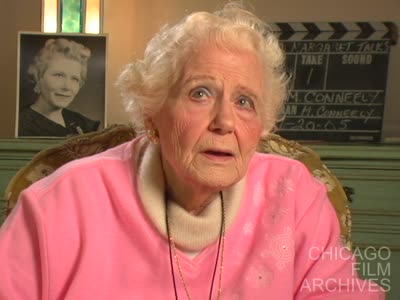
Margaret, if you wouldn't mind putting your notes up on the table.
I think it works better that way.
Thanks.
Okay, we're rolling.
Margaret, come with me.
Tape number two.
So you're just going to say that your favorite kind of films were always situation comedies? Yes, and always with a happy ending.
Margaret? Oh, sorry about that.
Take two.
What am I going to say? You were talking about situation comedies.
Well, they were always...situation comedies were usually what we did at the movie club.
Club...what do we call it? Anyhow, the club film, whereby people in the club got together to make it up.
And one person would be the director.
Usually he would be volunteering.
But of course, everybody in the club knows who was best and who was one of the best.
And they'd put their...sometimes we would vote, but most usually it was a real slide in.
Usually it was like Karl Fraser or myself.
Then the kind of film we usually would make would be usually about a 400 -footer, something that was really entertaining like the situation comedies.
But they always had a happy ending.
And one of the ones that we made was...I guess you would call it mine because I wrote the script.
And I picked out the actors and the lighting...everybody who was going to do something, they always had a report to their director.
So one of them was the 45.
And I got the idea of that from my friend Bob Dintol.
He had a whole big drawer full of guns.
And I said, gee, what are you ever going to do with all the loans? Oh, he said, someday I'm going hunting.
I said, do you ever go hunting? No.
I said, well, how would you like to lend me one of those guns? What do you call that one? And he said, oh, that's my 45.
So then I thought, well, I'll make up a little story on that one.
I got one in my head already.
And I had this big burly guy.
We went out.
We were working out in the field house, which was a house made of wooden planks.
And it looked like a real old -time West Fast Western show.
So this burly guy comes knocking on the door, and the beautiful little wife of a fellow who wasn't home at that time opened the door and said, oh, hello.
He says, is this Joe Bowlin? Yeah.
Well, I want to see him.
And she said, well, he isn't home.
He said, I'll come in and wait for him.
And she got really scared.
He looked like such a tough guy.
She got really scared.
So she lets him in.
He sits down at the table.
And she said, can I get you something? And he said, yeah.
So she brings him cake, and she brings him sandwiches, and all that stuff.
And he eats like a pig.
He's like, whoa, whoa, whoa, whoa.
And the worse he eats, the worse he looks, and the more scared she gets.
So she says, are you sure you want to see my husband? Yep, yep, he says, yep.
So then after she feeds him and wines him and dances with him, she says she makes some motions like, you know, anyhow.
She knew just how I told her what makes the motions like you want me to go and follow you.
And she said she knew just what to do.
So she did.
And she goes, hmm, hmm, hmm.
God's been funny.
He follows her in the room.
And when you see him come out, you see him buttoning up his shirt.
So you're supposed to use your own imagination.
And then she says, now will you go? Now will you go? She's watching the clock, and her husband would be home in 15 minutes.
He says, oh, yeah.
So then he gets ready to go, and she grabs him home, and she says, wait, what did you want to see my husband for? And then he puts his hand on her and she says, to return his gun.
And she's so disgusted with all the things she gave him.
And we did another one called Mr.
E.
And Mr.
E, Mr.
E, you can say it like it's a mystery or it's Mr.
E.
So this was my friend Mary Ann.
She was a young wife, and she was disgusted that her husband would go out and play cards across the street with the people that live upstairs and not come home.
And she'd be all alone.
And she's telling this to her girlfriend.
And girlfriend says, well, why don't you play a trick on him and make him do something that he will stay home? Make him jealous.
So she says, that's a good idea.
So she gets a mannequin all dressed up like a man and with a hat on and a suit and everything.
And she has him in the closet.
And when her husband goes out, her girlfriend comes over, her husband goes out to play cards, and across the street she's watching them.
And then when she thinks it's the right time, she pulls up the shade and she and her girlfriend go in and they bring out the mannequin.
And Mary is putting her arms around him.
And all of a sudden her husband Stan looks out the window and he looks across and he sees this guy in his house with his arm around his wife.
And he hurries up home.
And the girlfriend says, hurry up, put the mannequin back in the closet.
So they get the mannequin back in the closet.
And when the husband comes home, he says, where's that guy that was just here? Did he want to see me? And Mary says, what guy? What guy? And then she says, oh, they had the policeman coming too.
Because oh, that's when Stan came by and he sees, she says, I'll tell you who it was.
And she shows him the mannequin and he takes the mannequin like this and he goes, throw him out the window and the three policemen come die.
And then there's clear back to Mary and the husband and wife, Mary and Stan.
And Stan puts his arm around her and he says, Mary, I won't play cards anymore.
I didn't know you were so lonesome.
And that's the end of that one.
Your movies, like the situation comedies, you said they leave a little bit to the imagination.
Yeah.
They leave a little bit of mischief to the imagination, huh? Yeah.
Yes.
Was that always a sort of goal of your short films? Well, it's a problem and we have to solve it, I think.
It's just one of the things I like about your movies is the way that the problem is sometimes, you know, some guy with a gun.
Yeah.
And the way you solve it is, you know, some woman showing off a little bit.
Yeah.
Well, I never showed anything I shouldn't show.
I have to leave it to your imagination.
Sorry, go ahead.
The 45, that was interesting, an ACL contest and it won a first prize.
Let me see, what did they say? They were both first prizes.
My film and the doctor's film.
But doctor's film was one that was made to fit a song.
And I think the fact that they said the fact that it was not original, original script, it couldn't be first.
So my film was first because mine was original.
Nobody had ever done that one before.
And then I remember Oscar Horowitz was the guy who decided that.
And at that time for prizes, for awards for the contest was camera equipment, like a camera and a beautiful tripod.
There was a whole bunch of stuff you could pick out of a recorder, cameras, movie camera, all movie equipment.
But Oscar was able to get that from the New York camera stores.
He went around and got them all.
He could have bought them all himself, but he didn't.
So is that all the stuff that we were taking out of your basement, the equipment that you won over the years? A lot of it I gave away.
If I had something and they gave another camera like that, I would see who needed one.
A lot of the stuff, if something new came out, I had to have it.
And I got it.
Is that because you like the gadgets or you like the challenge of doing a new thing with the new equipment? Well, I always liked to try the new equipment.
Then if I didn't want it, I'd give it to someone else.
But a lot of the manufacturers would give equipment to award for competitions.
Bell and Howell was especially good.
I remember when Bell and Howell, when Glenn Turner won, he had animation too, but he had little things that he'd make out of toothpicks and little witches and stuff.
There was, oh, like these pirates, pirates in little ships that he had in water.
But Glenn Turner, he was the first great guy I knew.
And he was a teacher at the University of Utah, a Mormon university.
And he was a Mormon.
He was really something.
But what they awarded, what Montgomery awarded, no.
Bell and Howell awarded him a 16 millimeter Bell and Howell film projector, camera, and titler, film titler.
That was another thing that was really great to have, is there was a film titler.
I had a Bullock's film titler, and it was really something.
I think I gave it.
I think you gave it to us.
The one in the wooden case? All the little compartments? It was big.
I know we can't get it.
Yeah, it's big, about this big.
I have one of those.
This was a Bullock's.
Yeah, it was made by Bullock's.
Yeah, I had two Bullock's, two Bullock's titlers.
So I gave one away.
I think I gave you one, Charles.
I think so too.
I think it, did you get, yeah, didn't you? Maybe.
You gave us so much stuff.
Yeah, I did.
A Bullock's titler, I'm sure.
And it was brand new.
You'll have to show him how to use it, because he'll never figure it out.
No, you'll have to teach me.
You know what, it's been 20 years since I looked at it.
That's a long time.
Can you tell me a little bit about Central Cinematographers? Oh, that was, Central's, well, let's see.
I'm trying to think of the fellow's name who was from, the big film company here.
Oh, the guy who was from Encyclopedia Britannica.
Yeah, Britannica.
Do you remember? That's not Karl Frazier.
No, no, no.
That's...
Fred Strauss.
What? Fred Strauss.
Fred Strauss, that's right.
That's Fred Strauss.
You know, you have a little film of him, too, called Group of One.
That's Fred Strauss.
And so he started the Central Cinematographers? Yes.
He, this, there was way back.
Well, not that far.
At the Central YMCA, they had classes.
And they had a class in cinematography.
And Strauss, he loved film.
He loved film like I did.
And like other others that belonged to Central Cinematographers.
Film was first, and anytime you could have it.
Well, Fred, he taught film at the Central Y, and we used to all go, we used to go down there.
Mary Ann and I think there were about 12 of us at the time.
And we took classes.
And then they were not going to have their class anymore because there weren't enough people.
So we decided to have a club.
And Strauss lived in Glenview.
And of course, I lived close to Glenview.
And Mary lived halfway between.
And so we got together and we formed a club called Central Cinematographers.
And we would just make film.
We always did film every night.
And we always would have maybe a part of one film to do one night and a part to do the next Sunday morning at the racetrack or something.
We always had it very well documented, what we were going to do.
And we never wasted any time.
And when we came right from work, everybody came right from work, there was Harold Hogan and Hans Thorn.
And...
It seems like one of the things that was different about Central Cinematographers is that they were all club films, right? Like it wasn't just people making their own films, it was everybody working on a production together? Everybody worked on a production together, but it didn't belong to the club.
It belonged...
it was the person whose film it was.
And everybody worked on his or her film when it was their turn.
And if you had to pass up a film because maybe you were going to be away or you were going for a couple of months or something, then you get to skip to the next person.
Tim Kennelly belonged.
And gee, I should have written them down, but I can write them down and give them to you.
And we went on for several years.
Some of the clubs were starting to fold, but we were just...
we went every Friday night.
And I remember one time when we were driving in a car and we were filming...
I was filming out the back...
laying in the back of a truck and filming out...
certainly we wanted Santa Claus to come out of the alley, and I was supposed to catch him.
And I remember that as we went to film, I went to film him.
I said, back up Santa Claus.
And a lady stood on a thing, and an ant man, and they posted Staron.
And I said, oh my God, this is...
it's St.
Patrick's Day, and here there's Santa Claus.
How did Santa Claus come out on St.
Patrick's Day? And then we had to tell her we're making a film.
It was St.
Patrick's Day on St ....
finishing up the St ....
the Santa Claus film.
That was really funny.
And Central Cinematographers, you're right, it lasted even until video, right? Yes.
Some people were shooting on film and some people were shooting on video.
How did that work? Well, they never shot the same film.
I mean, the same...
But you would take turns? Yes, take turns.
And when it was your turn, you were...
We first, we did it alphabetically.
And then when you always knew who was next, who...
And what you'd probably have to do is the first night bring the script, and then pick out who you were going to have as an actor, and which part they had.
Now, I remember one woman...
She's still with us.
It's outside.
Well, Don was making this film.
Don Peters was making this film.
And he had to have a...
It was very important to have an English woman with an English accent.
And then another woman was American.
And he wanted me to be the American, and he wanted Joan.
Joan, Joan was her name.
He wanted her to be the English girl.
And she was.
She was English.
She was an English war bride.
And she had a definite accent.
And she didn't want to be the English woman.
She wanted to be the American.
We had a little trouble over that one, I remember.
It was...
Where did they get that idea? They got that idea from a story, I think a Hitchcock story.
You could do a Hitchcock story if you wanted to.
But anyhow, Joan, she didn't want to...
And Ed Synnett, Ed Synnett is one of the...
He was the leader of this group.
We just let him be the president year after year.
And then I became president.
But we didn't have much organization.
Stuff like...
We didn't have dudes and things like that.
Whatever came up, we would take care of.
It's interesting.
You said somebody made a film based on a Hitchcock story.
Was that common for people to make a film based on a story from TV? Yeah, I think, no.
I think this one was.
This one that...
The reason is she was supposed to come in on a plane.
And...
Let me see, what did she do? She had stolen some money from somebody.
And then when she got here, they had changed it around that she was going to get killed instead of the other.
Well, that's okay.
It wasn't too clear.
You had to have all the narration to it.
All right, good question.
I was just curious if you were one of the few women cinematographers back in those days when the club started.