AIST Laboratories presents an anesthesia motion picture clinic in cooperation with the Department of Anesthesia at the University of Missouri on the techniques of anesthesia for minor surgery involving the oral cavity, pharynx, and larynx.
First we shall demonstrate anesthesia in a 23 -year -old volunteer.
The second part of this film will show anesthesia for biopsy of the velecula.
The features we shall emphasize are the vaporization of flueathane with air or with oxygen, a vaporizer which does not require compressed gases, continuous monitoring of respiration, a new airway technique involving intubation of both nasopharyngeal passages, and a monitored method of assisted respiration which ensures smooth anesthesia and guarantees adequate ventilation.
The IV premedication was three -tenths milligram of atropine.
The only anesthetic agent will be flueathane which is ideally suited to the ambulatory patient.
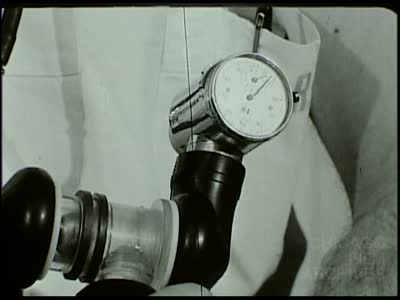
A new monitoring valve called the Saturn will show the patient's breathing and also act as a non -rebreathing valve.
The ambu bag and a small flueathane vaporizer complete the anesthetic equipment.
Anesthesia will be induced with a mask.
The vaporizer is set to deliver 1 % flueathane which is usually well tolerated by the conscious patient.
Note how the Saturn monitor deflects to and fro as the volunteer takes a deep breath.
The right meter attached to the exhalation tube measures the tidal volume.
One revolution of the small hand is one liter of ventilation.
Frequent blood pressures are necessary to follow the plane of flueathane anesthesia.
The initial pressure, 110 over 60, is plotted on the blackboard which will be used as the anesthesia chart.
The temporal pulse is 80 per minute.
Blood pressure falls with onset of surgical anesthesia.
The systolic pressure has decreased 15 millimeters of mercury and the patient has lost consciousness.
After a peak concentration of 2 .5, flueathane is reduced to 1 .5%.
Maximal assisting delivers more agent and hastens induction.
The monitor signals the moment to assist inspiration.
If expiration is obstructed, the right meter stops.
It moves as soon as the obstruction is relieved.
Two nasopharyngeal airways will provide a low -resistance connection to the anesthetic system and eliminate all of the dead space of the mask.
This patient is ready for intubation after a four -minute induction.
Before inserting the nasopharyngeal tubes, several maximally assisted inflations are delivered to produce a brief apnea.
During this interval, intubation should be completed if possible.
The lubricated nasopharyngeal tubes are carefully inserted.
Their tips should rest beyond the tongue base but just short of the vocal cords.
The nasopharyngeal tubes are connected into the anesthesia system.
Their correct position is proved by the deflections of either the right meter or the Saturn monitor.
Note that he breathes from the anesthesia system whether the mouth is open or closed.
Spontaneous tidal volumes are 350 cc.
Assisted tidal volumes are 800 cc.
If inflations are excessive, the patient's tongue serves as a pop -off valve.
The concentration of fluothane is reduced because the nasopharyngeal tubes are still tolerated during light anesthesia.
The tubes and connector should be secured to prevent their moving in the pharynx and stimulating the patient during light anesthesia.
With 7 tenths percent fluothane, the tidal volumes are now 300 cc.
Because of the low dead space of the nasopharyngeal tubes, these spontaneous tidal volumes are adequate.
However, ventilation will be assisted as often as possible.
Maximally assisted inflations improve ventilation and help maintain stable anesthesia.
During insertion of the bite block, note how the jaw muscles remain relaxed and provide an easy access to the oral cavity.
The gauze pack is placed deep in the oral pharynx but with precautions not to include the rubber airways and obstruct respiration.
After packing, the jaw may need to be repositioned to ensure that respiration is not obstructed.
A free airway is indicated both on the monitoring valve and on the right meter.
Airway management by this technique provides continuous visible observation of respiration and the means of inflating the lungs at will despite some leakage through the open mouth.
Fluothane is still being vaporized with room air.
The question arises as to the adequacy of oxygenation.
To answer this question, blood is drawn from the femoral artery in a heparinized syringe and is immediately analyzed for oxygen saturation with the American optical oximeter.
The sample shows 90 % oxygen saturation, a safe but low normal value.
If ventilation were further reduced, room air alone would not be sufficient.
Therefore, whenever ventilation becomes marginal, oxygen should be added to the reservoir surrounding the intake of the vaporizer.
Ventilation is maximally assisted with fluothane and oxygen.
The blood pressure remains stable.
Another arterial sample will show whether oxygenation has been improved.
Note that arterial pressure displaces the plunger of the syringe, proving that the needle is not in the adjacent femoral vein.
The arterial saturation will again be assisted with the oximeter.
The saturation is 99%, demonstrating the advantage of adding oxygen to the vaporizer.
As fluothane is turned off, emergence will be accelerated by hyperventilation.
Tidal volumes are 800 cc.
During 20 minutes of anesthesia, the blood pressure stabilized at 100 over 60 millimeters of mercury and a pulse at 80 per minute.
With recovery, the blood pressure returns to the preoperative level.
Observe that the nasopharyngeal tubes are still well tolerated as anesthesia progressively lightens.
The pharyngeal packing is removed.
Then the tape securing the nasopharyngeal tubes comes off.
The return of muscle tone in the pharynx will prevent collapse and obstruction of the airway as the nasopharyngeal tubes are withdrawn.
The bite block is no longer necessary.
For an optimum airway, the jaw is extended.
If respiration is free and unimpeded, one can feel exhalation.
Breathing remains adequate.
His eyes now diverge, indicating that he will awaken shortly.
This technique is safe and efficient because spontaneous ventilation can be monitored continually and assisted as needed.
The anesthetic apparatus does not encumber the operative field.
The patient will promptly respond and recover his protective reflexes.
Recovery time is rapid because light planes of anesthesia are adequate, lighter than required if a tracheal tube were used.
Within minutes, the patient awakens without the confused groggy state often seen after barbiturates.
He will be able to sit up, get up, and walk away without the need for close observance during the recovery period.
Nausea has not been noted.
He is lucid, knows time and place, and can walk without help.
Assisted fluothane anesthesia using simple equipment and bilateral nasopharyngeal tubes offers better and safer general anesthesia for oral procedures than the intravenous techniques which neglect the means to prevent respiratory depression and hypoxia.
This technique is also suitable for any procedure requiring access to the larynx as in the next patient, a 74 -year -old male scheduled for biopsy of a lesion on his right velecula.
Following induction with fluothane, the nasopharyngeal tubes were inserted.
He has been anesthetized for four minutes.
He is breathing spontaneously.
Spontaneous tidal volumes of 200 cc are just adequate with a rate of 26 per minute because of the reduced dead space.
Preserving adequate spontaneous respiration is essential for the open insufflation method to be used here.
Compressing the bag will deliver the anesthetic vapor into the pharynx, but it is the patient's own inspiration that must carry it into his lungs.
Therefore, the chest will be observed and bag compression will be timed synchronously with each spontaneous inspiration.
Before inserting the lynch tongue blade, his reaction is tested by large inflations which he accepts without bucking and therefore is judged to be ready to tolerate laryngoscopy.
Vigorous assisted respiration should not be continued to produce apnea which would complicate the maintenance of anesthesia by the insufflation method.
The lynch suspension apparatus is in place.
He tolerates the adjustments and elevation of the blade well.
Fluothane anesthesia is maintained by intermittent delivery of vapor into his pharynx by bag compression, synchronous with spontaneous inspiration.
Blood pressure is 110 over 70.
Here is a close -up view of the field of examination.
The tongue blade of the suspension apparatus is seen at the top, providing a wide exposure of the hypopharynx and the posterior laryngeal structures.
Please observe that there is minimal movement of the laryngeal structures with spontaneous respiration.
Near the middle of the frame, the two clamps of the apparatus are secured to the upper molars to ensure stability of the patient's head.
The nasopharyngeal tube connections are seen in the lower part of the frame.
The surgeon has a wide access to the entire hypopharynx without the encumbrance of an endotracheal tube.
Surgical manipulations do not interfere with the maintenance of inhalation anesthesia and ventilation.
During the entire examination and repeated biopsies, anesthesia is maintained by intermittent insufflation of 1 .5 to 2 % fluothane in rhythm with the patient's breathing.
There is no need to hurry the surgeon as in other methods which utilize apneic oxygenation.
He can be sure all bleeding is controlled and that no blood has been aspirated into the lungs.
This technique of open insufflation, unlike the older ether insufflation for tonsillectomy, utilizes an intermittent high flow of anesthetic vapor into the pharynx with volumes which exceed the tidal volumes.
This excess prevents dilution of the patient's inspiration with room air.
The result is an improved control of the level of anesthesia and the elimination of all the dead space above the larynx.
The biopsy site is dry and the procedure is completed.
The Lynch apparatus is removed and anesthesia will be terminated.
Emergence is hastened by hyperventilation with room air.
Rapid recovery is another advantage of this method with fluothane over ether insufflation.
Removal of the nasopharyngeal tubes provokes a cough which is desirable.
Fluothane air insufflation with nasopharyngeal incubation and assisted respiration provides a smooth and safe anesthetic for examination and biopsy of the larynx.
In summary, we believe that inhalation anesthesia for minor surgical procedures upon the oral and laryngeal airway is safer and more effective than other techniques.
The four cardinal principles are, one, atropine to dry secretions and partially block the cardiac vagus.
Two, fluothane in concentrations of one to two percent.
Three, management of the airway by incubation of both nostrils with soft catheters which provide a resistance of one half that of a tracheal tube and which also permit lighter anesthesia.
And finally, but of crucial importance, the continual application of the new practice of maximally assisted ventilation by which the patient regulates respiration and the anesthetist provides the power to move the anesthetic vapor and oxygen to the lungs.