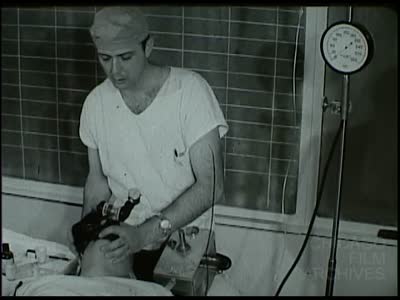
Fluothane for Oral Surgery

Transcript (Download)

This training film demonstrates a new anesthetic technique for oral surgery employing light fluothane.

Oral surgery imposes anesthetic problems of ventilation, which we've solved by intubating both nasal passages.

The resulting control of respiration provides a degree of safety lacking in the intravenous from arbitrate method.

This new Saturn monitoring valve will show the patient's respiration and act as a non -rebreathing valve during assisted and controlled respiration.

The portable fluothane draw over vaporizer at the right of the patient's head is a prototype unit called the FluAir.

Until intubation, the upper airway will be maintained patent by hyperextended position with upward traction on the mandible.

To begin induction, after pre -medication with 0 .3 milligrams of atropine, the FluAir vaporizer is set to deliver 1 % fluothane.

This concentration is well tolerated by the conscious patient.

The Saturn ball valve serves as a visual monitor of the patient's respiratory pattern.

The right respirometer is attached to the exhalation tube and measures tidal volume.

Each revolution of the small hand represents one liter of exhaled gas.

Vital signs will continuously inform the anesthetist of the depth of fluothane anesthesia.

The most important vital sign is blood pressure.

The initial blood pressure is 110 over 60 millimeters of mercury.

Assisting respiration at the patient's own rate delivers more oxygen and more fluothane to the patient's alveoli, thereby shortening induction time to three or four minutes.

With antipotent agent, the pulse must be followed continuously.

The temporal pulse is palpated and is 80 beats per minute.

Blood pressure usually falls about 15 % by the time satisfactory fluothane anesthesia is established.

A reduction in blood pressure of 10 millimeters shows the early effect of fluothane.

By now, the patient has lost consciousness.

As he starts each inspiration, the Saturn ball moves to the right.

This signal calls for the anesthetist to squeeze the bag and assist each breath with a maximal inflation.

The right meter shows assisted tidal volume to be about one liter.

Fluothane is being vaporized with room air.

Blood pressure has fallen to 90 over 60 millimeters of mercury.

The patient is ready for intubation.

Induction is complete after four minutes.

Nasopharyngeal airways will be used to provide a means of maintaining the airway despite an open mouth and pharyngeal pack.

These tubes eliminate two -thirds of the previous dead space of the mask.

Vigorous assisted inflations are used briefly.

This hyperventilation should produce an apnea during the interval before intubation.

The Robertasi tubes are lubricated and the patient is ready to go.

Inserted.

Connected to the Saturn valve.

These tubes should rest beyond the tongue base with their tips just short of the vocal cords.

Spontaneous tidal volumes are 350 cc's.

Assisted tidal volumes are 800 cc's.

The Robertasi all pharyngeal airways are tolerated during light fluothane anesthesia so the concentration of vapor is reduced.

The tubes and connector are secured.

At 7 tenths percent fluothane, the tidal volumes are at least 300 cc's.

With the lower dead space provided by the nasopharyngeal tubes, these spontaneous tidal volumes are just adequate.

Occasional inflations are conveniently managed to increase anesthetic depth and ventilation.

The rise in systolic pressure to 100 indicates a lighter level of anesthesia.

But fortunately, at this lighter plane, the jaw muscles remain as relaxed as necessary for easy access to the oral cavity.

To hold the mouth open, the bite block is inserted.

The gauze pack is placed deep in the oral pharynx without occluding the rubber airways.

After packing, the jaw may need to be repositioned to ensure that good respirations are maintained, as indicated on the Saturn monitor or right meter.

The method of airway management provides continuous, visible control of respiration, despite the fact that the open mouth allows for some air leakage.

Fluothane is still being vaporized with room air.

The adequacy of oxygenation will be determined by arterial blood analysis.

While the pharynx was being packed, the patient's ventilation was not assisted for several minutes.

Has the patient's oxygenation been adequate during this time? To answer this question, blood is drawn from the femoral artery in a preheparinized syringe and analyzed for oxygen saturation in the American Optical Oximeter.

This sample shows 90 % oxygen saturation, a safe but low normal value.

Had ventilation been further reduced, room air alone would not have been sufficient, and ventilation should have been assisted more frequently.

Another way to increase oxygenation is to vaporize fluothane with oxygen instead of air.

After a period of ventilation with fluothane and oxygen, the patient's oxygenation is measured again.

Another blood sample is drawn from the femoral artery.

The blood pressure remains stable.

Note the arterial pressure moving the plunger of the syringe, indicating that the needle is not in the adjacent femoral vein.

Arterial saturation is over 99 % after replacing air with oxygen in the vaporizer.

During 20 minutes of anesthesia, the patient's blood pressure stabilized at 100 over 60 millimeters of mercury.

Pulse remained around 80 per minute.

As fluothane is turned off, emergence is accelerated by hyperventilation.

During recovery, the blood pressure returns to the preoperative level.

The nasal pharyngeal tubes are still well tolerated.

The patient is breathing on his own now.

The pharyngeal pack, bite block, and tubes are removed.

By now, the patient's pharyngeal muscles have lost their flexibility and will not collapse to block the airway.

However, to ensure an open airway, the jaw is extended.

Oxygen by mask is available but is not necessary.

One can feel his exhalation.

Breathing remains adequate.

His eyes now diverge, indicating lighter anesthesia, and he should awaken shortly.

Within the next minute, the patient responds and now has the return of his protective reflexes.

This technique is safe and efficient.

Spontaneous ventilation is watched continually and assisted as needed.

The anesthetic gear does not encumber the surgeon's field.

With fluothane, the anesthetist maintains continuous control of the anesthetic level.

Anesthesia need not be deep since no tracheal tube is used.

Recovery time is rapid.

Within a few minutes, the patient awakens without the confused sensorium seen after barbiturates.

He is lucid, knows time and place, and can walk without help.

Nausea or other complications have not been noted.

Assisted fluothane anesthesia using compact, simple equipment and bilateral nasal pharyngeal tubes offers better, safer, and more physiologic anesthesia for oral surgery than the intravenous barbiturate and excludes the possibility of hypoxic brain damage.

Do you know more about this item?
If you have more information about this item please contact us at info@chicagofilmarchives.com.