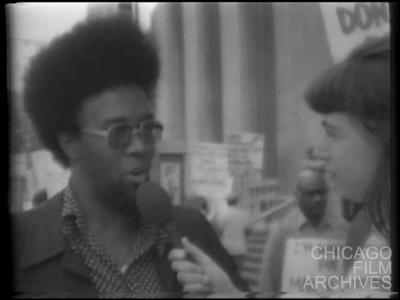
Post Office Demonstration 7/12/78
Is it all of them? Are you for real? No contract? No work? No work.
Okay, I wanted to ask you next, do you think that we'll have a contract by July 20th? Do I think so? I have no way of knowing.
I'm hoping that we have one midnight July 20th.
And if we don't, what happens? Well, I'll wait for a direction from the national office on whether or not we strike.
And if they say strike, it'll take me about five seconds to get it going.
And you think the membership will go along with that? I don't know.
Okay, is there anything else that you'd like to tell us? Well, what you say, the only thing I would say is the people that's not supposed to have been involved should butt out.
On the Reform Labor Act, it gave us an assurance that Congress, the administration, don't mail in our negotiation.
When the President come out and talk about 5 .5 wedge ceiling, he have interfered.
What he intended for the Postal Service or not, that's the way it came out.
And it's an influence to people, the public, and the negotiator.
They're trying to wait to see what else he say.
Are you for real? Are you for real? Are you for real? Are you for real? No contract? No work.
Are you for real? Are you for real? Are you for real? Are you for real? Okay, do you think that there'll be a contract by July 20th? We hope for that we reach some type of agreement before July 20th.
Post employees are dedicated workers.
They want to continue to do and be such.
As has been said before, we feel by the White House, or whoever that may be, is interfering in the negotiation, this which has caused a slowdown.
Now our people have requested with the postal service to negotiate around the clock.
But since May 20th, the postal service has been only willing to meet one or three days per week.
So it's not the postal workers.
It's the postal managers being influenced by the White House, which is causing a breakdown in negotiation.
Do you think they're intentionally keeping the negotiation slowed down so that there won't be a contract? We do feel that intentionally this is what is happening.
By what has happened over the last three years, 70 ,000 jobs have been eliminated.
And by their own admission, they plan on eliminating 100 ,000 jobs over the next five years.
We feel that there's some type of pressure point being levered toward postal employees, hoping that we will do something foolish.
But there's a real hope since the federal mediator has interceded into the talks.
There was hotlines prior to that, but since that time, all hotlines have been cut off.
So at this point in time, we are optimistic.
That there will be a contract by July 20th? We are.
Do you think it will be a good contract? Well, if you look at the proposals that we have put on the table, it's only something that's rightfully due us.
We have a grievance procedure that only management can interpret.
We're asking for some clarification on the grievance procedure.
We're asking them to get out some of that ambiguous language, such as me.
And normally, we want some strong language, must and shall.
We're further asking that contractors that in reference to the grievance procedure that management also be penalized if they do not process their grievances timely.
Only the union at this particular time is penalized.
That seems to be a one -size -affair.
Now, it's unrealistic for labor unions to give up any gains.
And they are asking us to give up one of our most precious things, the no layoff clause.
I think that postal employers are second -class citizens anyway because of the laws that prohibit them from many things.
Free participation in the political process.
Free to withhold our labor if management fails to negotiate in good faith.
With all those shackles over us, now what they want to do is take our jobs.
What they've done in the past is you all wear the BMCs.
They have 21 of those around the country.
We want to bring that mail back into the inner city.
And our message to our great leader, the honorable Jimmy Carter, is to take care of the White House, let the postal unions and the postal managers take care of the postal service.
We're not going to give it up.
What are we doing here? Why are we here? This is an informational picket to make it known to Chicago residents and the nation that we're against unjust managerial practices, especially those of refusing to recognize the present contract and doing everything in their power to try and weaken or eliminate the contract that's being negotiated now.
Nations all over the world, I mean locals all over the nation, are seeking to get a just contract that will do the best for the American people.
We are willing to work as postal workers, and we're not negative in our thinking.
We want to do that which is best for all concerned.
But it seems that management officials don't want to recognize the rights of their employees, and they want to ignore things that they have set down at the bargaining table and agreed to.
Mainly, we want to be recognized as human beings and as efficient and productive postal workers.
And that's all we're requesting, is that management will be real in their dealings with us and that they'll be just in their negotiations at the table and after the negotiations have been put in paper.
You think we'll have a contract by July 20th? I'm in hopes that we will.
I feel fairly confident that we'll have one.
You think it'll be any good? Well, that remains to be seen.
That's one of the main reasons why we're here today.
What are you looking for in the contract? The main thing I'm concerned about is that the no layoff clause remain in the contract and that the cost of living remain in.
There are about three or four, but that's the two main ones that I'm concerned about.
Okay, anything else you want to tell us? Thanks for giving me the chance to speak.
I represent South Suburban Postal Facility.
I'm the president of the maintenance camp.
And we think that President Carter ought to be reconsidered and give the postal workers what they're asking for.
We feel that we serve the cities, states in the rain, sleet and snow.
It's always been the postal's policy to get the good mail to go.
And we're saying that to President Carter with our earnest and sincere desire that we deserve a better contract than we have.
And we also that we must not have the layoff clause removed.
And we must not have the supervisors doing the postal worker's job.
We feel that this will infringe upon the rights of those that are looking for jobs and seeking for jobs.
And we feel that the layoff will take bread and butter out of our jobs and will cause the crime rate to steady increase.
It will cause all types of hostilities in the families, not necessarily in the families, but breaking up homes and causing people not able to pay their rent.
Therefore, we feel that when a person is out of a job, they're out of a home.
When a person is out of a job, they're out of a car.
When a person is out of a job, they're out of their skill.
When a person is out of their job, they're out of everything that they desire because money is what makes this city go around.
And we feel, whoever I am talking to at this time, if it's any way possible that you got any influence in the White House anywhere, we feel that you should let it be known by your feelings as to whether you think the postal workers are not required that the postal workers are doing a fine job.
We go win in rains, we go win in snow, we go win in hell outside and fights all over, Nazis marching, and the miners out on strike and everything.
President Carter, you ought to be really considerate.
You ought to be ashamed of yourself.
You're not taking a decrease in your salary.
You're not taking a decrease in your output.
You're not taking a decrease in the cost of living.
Washington, we are postal workers.
And we wish that you would understand that we are human.
But what about the postal workers that get all this information to you, Mr.
Carter? Get this mail to you, Mr.
We have a deal of optimism for Boston.
We are optimistic because we know that the oppressive conditions we perceive directly correspond to an immense revolutionary potential among the masses of people in our area.
Through our own individual experiences in different parts of the city, we have encountered many, many individuals and groups of people who are still struggling, who have the will and commitment to do what is necessary to end this oppression.
As we begin to organize, to pose at every level the correct revolutionary alternative, we are confident that our ranks will swell and that we will build a strong organization capable of development to the highest levels.
For a very specific report, sort of a case in point, we want to examine the United Community Construction Workers.
This section was written by one of the brothers who came down from Boston who just started working in United Community Construction Workers at the beginning of the summer.
UCCW, a workers' organization or worker -orientated poverty program.
In raising this question, two images, which are all too familiar, come to mind.
Worker organization, for example, brings to mind the image of a group of workers raging struggle for jobs, better living and working conditions, united in a common effort for common good.
Whereas a worker -orientated poverty program immediately brings to mind a community institution functioning as a service rather than a grassroots power base.
In the beginning, the UCCW was of course a group of black workers united in the struggle for jobs and the right to work.
The need for jobs has not changed and the basic demand of right to work has not changed either.
What has changed is the nature of the struggle.
Where once a group of hungry, desperate brothers went out and formed picket lines as a part of a daily routine in the fight for jobs, they now have job developers who develop a report with contractors to secure jobs for the membership, membership being a key word in this question.
For one is not a voting, car -carrying, policy -making member in the rank and file of the UCCW.
One is merely a member of an organization which offers one a limited form of job security.
As a third world trade union, the UCCW is a sorry sight.
The rank and file are called upon to make a commitment to struggle over issues that seem unrelated to themselves.
In other words, there is no trade union consciousness among the rank and file, no class consciousness or group consciousness.
Simply pay dues, come to one membership meeting once a month, attend classes at night, and sometimes you may get to vote in a new board member, a board which has none of the rank and file sitting on it.
This is not to say that the leadership is not recognized and contradictions do exist.
There is an effort to make the organization more of a rank and file movement.
This effort is briefly described.
Number one, the establishment of a workers or membership committee, which is hoped by some to be the beginnings of a rank and file policy -making body.
Twelve members of the rank and file will sit on this committee.
They will set membership priorities and be a rank and file disciplinary group.
Number two, the establishment of what is in essence a political study group in the form of a course on the history of the third world worker struggle.
From talking to the brother who will be running this, this is very similar to the school the brother is talking about in California.
We will try to make this an instrument in the raising of worker and trade union consciousness.
These actions are only as good as the people behind them.
And I regret to say that tendencies toward a petty bourgeois poverty -pimp attitude on the part of the staff of UCCW, which is in every way its leadership, can only be seen as counterproductive reactionary elements.
What are some of these contradictions? Number one, the attitude that the UCCW's purpose is to service rather than lead the community, the workers in struggle.
Number two, the lack of principle discipline, criticism, and self -criticism.
Number three, the dogmatic attitude on the part of the leadership, the arrogant assumption that they know what is best for the rank and file without having ways to ideological struggle and self -cultivation.
Number four, opportunism on the part of all concern from the rank and file to the leadership.
How do we deal with these contradictions? The answer is clear and simple.
Ways to ideological struggle on the principle that working class movements must be led by the working class leadership.
And it is our dutiful obligation to develop such a leadership.
The leadership, though having the aforementioned tendencies towards dogmatism, being undisciplined, failing to fully grasp the principle question of power to the workers and being opportunistic, has voiced their support of any move that would make it more a rank and file organization, more responsive to the people's needs and to work toward the establishment of a worker power base.
This is in itself a contradiction for a course, an individual or group of individuals may express the desire, but it still must come out in their practice to make it true.
For as Marx put it, practice is a criteria to all truth.
So far, their practice has proven how easily they fluctuate from intense effort to little or no effort at all, clearly showing a complete lack of discipline.
We have but one course to follow to wage ideological struggle, denounce these tendencies for what they are for the sake of ideological cultivation.
These struggles must be waged whenever the contradictions come up.
This form of struggle is the greatest educator of all power to the workers.
The preceding analysis of a specific Boston community organization, the United Community Construction Workers, examines points of contradiction common to nearly all of Boston's recognized groups.
Struggles presently being waged in Boston's third world community are limited by the lack of internal struggle, lack of discipline in study and by antagonisms fostered by nationalism and reinforced by opportunism.
But a complete analysis must offer some form of solution, and we believe that correct political practice on the part of the revolutionary cadre can catalyze new developments in the movement in our area.
A class analysis that explains the developing crisis can also provide the ideology and mode of practice that will avoid a catastrophe.
For students, the frustrations they experience in struggling to define a role for themselves in ruling class institutions can be relieved through political education and the channeling of skills and manpower into viable programs.
In the community, the correct political example must be set at every level.
Our job must be to inject in present struggles a fresh ideology and outlook that will explain new developments in terms of the political processes in which they occur.
If our theories are part and parcel to consistent practice, then we will have the means with which to build a strong base in Boston, a revolutionary force that will heighten existing contradictions and advance the struggle to higher and higher levels.
This is our prepared statement for a few additional comments.
We want to point out that recently in Boston, several struggles have been raised, and we hope that in the future we will have positive results.
In the prisons, for example, specifically in Walcoll and Norfolk, there have been prisoner strikes.
There were strikes held this summer last year, and there is a high degree of political conscience being developed among the prisoners there.
Several organizations sponsor prison programs where they provide transportation to prisons.
Several groups are sponsoring prison education classes and are trying to develop mechanisms with which to work with the brothers who are in the joint.
Another form of struggle in Boston has been ways concerning the MBTA, which is the Massachusetts Bay Transit Authority.
Some of the things they're trying to do is bring down a policy of multiple fares.
They have a threat of increases without improvement of services.
Also, at the beginning of the summer on July 16th, there were some riots in Boston.
The Puerto Rican community in the South End responded to police brutality at Blackstone Park, and riots were waged for over four days.
This information, I'm sure, did not get out throughout the country.
A lot of things have been happening in Boston.
The problem with housing, one whole area of Boston, the South End, is in the process of being redeveloped.
They're trying to move all the Third World people out into Dorchester and Mattapan, redo the apartments, raise the rents, and move in a professional class of people.
The response to this has been somewhat disorganized.
We will address ourselves to these questions though.
In the area in which I live, which is the Columbia Point Housing Project, several things happened this summer of importance.
One of these was the fact that one of the mothers, Mrs.
Cowling, has two daughters who were attacked by NBC police.
In response to this, the community was informed of this.
She took individual action, and we took the advantage of the opportunity to try to get the Black and Puerto Rican people in Columbia Point to respond to some very inhumane conditions, which they have been subject to by a shopping mall located right next to the shopping center.
We tried to initiate several programs of community patrol, etc.
These had some effect, although they had to be stopped because of lack of support, which sort of paved the way to get a lot done.
Also, one important thing is last spring, on Harvard's campus, we waged a struggle concerning Harvard University's ownership of Stock and Gulf Oil Corporation.
Gulf Oil is very active in southern Africa.
It extracts several billion gallons of oil every year.
We took over Massachusetts Hall, which is the main administrative building of Harvard University.
This was the first time that Black students in colleges in New England had exerted leadership over white students and introduced the concept of class consciousness to the student population.
We plan to follow all of this up with increased activity.
As we said earlier, we are open for suggestions and we want to set up some sort of apparatus so we can share more information with the people at this convention.
One of the things that we have noticed, this is my own personal analysis, but we always try to put our peculiar set of conditions into perspective.
One of the major problems in Boston has been dope, and we've seen this develop from the point where in the early parts of the century, the principal problem was liquor.
This directly corresponds to the fact that this was a domestic industry.
As capitalism developed to the stage of imperialism, they brought in coke, heroin, and reefer, etc.
Now, specifically in the Columbia Point Housing Project, they're trying to introduce a methadone program.
There are several people who are organizing against this sort of thing because we believe that this is a form of genocide.
They've been offering federal funding and they're trying to move around the grassroots people there who are organizing to bring in methadone into this community.
There are all different aspects of the struggle in Boston.
We're trying to pull this together.
I'm on the organizing committee in California as a member.
Just to give you an idea of what the unemployment workers organizing committee is, it's called UOC and how it started.
There were three Bay Area workers' newspapers in the East Bay that conducted an investigation of if there was an unemployment crisis and to see what could be done about it.
This investigation was carried out by going to unemployment offices and talking to workers, seeing if there were jobs they were looking for, and getting comments like, I know there ain't no jobs.
I've been going to 50 different places, putting applications in, telling me to come back tomorrow or I'll call you.
Constantly getting this and plus studying the situation nationwide, finding out like Gary, Indiana, the high unemployment rate, especially in the black communities, like the brother before said about Baltimore unemployment, and it's happening in all the major areas of major cities.
So the question came up of now that we carried out an investigation, what are we going to do about it? And there was some doubts among some people who had done the investigation, but still in their minds was there a crisis? They still didn't believe that there was a crisis, yet unemployment lines at the offices were growing every day and every week.
What we did in about February 1971 is we came out with a petition demanding that an extension of unemployment insurance be carried out for people who had been cut off unemployment insurance.
Now what it was is people had 26 weeks of unemployment insurance and then one 13 week extension.
After that you were told, well, you can see if you qualify for welfare or split.
So on our petition what we did is we demanded the unemployment extension of 13 weeks, but also seeing the necessity of saying exactly, putting the blame on exactly who was the cause of this unemployment situation.
It wasn't an act coming out of heaven, it was an act coming from corporations, with in league with the state.
Now this petition went around for four months.
It went to each unemployment office in San Francisco, Oakland, Richmond, Pittsburgh.
The majority of the people in the beginning were mostly ex -students who saw the necessity to go to working people and tried to do some type of organizing.
And mainly these people were mostly white, which was very difficult for them to relate to because the majority of unemployment right now is affecting black people, Chicano, Puerto Ricans.
Now, since then things have changed, but during a 13 week extension of unemployment insurance, people learned a lot of things.
One was that by going to these unemployment offices and talking to unemployed workers, they started seeing there was no doubts in the workers' minds as far as there was no jobs, that there definitely was an unemployment problem.
And pointing out to them that it was the corporations who were telling them to get lost after they had created so much wealth for this country, they started raising the level of their thinking, of the people in UOX, their thinking.
During the 13 week extension struggle that we had over a period of four months, we went to unions, a couple of unions, unions specifically, laborers, and took the petition and also a paper where UOX articles were in.
And more or less just try to get a feeling of how the membership there, what they were doing about it, what was the union leadership doing about it as far as fighting for work for the men.
And just going there just to develop some type of ties with them.
Now we knew that a petition alone ain't going to do nothing.
We knew that from the beginning.
But we had to get some way of getting a feel of what workers needed.
Now they definitely needed a 13 week extension.
And how they were going to do it.
We had two massive demonstrations in two unemployment offices.
In the second demonstration, we had some of the brothers from the labor's local came down there, Longshoreman Hall.
We sent a delegation in to the office telling people inside the office that while we were there, we told them about that second unemployment extension has to be given to us.
We went in there and we demanded to see the manager.
The manager, after finished stuttering for a few minutes, finally said, well the state doesn't have the funds or the statistics that they're down below the certain point level, whatever he had to say.
doesn't believe in as far as what the government says as far as statistics, period, as far as the unemployment situation they talk about or anything else.
They say 5 million people unemployed, we don't believe that.
6 .2 we don't give a damn about what they say about how many unemployed as far as that can, all we want is that unemployment extension for people.
Well, a week later after that demonstration in front of that office, the extension came through.
And the media said, well Reagan had the heart to give it to us because he felt people were suffering.
Nixon said he didn't want people on welfare rolls.
It was those people, those workers coming out there and showing that they weren't going to take no.
Well, after the 13 week extension had been won, you had to decide, you know, there is an unemployment crisis in this country.
What are we going to do in California? Well, we went back to the unemployment office and we asked people, you know, what do we have to do to...
So, we went back to the unemployment office and we asked people, you know, what do we have to do to get the unemployment extension to the people? So, we went back to the unemployment office and we asked people, you know, what do we have to do to get the unemployment extension to the people? Thank you.