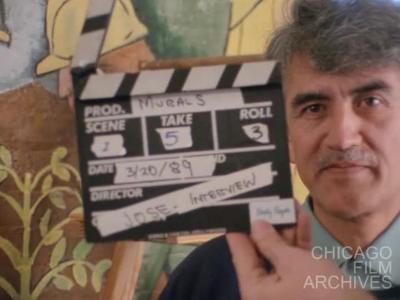
I'm going to get close to when they start coming last.
Scene one, take four, roll three.
How do the murals affect the feelings and opinions of people in the community? For one thing, a lot more anti -drug, you know, or anti -gang, whatever.
So a lot of times, especially the young people, especially the ones that help, would say, well, this is a good way of doing things and a good way of thinking, you know, instead of using crack or heroin or whatever, the mural sort of invites them to think in a different sense, you know.
That drugs are negative or that gangs are negative or whatever the issue is.
If you could paint a mural anywhere you wanted on any subject, what would you paint and wear? What would I paint? Well, I've been doing stuff in schools and churches, and there's a church on North Avenue that the guy wanted to paint, and I would like to paint the altar.
And it would deal with, you know, people in the community and what they do as compared to other people around the world.
Which a lot of times, there's a lot of things in common with people here in Chicago or El Salvador or Guatemala or whatever, you know, Ireland or the Middle East.
It's a nice idea.
Are the murals changing? Since you've been involved, do you see different techniques, different things? Well, the techniques are advancing, you know, because before they used to do it like collage, they just put up the pictures.
Without taking into consideration the geometrics or taking into consideration the spectator, how he would look at it, they would just place a picture like a large painting.
But now the people are advancing to a more advanced way of doing it so the spectator can see it from different angles and still appreciate it.
Who are the muralists? Is there a certain kind of person who's a muralist or do you come from all different backgrounds? Well, they're from all different backgrounds because, like the guy I was working with at one time, the one that I was working as an apprentice with, he teaches at Amherst.
He's an artist known around the world.
His name is John Weber.
So it's from different walks of life that people paint, you know, paint murals.
But basically they all have political ideas, you know.
Murals are, especially murals are political.
They're not just mere decorations.
How did you get into painting murals? Well, because in the 60s.
I could just wait a moment.
Okay, now we can.
When I met John, we were doing like cartooning.
So he was doing murals and he asked me if I wanted to help him, you know, to learn the technique that he knew in doing large areas as opposed to small canvases.
And I started working with him.
Then I picked it up on my own.
What do you think is the most important thing a mural can do? Well, like in this case, in the case of this mural, it can make people think that they can do bigger things than just paint the whole flat, you know.
Like you saw Bernie do on the lines.
This is a way of introducing a new form.
And it makes people think of different colors and that there's other ways of doing things besides the same way they've been doing before.
Why is it, do you think, that murals are such a strong part of Hispanic culture and tradition? Well, it's not really, in my opinion, not confined just to the Hispanic.
Though the people who brought it to the highest form were Mexican artists, you know, like Diego Rivera and Orozco and Siqueiros.
So they identify mural art with them.
But actually, mural art is, at this point, it's gone beyond that, being just Hispanic.
It's not Hispanic only.
You see it at the border trade building downtown.
You see it at the expressway over there on, what's the name of it? Expressway? The Kennedy.
And different places you see it in.
So it's not just, well, this one right here, you know.
But it does seem like you see more in the Hispanic neighborhoods.
Do you have a feeling about why that is? Because when they started doing them in the 60s, that's where they were confined to, you know.
And people would identify that it was art in neighborhoods such as, you know, poor neighborhoods or slum neighborhoods.
That was identified with that then.
Especially coming from L .A., a lot of the people in L .A.
were doing it in their communities, the barrios, as they call them.
And so, of course, they identified with the Hispanic community.
But now I don't think that can be said, you know.
Because it goes beyond being just Hispanic.
You see people doing murals downtown at, the fancy store, what do you call it? Bloomsdale, whatever, you know.
Doing mosaics and different forms of art.
It's mural, still mural, but it's being taken downtown instead of being confined to the neighborhoods.
How do you feel about the...
I just have one more question.
One more question.
Okay, let me get my coat.
That's okay, you can wait in here.
Scene one, take five.
Okay.
How do you feel about the transient quality of your work, the fact that it's outside and it can be affected by the environment or a building can be torn down? Well, a lot of the murals are being done outside.
Now we're doing them in a different way.
We use better paints.
We prepare the wall better.
We tuck point it.
We have to be tuck point it.
We tuck point it.
Let's try this one more time.
Let's see.
Scene one, take six.
Okay, it's really the same question.
What I'm trying to get at is...
About one step to your right, please.
What I'm trying to get at is the fact that they're not protected in a museum.
You put all this time in and they're outside.
If you could address that, how you feel about that.
They're not as protected? They're not as protected.
They're out in the environment.
Well, those are the chances we take.
We do what we can to prepare the wall and then after the acrylic is put on, the acrylic's got a life expectancy of about 10 years without even being nothing done to it.
So when we do treat the walls with the polymer gloss or a protective, some people call it varnish, it's good for at least 20 years before it starts fading.
And then there's money that artists can get to repair the wall and redo the...
Go ahead, get some ground.
Oh, okay, go ahead.
And redo the parts that'll fade it out or whatever, but it's got a life expectancy without any treatment at all for 10 years.
Then with the treatment it gets, it's good for 20 years.
But how long can it last? What's the longest a mural can last? Well, as long as it's been taken care of, you know, attended to, like if it fades out in 10 years, you go out there and redo it again.
And it can last for a long time.
Of course, if it's done in mosaic, then that's a different thing, you know, it'll last as long as nobody knocks it down.
Okay.
Okay.
Very good, thank you.