And you confront them.
And then I'll give you a second.
Okay, what do you want, right in front of her face? Yeah.
Just so you don't take her nose off.
You can't mar or stop.
Okay.
Okay, go ahead.
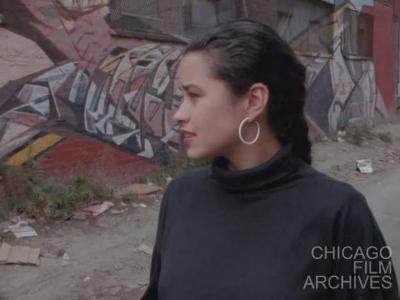
Sandra describes Mural October 26, 89, take one.
Sandra, could you tell me a little bit about how this mural inspired your own one? I would have to say mostly because of the style of it.
I say the strokes.
The strokes are very, I don't know what the word is, they're just hard.
They're harsh, harsh strokes with a lot of color, and that's exactly what influences me a lot.
Also, the fact that they're against drugs or the fact of what they're trying to say.
And it's really important what they're trying to say.
That's what a mural, that's what my work is like, you could say.
That's what my murals are like.
That's what my artwork is like.
I try to say something with my work, and this mural here says a lot.
I think that's very important.
Cut for a moment.
Okay, cut for a moment.
I couldn't find the word.
What was that? Are you rolling? You rolling? Sandra describes Mural October 26, 89, take two.
Sandra, can you tell me about this mural and how it inspires you? Well, this mural inspires me because, for one, it's by Hector Duarte, and I really admire Hector Duarte's work.
And most of his work has to do with the message that he has behind it.
The message behind this mural has to do with drugs, and I find that very intense.
The fact that my murals and my paintings have to do with this kind of message, and the fact that my murals are mostly about I'm trying to direct it to teenagers, I think this mural is really the one that inspires me the most, more than any mural that I've seen.
Cut, good.
Is that fine? Is that true? Sandra describes Mural October 26, 89, take three.
This mural really inspires me because of the fact that there was, it has a message having to do with drugs, and my work is very similar to that.
The needle, it has a needle, and you can see the body just laying down as if it were, as if he were dying or something, and I think that that has a lot to do with my work.
I would say when I first saw it, it had a great impact on me, and right away I said to myself, well, I think I'm going to try to portray some type of message to the teenagers of my age, and it just had to be the mural that inspired me the most that I've ever seen.
All right.
That'll do.
Stay right there.
Very nice.
That was very good.
Practice makes perfect, huh? Practice makes perfect.
Yeah.
I think a couple more times I would have had it.
You going? Okay.
Sandra describes Mural October 26, 89, take four.
Wait, wait, wait.
Let me get ready.
You ready? Turn back around.
Okay.
Okay, go ahead.
This mural really inspires me because of the message that it portrays.
I'd have to say that when I first saw this mural, it had a great impact on me.
The fact that it had the needles and the fact that there was a body laying down as if it were dead, and it's really important because most of my friends, the atmosphere that I was brought up in, it had a lot of death.
It had a lot of drugs.
I'd say when I first saw this mural, I said my work was going to be like this.
I had to portray some type of message.
I had to help or I had to say something to the teenagers that were my friends.
So I say that this had to be the favorite mural that I had, and this really inspired me a lot.
Sandra describes Mural October 26, 89, take five.
This mural really inspires me because of the message that it has across, having to do with the needle, having to do with death.
And I say that it has a lot to do with the type of work that I have now because my work really has to do with the message trying to put across to the teenagers.
Is that quick enough? I didn't say enough.
That was a great length.
If you could do...
I can do that, but stick more in there.
Don't worry about trying to talk real fast.
Yeah, just...
You didn't like it? I didn't like it either.
Okay, well talk a little slower, give a feeling.
Keep it short, but I know it's a lot to ask.
Yeah, go ahead and roll.
Oh, it's okay.
Sandra describes Mural October 26, 89, take six.
This mural really inspires me because of the message that it has and the message having to do with the drugs, which is really powerful because most of my work that I would do had to do with drugs or having to do with trying to tell the teenagers not to do this, not to do that.
And it's really important to me.
We're just going to keep going soon.
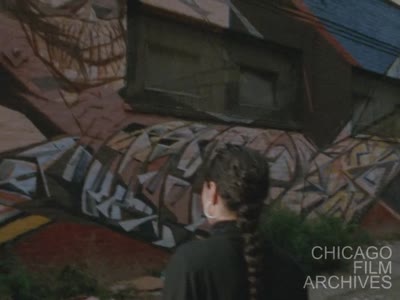
Okay, can you tell us a little bit about the mural, what you see in it? Well, first of all, I see...
I see a man who has taken drugs or a person who has taken drugs, and that's what the needle's about, and he's laying down as if he's dying.
But if you look at the far side by the feet, it looks realistic, and it's a man.
Suddenly he starts deteriorating and his stomach starts deteriorating.
You can see the insides, and towards the top part you can see the rib, the rib cage of the skeleton.
As you look at the face, it's trying to turn into a skeleton, although the artist never finished it.
It starts to turn into a skull, so you can see how he's lying down and he starts to die, and you can see that part, which is really important.
Are there things about it that inspired your technique? I'd have to say just the whole, the way he did it completely, the entire technique.
The colors, just the strokes are really hard and vicious, and it's just, when I look at it, I get this strong feeling inside of me.
It just gives me a feeling, and I just feel like if I want to paint like this, and most of my work started turning out to be this type of stroke and this type of color all the time.
Can you point out some details that you think are interesting on the mural? Yeah, I would say the face especially.
I like that part a lot.
And I would say, too, the way, if you look at the mural from a certain angle, it looks like he's lying down, but when you go to the other side of the mural, it looks as if his feet were really huge, and then you could see him and he just goes off in the distance, which is really nice.
And I also like the inside of the stomach, the rib cage.
It's wonderful.
The way he plays with the colors, the way he plays with imagery is great.
He takes advantage of the length of the wall.
He just takes advantage of it and shows us what he can do with it and also puts a message across to us.
How did you ever find this mural in the first place? I was wandering around, actually.
I was just walking around and I was looking at murals that day.
I had spoken to the artist who did this, and he told me that he had a mural around here.
So I walked around and I didn't know this was his.
I saw this, it inspired me, it was incredible.
And suddenly when I spoke to him, I told him about this mural, and it ended up being his, because I didn't know exactly where it was at.
I just stumbled across it one day.
How do you think it would affect young people going by when they see this? What is it that they would do for it? Well, normally when you look at a mural, you don't think that that's what it's for.
You don't think that it's to show a person what you feel, your inner self, or to make a statement or something like that.
But if a person walks by here, they immediately see him lying down.
They see the needle and they see the connection between it, the needle, the skull, and the connections.
It's just there.
So when I walked by, I'd say my friends would walk by and they'd say something about it too.
How do you think it expresses the feelings of someone who maybe is taken for us? The energy inside of it.
It looks as if he's suffering, as if something was going on inside his body he couldn't control.
Everything was out of control.
It's basically what you see.
And even the background, you can't look at it all.
You have to look at the background too.
And the background is pretty strong.
It just has lines, shapes going everywhere and it's pretty strong.
Why do you think a muralist would choose to paint it? I wanted to actually say something.
I thought maybe you were fishing for questions a little bit.
Oh, okay.
Because you don't have to.
Okay, you think that's enough? Well, yeah, because I can just shoot.
I need to shoot the mural.
I remember when I spoke to him, he said something about the garbage being around.
He said something about there was a lot of garbage and then having to do with the figure was there and then there was garbage everywhere.
But I don't know if, I don't think he chose this place.
I think it just turned out to be good.
Well, then we won't bother asking that.
Okay, I just want you to, we're just getting ambience.
So you're the microphone.
Are you rolling? Okay, this is ambience for Sandra for interview on 102689 in front of Drug Mural.
Ambience starts now.
Okay.
End of ambience.
Do you know we need some ambience without the saw? Yeah, I think we can get it.
Okay, that was ambience with saw.
So this is now ambience without saw, starting now.
End of ambience.