We're rolling there.
Scene one, take one, roll four.
Let's get back.
If you could just briefly explain what you're doing here.
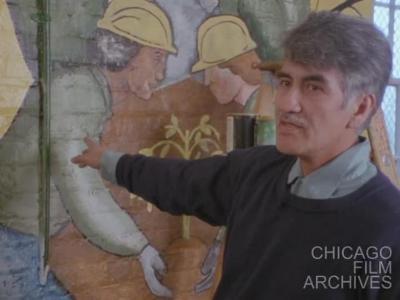
Well, like I said, this is a field house, okay.
Like I said before, being inside the field house, I think I'm doing something different.
I don't know anything different.
It's the same thing we've always been doing.
These were the plumbers, landscaping, painters, and the carpenters.
What sort of work do you do? I mean landscaping, landscaping maintenance.
And the other guy helping me is a painter.
Right.
Can we stop for a moment? I'm good.
I just changed into take two.
Okay.
Do you have speed? I think I do.
Scene one, take two.
You paint murals all around the city.
Who do you usually think of as who your murals are for? Who do you paint for? Well, most of the murals are community.
So most of the murals are for the community or whoever's around that certain community.
It's in the case of the one here.
Since it's in the park, of course the people that are in the park, working inside the park are the ones that will view it, you know.
And of course the ones that also participated in helping paint it.
You've said that your murals are more often for young people, that you're influencing young people.
Can you tell us about that? Well, if it's, if the ones we do in the schools or in some of the neighborhoods, they are for the influencing the younger people, yeah.
Except for all the other ones that still got a lot of time ahead of them, see.
And at the same time the muralist, as opposed to an art teacher, he would be considered with sort of outside looking in and to look for validation for his art, he looks to the art world.
And in our case, we don't do that.
We look toward the community.
If they like it, it's all right with us, see.
Me and my fellow murals too.
What sort of messages are you interested in conveying to young people? Well, a lot of the messages include the ones we've done before, you know, anti -drug, anti -gang, you know.
And like I said, most of them all have to do with the neighborhood and to a large extent are political.
As this one here, you know, recently it might be political because it's got the Plumbers Union behind them and it's got the Landscapers Union, Painters Unions.
So it has to be political one way or the other.
You said that all murals are political.
Can you, or all art is political.
Can you maybe restate that for us and explain it? Well, for the simple reason that art is always connected.
Oh, we need you to say all art is political and then explain it so that the audience knows what we're talking about.
All art is political for the reason being that anything that's painted has got something to do with the state or the city or the local offices in the neighborhood.
Like in the case of this one, it's inside the Park District territory and the Park District, of course, is political, you know.
Is that a long -term tradition, the political nature of mural art? It's always been like that, yeah.
For instance, in the 30s, the murals would paint murals dealing with the depression, the strikes that people were going through, and now people still paint about, you know, political events that are happening around the world or community -wise.
How do you pick a theme for a specific community? How does that come about? Well, each community or area calls for a certain thing.
For instance, in this case, it called for workers that work in the park.
If I had been in a different area or a school, it would have called for something that had to do with history, teaching, students, teachers, parents.
This one deals with workers, you know, with landscaping workers.
Who all is involved in deciding the theme of the mural? Well, like in this case, when my friend Bernie brought it up, he suggested we do the plumbers, landscapers, and carpenters.
So he suggested the idea.
It was okay with me, so we went ahead and did it, you know.
It's not that the artist usually pops up his own idea, you know.
Usually somebody has suggestions, and the artist takes it from there and refines it.
What about if it's a community group? How would that work? In the case of a community group, like this summer, we're going to do a mural with teenagers that do graffiti.
So of course, I'm going to meet with them, and we're going to decide what it is that they want to put up there, see.
Because graffiti is something that they're using now to an extent that they're using doing fine art with it now.
It's not like they spray it on the wall now.
They got a way of making it look like fine art.
So we're going to get together with them, and I'm going to discuss the theme, and then we'll decide what it is they're going to put, what it is I'm going to put.
But it will work together.
We're thinking of using silhouettes, you know, like standing somebody in front of a projector with a spray can, projecting the silhouette on the wall, photographing it, and then projecting it on the wall.
But that we'll decide when we get together with the kids.
What do you hope when you get kids working on it like that? What kind of effects? How do you hope it will affect them to be involved? Well, for one thing, like in L .A.
and New York where they're doing graffiti, the idea they have, or where they can do graffiti pretty advanced, you know, the ideas that they put across are very sexist or very negative.
But the idea of the muralist is if he's going to do something, you know, and he's already doing it right, might as well do something that fits into a more positive light.
Who pays for it? Like in the community? How does it happen? Well, like in my case, when I've been doing the murals in the communities, Chicago also Fine Arts, I work for them, and they usually commission me to do the murals, you know.
So you have to get a grant? Yeah, it's a grant that they give me every year.
Or if it's a private, the guy owns a business, and then he'll pay direct, you know.
So what are the themes that are most important to you if you can choose? What do you like to paint? Well, as opposed to like, for instance, canvas painting, it's a different thing.
You can do whatever you want doing canvases, see.
But if it goes out into the public, then it's got to be something that hits a certain issue or something that's happening in the community, you know.
Do you have certain messages that you feel very strongly about? Well, for instance, like the one we did last time called We Will Stop the Storm.
The message was, we will stop the storm, you know, like talking about the youth.
Most of that in 12 more years, we'll be into the 21st century, and it will be up to them to stop the storm, you know, because they were the most daring, you know, as opposed to people up in the 50s who are saddling.
They want to just be comfortable.
The kids are still daring and doing things, you know.
Is that why you do murals, or I guess I should say why do you paint murals? Why do you personally do it? Well, the reason for the murals is to put across my ideas in combination with their ideas and make a strong political statement, the stronger, the strongest possible, you know.
What about colors and design elements? How does that play into it when you're creating? Well, like in the case of this one, the time is limited.
We're trying to figure out how to use color and take up a lot of space.
It's supposed to be very technical about shading and stuff like that.
We take large areas and use a lot of color because we only have a couple of weeks to do it.
What do particular colors mean to you? Well, the colors are the lighter colors, for instance, make the room look wider.
Darker colors make it look smaller.
Dark lines like that one looks closer this way.
A lighter color looks farther away, you know.
That's the reason for using colors inside a building and with limited time.
Now, if you've got a lot of time, then you can blend in a lot of colors and take all the time you want.
What are the symbolic or psychological or human messages in the colors? Well, like in the colors, it's warm and dark colors, right? So we're using dark colors and light colors to project certain feelings.
But in the case of this one, we're using colors that are familiar here in the park, like yellow and green.
Those are the colors that are familiar here in this area here.
You began painting nails in San Antonio or became interested there? No, I started painting when I was here in 1964.
Were you influenced by things you saw in San Antonio? Not with the murals, no.
I was influenced mostly by the stuff that they were doing here when I got here, see? Like a lot of the artists were doing political work, so I was influenced by them, you know.
But you talked about the heroes of Alamo and that you felt they weren't representing...
Graphic.
Okay.
Yeah, I was going to kind of get into a political...
Scene one, take three.
Jose, you said once that your art was influenced or maybe some of your political feelings were influenced by things you saw in San Antonio, that Alamo and the fact that those heroes weren't really your heroes.
Can you tell us about that? Well, see, the heroes of the Alamo are not heroes at all to nobody, in my mind.
Most especially to the Mexican people because they were occupying the country, see? So those are the Alamo plus whatever else they got there were mostly like symbols of reaction, you know, to the Mexican people.
And to a lot of other people, but mostly to the Mexican people.
They don't see it as a monument to heroism, but to oppression, you know.
Has that influenced your art? What you think? Well, political art, that's only a small part of it.
The political art evolves from seeing whatever happens around the world, you know, or even here in the U .S.
Do people respect the murals out in the community in a special way? Most of the murals are painted like Spaulding in the north and Kastner on 26th Street.
People leave them alone.
They usually don't deface them or anything like that.
For instance, I wanted Spaulding.
It's got graffiti all around it except on the mural, you know.
So people usually leave them alone.
They respect them, yeah.
Why do you think that is? Well, because a lot of times the people participate in them, you know.
They identify as part of the community.
You had talked about not thinking of yourself as an artist or not wanting to be called an artist.
What did you mean? Well, mostly as a member of the working class, I'm a culture worker, you know.
Because artists can cover a lot of things, you know, like Andy Warhol or people like that, you know.
And they come from different classes, you know, so I would say to me I consider myself a cultural worker, you know, as opposed to artists.
How are you treated differently in the community because of your work? No, because I consider myself more a cultural worker than an artist.
I'm treated just like one of the people there, you see.
Or like here, you know, I'm just a worker here, you know.
I just work for everybody else, you see.
I just work for us, you know.
But you mentioned, you told us a story about being the mural man.
People call you the mural man.
Can you tell us a little bit about that? Well, that's at 26th Street because I've been going there every year, you know, so instead of saying I'm the artist or the guy who's painting the walls, he says they refer to me as the mural man, you know.
The man who works on the wall, you know.
Have you seen the results of your murals in terms of what you painted and what you shoot?