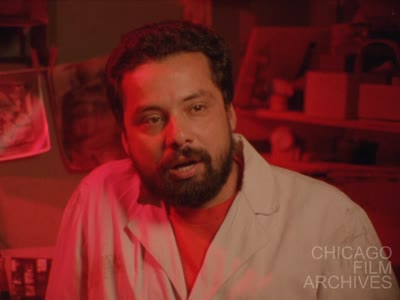
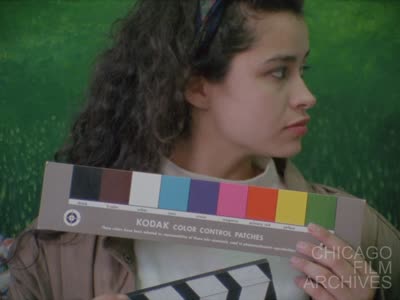
This is take one, roll one, 31289, this is the interview.
Okay well, one of the reasons, something that I saw the difference in colors when I came to Chicago from Puerto Rico is that probably because Puerto Rico is a tropical island, you see a lot of colors and flowers and everything, here I hardly see any colors, like the buildings, to me we don't see the colors, they are dark gray or brown, but it's not different colors and that's something that I noticed when I came to Chicago and compared to Puerto Rico.
Okay, be sure to look at Susan and not at the camera, you can look at other places.
Alright, let's do it again, that was real good, just the contest from the college, but this time...
Take two.
Okay, something that I noticed the difference in colors with the murals when I came to Chicago is that compared to Puerto Rico, I mean the bright color that we have there, compared to Chicago, every time I walk in the neighborhood, here in Chicago I see those colors again, and it reflects some of my, you know, the way I used to see it before in Puerto Rico, and that's one of the things that caught my attention, besides so many other things on the murals.
Okay, stop.
Scene two, take one.
Okay, ready.
Okay, go ahead.
Well, the murals, when I see it, I see that they represent us, I mean the Latino community, the Puerto Rican community, when I see the paintings, to me I see my own life in a way.
When we first came to Chicago, there was no newspaper, I mean there was, but not informative, I mean, well enough, so those murals are telling us continuously, remember the reasons why you come to this country, don't forget who you are, and they're controversial, I mean, they may not...
A lot of people agree and disagree, we all talk about, you know, about the work, but I like to see it, because we have to walk every day and see it, and it's part of the community, I respect the people who did the work, and I believe they did it to help the community, they may not, we may not agree with their point of view, political or any other reasons, but I agree that they are doing it for the well of the community.
Okay, very good.
Scene two, take two.
Okay, when you're ready, Ivan.
Okay, for us to be, to get used to live in a new city, with new people, people that are not, that we don't know each other in a way, I mean, this mural helped us create our community, there was no newspapers around, no other way of communication, we used to have, there was a few, like, radio stations, putting up music all day, because probably they didn't have the facility to, reporters or whatever, so they only put music continuously, and here come those murals, and in a way they were telling us continuously who we are, and the reason why we came here, and we may not, we may not see now, you know, when we see it now, probably it's not the same, like, 20, 25 years ago, because everything is changing, I mean, what I'm telling you now, probably not, what's happening right now, because we are growing up, this is a wider community right now, and we have different groups, from Latin Americans and other countries, but when I first came here, it was not, I mean, we were starting, everything was coming out, and those things helped us, in a way, see it every day, that's one of the reasons I started photographing the murals, because when I photograph one of those, and I put it on the wall, my house, someone that comes to my house, they say, I seen that work somewhere, isn't it on the corner of this street, so they seen it, but it's not until they sit in my house, that they recognize what, you know, now they pay more attention, they start asking me, why did I photograph that mural, and I used to tell them what I see, you know, on the mural, it could be political, religions, but they start asking questions, and I didn't know the artist who put, you know, that was my point of view, on the murals, to see it, and, you know, there are so many reasons why they're there, that probably a lot of people like the murals, I mean, in the community, because something that I notice continuously, is that there are no graffiti on it, there are a few, because there is no way to stop, but if you look down to the black, you see more graffiti all over the walls, and I don't know why, on the murals, the kids respect the murals, I mean, they're not 100 % protected, but I don't know, the murals are telling them, you're doing it to yourself, and you, you know, and that's what I see, on the murals.
Okay, can you tell us how you pick a mural to photograph? What, how did you decide? Again, if you could explain how you pick a mural.
Well, when I pick a mural to photograph, usually, I won't go out of my neighborhood to do it, I mean, I don't chase, I don't go looking for murals, it's, I don't know, probably because they're not over, not all over the city in Chicago, it's like they are in the ethnic group, ethnic communities, I don't know, probably if I go to an upper class neighborhood in Chicago, they're against that, because that will not look nice in their neighborhood, so I don't know if that's true or not, I'm not, you know, but I've been around Chicago, and I only see those murals in certain areas in Chicago, so when I look into it, I try to study what the artist wants to tell us about what's going on around, so then I study that, I may not see what the artist wants me to see, but I create my own, and I give credit to those guys who are doing it, and I start, you know, looking around, taking photographs, but in a way I believe they represent what's going on, you know, what's happened to us, everyday drugs, dropouts, no housing, someone is crying, someone is telling us, up and up, I mean, look around you, you have to do something, because we're here to stay, I mean, we're not going anywhere, we're part of this community, and we may not have the power on the media to let people know that we're here to stay, but that mural there are telling the people, you know, we're here to stay, let's fight, but not fight in a way that we're going to destroy things, that we have to educate ourselves, and we need more housing, we need better education, and we can look forward, we can look, but when I pick a mural, before I photograph, I look into it in different ways, I study the pictures, and I like the colors, I don't know why I have colors, I like the colors, probably because they're here in Chicago, and that's one of the reasons why.
Something else about the murals is that they're very informative about what's going on with the teenagers in our community, I mean, every morning when I go to the bus stop to wait for the bus, there's a group of people, I mean the students, they're going to school, but none of them drop a quarter there to buy the newspaper.
They're telling that we're in front of the mural, but that mural will tell them not to drop out from school, to stay out of drugs, there's so much information there, they may laugh at the guy because he's drunk, and he's on the floor, but the artist is telling them this could be you if you don't keep looking toward the future, and there are times that I look around and I say none of them bought the paper, I mean not even for the sports section, I mean it's like they don't care, probably I used to do the same thing, but right now that's the way I see it, that the murals are there, and every time when they have to walk to get the bus.