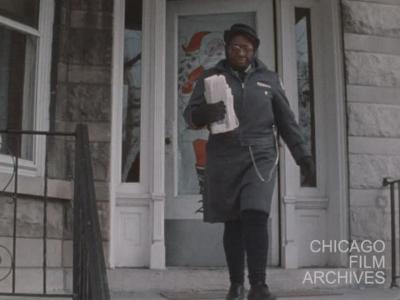
When I first decided to take the postal exam, I think my husband had in mind that I was going to be a clerk, you know, inside of the post office, you know.
I told him I was going to be a carrier.
He don't need the job because that's a job for a man, you know.
Women don't do that kind of job.
You know, I said, well, hey, the other women are doing it.
That's not a job for you, you know.
Now he says, hey, aren't you going to work today, you know.
But to begin with, it was like, I don't want you on the street.
It's as if, you know, maybe some of the men feel, well, my wife can't take care of themselves, you know, or something like that, you know, out in the public, you know.
In the areas where I live, where I deliver the mail, there's a great percentage of Spanish -speaking people.
And due to the fact that I speak Spanish, most of the Spanish -speaking people become more close to me.
For me, it's easier because I just talk to them in the language that they talk.
And that way I can deal with them and do a better job for them.
I was down south in Alabama.
There were no black letter carriers, and they didn't give black people to jobless carriers down in Alabama in the early 60s.
So I came to Chicago where I think jobs were more available.
Yeah, I took all the exams that I could get a hold of.
I took CTA, police, and I took the post office.
And the post office was one of the first people that called me.
It was not my intention to stay in the post office.
I felt that that was just a step in the direction that I wanted to go at that time.
Hey, what can I say? I'm here for 20 years now.
I'm still here.
Well, I've been a letter carrier for three and a half years.
Once you learn what you're doing, that's a pretty nice job.
There's really a wide assortment of people that deliver mail.
I'm much more diverse background than most jobs I've been at.
People from master's degrees to people who didn't finish school.
There are a lot of veterans, people who are artists and poets.
I've enjoyed basically the people I've worked with.
To me, I'm going to have to quit this job because the hours conflict with my husband's schedule and I have two little kids, and then all the money goes out to daycare.
And if I could work this job part time, I keep it.
And then once the kids were older, I'd go back full time.
I am a happy mailman.
Oh, just you know I am a happy mailman.
I'm here to tell you.
I am a happy mailman, and I never give a walk.
I wish I would on my round, I would would it have a light of fun.
Oh I am a happy mailman.
And I would as you know ask for just the services, Oh, if you knew I am at this mailman and I'm here to serve you.
I am at the mailman walking down the street.
I love to say hello to all the folks I breathe.
I am at the mailman.
Oh, if you knew I am at this mailman and I'm here to serve you.
I'm one of the old time carriers.
I've had only one rope since I've been in the process of having only one rope.
I've been on for 17 years.
The old people especially depend on you coming by because they have established a relationship with you.
You're part of their family.
You've noticed their kids grown up.
You knew when they had their birthdays.
You knew when someone died.
They wait for a Joe the mailman to come by.
So that's part of their daily activity.
But I don't show something is missing.
And they want to talk about something.
They have something to complain about.
They want something to be done and they feel that I like Joe the mailman.
He'll tell me.
They want paper to be filled out.
I like Joe the mailman.
He'll fill it out.
Some of them used to get letters that they couldn't even read.
I had to read it for them.
To me it's important.
I enjoy it.
You know, it makes my job more fulfilling.
You feel that these people expect the service out of you and you should do it.
That's what you're there for.
You don't want nobody to inhibit you doing this.
And it's not limited to just delivering that letter to the door.
It becomes more.
It becomes more and more.
Increasingly more.
People get sick on my life.
I don't believe it.
One man, he was in the basement of his house.
He lived alone.
I've been knowing him for years.
He's a super old man.
Every day, you know, he waits for me.
He's just making a point.
Wait for Joe the mailman.
And that day he didn't show up.
They just hadn't looked through the window and I saw him laying on the floor.
Blood coming out of his mouth.
I had to break the door out and get in there.
Call the paramedics.
They came in.
They got him.
Took him out to the hospital and whatnot.
You just make the effort to try to take care of the people that belong to you.
You feel belong to you.
They're our people.
What makes this job really different from any job I've ever had, aside from your work outside, is you're on your own a lot.
And here you do a lot of different things.
You spend about three hours inside the station putting your mail together.
Then you get in your car, your jeep, and you just go out and do your job.
And you know, you're carrying people's mail around, which is really important.
Stuff people wait for a lot of, you know, a lot of what we deliver is junk.
But the mail that people do need, you know, they expect that they're on time and they want it at the right house.
And you have a lot of work to do that.
And you know, you have to be pretty responsible.
You have things people have to sign for.
A lot of money comes through the mail.
You know, I never had a job really that, you know, I was either on my own or had that type of responsibility.
Besides delivering the mail, you have a number of other jobs out there that nobody really told you about.
You have to give directions to everybody who can't find their way around.
They manage to find you.
And you should be on the lookout for people breaking into houses or children lost, somebody mugging an old lady.
When I first got the route, it was check day, and this guy had had the same mailman for like 30 years or so because this guy retired.
I came in that day.
I was coming to the corner tavern, and he said, you didn't leave my mail at my house.
I said, well, there is no name on your mailbox, you know, and I don't leave checks in the empty mailbox.
It's just as simple as that.
He said, well, I had the same mailman for 30 years, and he always left my mail in, blah, blah, blah.
I say, your mailman retired.
I said, no, I am your regular mail lady.
I said, now, I'm the captain of this ship, and you are the crew member, okay? So you dance by my music.
So the name went up, no more problems.
Everything went beautiful.
Everybody in the tavern gave me a big cheer, you know, after I kind of straightened them out about, you know, hey, you don't have that mailman anymore.
It's all the way different now, you know.
Dealing with dogs is a complicated thing.
One reason is because they have different personalities.
I have had different experience with dogs.
There was a dog that used to follow me the whole black when I was delivering the mail.
That was a friendly dog.
And other dogs, sometimes they are friendly to you, or sometimes they are mad with you.
The reason, I don't know.
One day, a guy asked me why the dog barked at the mailman, and the only answer I had was because they don't get mail.
Some dogs, they bark, and you know that the dog is behind the slat.
Some dogs, they don't bark.
They just stay there behind the slat, waiting for the mailman to put his hands in the slat and bite the mailman.
Another thing is that if I let myself go by what the owner said to me, I would be beaten every day.
So the owner, they come to me and they say, well, just go in there, the dog won't bite you.
But once you go inside, it's like a ring.
It's like bashing with another guy.
The dog goes after you, and you have to defend yourself, or you either jump the fence, or fight with the dog, or use the spray.
But by the time you use the spray, it's too late.
You are beaten by a dog.
There is a lady on my route, always tries to please.
She gives me Christmas candies and has a peek in these.
When I walk into her yard, she says, don't worry, it's all right.
But the minute that I turn my back, that dog, he tries to bite.
So watch that doggy, doggy, doggy, watch that little dog.
Watch that doggy, doggy, doggy, watch that little dog.
Oh, watch that doggy, doggy, doggy, watch that little dog.
Watch that doggy, doggy, doggy, watch that little dog.
Carriers have to stay in the station every morning and case all of their milk before they take it on the street.
Oh, they sort it out.
When I pick up a letter and look at it, not only do I know where that letter is supposed to go in the particular case, I look at that letter, I see the name, so you recognize the letter, you recognize the person at the same time.
That's the benefit of being on the run for so long.
You know all of the people who receive Social Security checks? When you throw in the checks in in the morning, if you're missing one or two, you go tell the boss, I don't have all my checks.
You know there are individuals out there waiting for you and you're going to bring it.
And they call on Joe to bring that check to them.
And if I don't bring it, I've got to sit there and give them a long, lengthy explanation of what the possibility of that happening with this particular check.
When you come to the station after you've had your few days of orientation downtown, you stay with somebody the first two days and you watch them throw the mail in the case.
It's putting the letters in the little slots in the right place.
People are doing it so fast and working with so much mail so quickly, you get a little worried that it's going to be hard to learn.
Then after two days, you're just put right in front of a case.
So you start throwing the letters in and you've done maybe half an inch of letters and the other carriers are almost done with their ledge.
And you start glancing at the time and you know you're not stupid, but you can't imagine how these people could overdo it as quickly as they appear to be doing it.
And it takes you months before you can actually be put on a case you don't know and do a reasonably good job.
But the first few weeks, you might be on a different case every day and you have no idea what you're doing.
Having the route the first day is the hardest part, but once I have the route the second day, with the knowledge that I acquired the day before on the route, it helped me to do my job, it became easier, I feel like I am more in control.
Let's suppose I don't have the route for a couple of weeks.
There are some names that I still remember.
And that's one thing I learned when I am in different routes.
The process of learning names, learning places.
Every time I am in a route, it's always a learning process.
It never ends.
It was like it was about three or four women carrying when I came into the station.
We had it a little bit hard, but we endured it and after a while they began to accept it.
I think now they really like us there, you know, but some of them were nice.
Others were, well you should be at home in the kitchen, that's what they would always tell us to.
A woman's place is in the kitchen, you know, you're out of place, you don't need this job.
Well we got to work too because most times you need actually two paychecks coming in.
Like a lot of us, if you don't have husbands then you're in trouble too.
You got to have a paycheck coming to take care of the children.
Between the sub and the rotor is the floater.
Because the floater is the one who every week on a different day he does those five routes that he has.
The post -off it works six days a week.
That day that the post -off it works extra and the regular care has to be off, that's when I would deliver the third route.
The flow set that I have now in comparison with the one that I had before is much easier.
Also the balling on the mirror is lighter than the other flow set that I had before.
Whoever had more time in the post -off it is capable of getting a better route and as a consequence the job would be easier.
That's the whole idea to try to get the easiest job in the post -off as a mailman.
Like in the old days it was my responsibility to get my route on the street.
I knew what I had to do every day and no matter how much mail came in I had to take care of it.
So some days I don't have very much.
Well gratefully I was really grateful for it.
On the days when the mail was heavy I still got it out there.
A long time ago we got stuff with a lot of mail and you took it all out there and you come back maybe in ten hours.
But you got it delivered and the boss didn't give you a hard time.
But now I can't do that because now we have a measuring system that the Postal Service use.
They measure my mail and they tell me well now I have eight hours of work.
Since you don't have eight hours of work we can utilize you somewhere else.
Because they want you totally productive.
They don't want you sitting around in the island town.
On any given day you have X amount of mail to deliver.
And you have to decide basically whether or not you can deliver all the mail that you've given that day in eight hours.
And if you can't you're going to have to leave some.
But you don't really know that at the beginning so it's very difficult to tell when to leave the station or whether you'll get done in time or not.
Your supervisor may or may not give you a hard time.
They want you to take out all the mail and they'll try and argue with you if it's possible.
But you have to be firm and just say you have a certain time to leave and that's all you can do.
And that's all you're going to do.
One thing you can always say and they won't like it but basically you're doing the best you can.
And everybody works at different rates.
And some people do the job better than other people and that's just the way it will always be.
I once had in mind that I wanted to become a supervisor.
Actually I pursued it to a certain extent.
I really had it in my mind honestly.
But with the system as it is today and looking at my supervisors today.
There's so many hassles that they have to go through now that I didn't see when I came into the service early.
They have a god of paperwork to do.
Every day.
Now they've got to put everything into a computer.
I'm not a lover of paperwork anyway.
Being a carrier has its advantages.
Because actually when you're on the street as a carrier you're on your own more or less.
All of us have to abide by rules and regulations.
But I don't think there's nobody who can follow the rules exactly.
There are so many ways that you can break them.
And a lot of the things that you do for your patrons on the route is actually not rules and regulations.
My idea as a professional carrier is an individual who goes out and takes care of his people.
And do his mail and get it to them and everything else.
Do you hear my idea of a professional carrier is a person who does what you're told and does eight hours work.
And that's it.
And you know it didn't power you to a certain extent.
But you have to just realize I'm here for eight hours.
And I have to obey the orders that are given to me.
No matter how ridiculous they may sound.
I have to do it.
I try to understand the situation and I tell them I'm a carrier.
You carry yourself.
You try to tell them that the old days are gone and this is a new day.
You're going to have to do what you're told now.
You don't have the option of making your decision on your own.
And we're dealing with human beings in this hard.
The Postal Exam I think my husband had in mind that I was going to be a clerk inside of the post office.
When I told him I was going to be a carrier, he don't need the job.
Because that's a job for a man.
Women don't do that kind of job.
He said, well hey, the other women are doing it.
That's not a job for you.
Now he says, hey aren't you going to work today? But to begin with it was like I don't want you on the street.
It's easier if maybe some of the men feel my wife can't take care of themselves.
Or something like that out in the public.
In the areas where I deliver the mail, there's a great percentage of Spanish speaking people.
And due to the fact that I speak Spanish, most of the Spanish speaking people become more close to me.
For me it's easier because I just talk to them in the language that they talk.
And that way I can deal with them and do a better job for them.
I was down south in Alabama.
There were no black letter carriers.
And they didn't give black people to jobless carriers down in Alabama in the early 60s.
So I came to Chicago where I think jobs were more available.
I took all the exams that I could get a hold of.
I took CTA, police, and I took the post office.
And the post office was one of the first people that called me.
It was not my intention to stay in the post office.
I felt that that was just a step in the direction that I wanted to go at that time.
Hey, what can I say? I'm here for 20 years now.
I'm still here.
Well, I've been a letter carrier for three and a half years.
Once you learn what you're doing, that's a pretty nice job.
There's really a wide assortment of people that deliver mail.
I have a much more diverse background than most jobs I've been at.
People from master's degrees to people who didn't finish school.
There are a lot of veterans, people who are artists and poets.
I've enjoyed basically the people I've worked with.
To me, I'm going to have to quit this job because the hours conflict with my husband's schedule and I have two little kids, and then all the money goes out to daycare.
If I could work this job part time.




![Post Office: [JoAnn Elam] on 52 Logan / 7252 Original](https://collections.chicagofilmarchives.org/media/cfa/images/4/9/87002_ca_object_representations_media_4932_medium.jpg)