This story is not about every child, yet.
Just now, it involves 12 ,000 summer school children in the city of Chicago.
Someday, it may be the story for all Chicago school children throughout the school year.
Certainly, it is the concern of every citizen.
It is a story with a future.
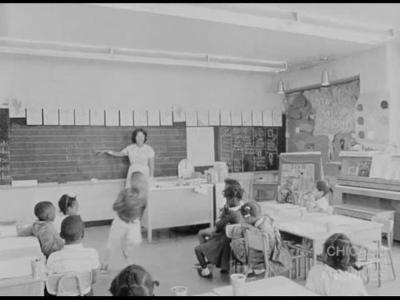
In the summer of 1964, the Chicago school system extended a pilot educational program conducted under ideal conditions to search out and employ the most dynamic approaches for motivating and teaching children in pre -kindergarten through the sixth grade.
What you see and hear are the sights and sounds of the special summer school program of the Chicago Public Schools.
Oh, glory hallelujah, glory, glory hallelujah, glory, glory hallelujah, glory, glory hallelujah, glory, glory hallelujah, glory, glory hallelujah, a happy, happy, happy little boss, rolling, rolling up the street and down, a happy, happy, happy little boss, rolling, rolling through the town.
Where we shall shine, how did you wait so soon? You cleared the little stars away and shined away the moon.
I tried to go to sleep and back before I left my bed.
How did you keep way over me and had you come to stay? Boys and girls, what is this word? And what is this word? Boys! If they learn to live in my house, I will make them mop the floor.
If a lion lives in my house, I will go down south to see my ants.
Down, and away, back, behind, by, down, far, far, far, here, in, inside, near, off, on, off.
No matter where we are, if they can realize that no matter what materials anything in the universe is made of, the electrons, the protons, and the neutrons are identical.
This is a great revelation to a youngster when he realizes that in his own body, there are the same kinds of electrons and neutrons and protons, they're the same all over in the universe.
And that within him and within the stars, within the very rockets, within the fuel that's in the bus that he may ride, within his lunch, all things in the universe are actually made of the same few building blocks.
This is a concept.
It isn't industrial.
It isn't mechanical.
This is a very beautiful idea that a youngster goes away with when he feels that he too is part of the entire universe and that he is made of the same materials, the same processes.
He is one with all things in the universe.
Did you carry your lunch today? What did you have to eat? Sandwich with eggs and...
How about the idea of having to leave Chicago itself? Many of them had never been here.
We're just visiting the loop, or seeing the lake for the first time.
Or actually walking over to the Fulton Street Market and getting fruits and vegetables and having then tasting parties.
This wasn't just a tasting party because it was rather exotic or fun.
It in turn involved nutrition and what was good for one and how you ate these things to build stronger bodies and stronger teeth.
And then of course the teacher nurse with the health program bringing in how to have regular physical examinations, the proper care of teeth.
There was just bringing in parents to discuss the nutrition plan, better breakfast, better lunches.
The day's program is divided into very definite segments with a great deal of choice, flexibility that the teacher can employ in planning her activities.
40 % of the time is to be developed in the language arts skills.
20 % of the time in arithmetic skills and the remaining 40 % of the time in integrated unit activities.
So that actually the child is getting more instruction in language arts and in arithmetic and science and social studies through the integrated unit, which emphasizes and strengthens some of these skills.
But there is definite teaching in the major areas.
However, the thing that makes it so remarkable are the teachers do not rely on the regular textbooks that the children would be exposed to in the regular school room situation.
They write their own reading materials.
In the primary grades the group experience charts are used a great deal for vocabulary development.
Anything that the teacher can use to develop a skill in the manner that will captivate the interest and motivate the children, this is what she uses.
They use every kind of manipulative device that they can get their hands on, any kind of illustration or audio visual aid that they can find.
And this I think is the secret of the program because the program is tailor -made to the individual child.
Our trip to the newsstand.
On Thursday afternoon we took a walk to the newspaper stand.
We bought newspaper that was written in Polish, German, Spanish and American.
It was a hot day but I enjoyed the trip.
What's that thing up there for? This is a light gun with a concentrated light beam and a red, green and white light in it.
And it's used to control or give information to airplanes that don't have radio communications with a tower.
Signal.
What's that? Sting.
Amelia Earhart.
She was born in Kansas July 24th, 1898.
When she was a little girl some of her friends...
I feel it's important for the child to learn very early how subjects fit into one another.
For example, writing.
We stress that they must have good writing being displayed on the board.
The fact that their art fits into many of the things that we're trying to do at the time that we're teaching social studies.
And arithmetic can be made to correlate with the units.
And so I feel that this helps the child to see how related or interrelated the various subjects are.
Time.
Teacher, time! No.
I know, study for us.
No.
It's an error.
Don't shout out the pronounce.
We might use it again.
All right.
Put a man on first.
Put a white socks player on first.
All right.
Minerva, what would you like to try for? Come on, Minerva.
Make up your mind.
At the last, the very last number that we use in our dividend.
What do we notice about this problem? Last one, please.
And what digit or what number is there that enables us to fill in this place? To hold the place of the tens here.
The court is called to order.
The case on hand.
Is the number zero essential in the number system or shall it be eliminated? The plaintiff has been heard.
The defense witnesses shall now be heard.
Ladies and gentlemen, Mr.
How many? Your Honor, zero is a number on equal footing with the counting numbers.
It designates how many and even if it's empty, it still tells that there is a number.
There's not any.
We need a number that does this.
Zero must be retained.
Thank you.
The story that we're going to have today, boys and girls, is about a young man, a very bold young man.
It takes place on a country road where we see the young man walking.
Each grade is divided into four achievement levels in reading.
Two for below average, one for average, and one above average.
The way a teacher approaches a subject is largely conditioned by the skills, abilities, and interests of a particular group.
Alright, boys and girls, the name of the story we're going to read today is Jimmy Takes Vanishing Lessons.
Many of you tell me what you think the word vanishing means or if you've ever had an experience where something seemed to vanish.
Audrey? Vanishing means disappearing.
You think vanishing means disappearing.
Have you ever had an experience where something you owned or possessed seemed to vanish? Friends, Romans, countrymen, lend me your ears.
I come to bury Caesar, not to praise him.
The evil that men do live by.
Hail Caesar! Hail Caesar! Hail Caesar! Hail! Well, this was my first experience in teen teaching and I had some ideas and after we discussed them we found some better ways of attacking the particular problem or the project which we were working on.
And also, it gives you more time with smaller groups of children.
Yes.
You take in larger groups of children, the expert in a certain specific field then is able to give a demonstration and everybody learns, the teachers and the children.
And something too, there's an enthusiasm that starts to build in the momentum.
That's right.
One kind of sparks the other in a teen teaching situation.
And there's an evaluation too.
One teacher says, well, perhaps I should have done it.
They enjoy it really.
They come home and tell me everything.
I'm really very proud of them because we speak at home different languages.
I'm very proud to pick this English language so fast up.
They picked it up and I'm really proud and they enjoy it.
They like to go in it.
What is this? Coat.
Coat.
Coat.
Can you find the vowel sound on the chart? Overage children, the potential dropouts, are met on whatever level their interest can be stimulated and broadened into participation in regular classroom activity.
Children with special interests are encouraged to express themselves in these areas, stressing the value of their contribution to the classroom.
And you never know what impression a child gets.
For example, in asking them what they got out of summer school, one youngster said that what he liked best about summer school was the quiet of his room.
In the land of Sue, but he don't know just what to do.
We are at the SMB.
Come along and sing with me.
La la la la la, la la la la la, la la la la la la.
Come on Bob, let's do it.
You know what I think it was? That this was theirs.
If everyone knew the story, they would have been very happy.
Everyone had been told the story.
We had our little group of playwriters, those who were interested in writing the play.
I sat at the typewriter and they fed me the words.
They typed, you know, bing bing each key at a time.
It was too slow.
We had such a, you know, time.
We need more time.
But they made up the words of the play.
Together with myself and the children, we made up the dance steps.
It was from the child.
The costume designs.
Everything in the whole production.
So I think that at the final production, they should be.
It was theirs.
Why, you can do something that is part of you and is yours.
The best, can't you? Yes, I think so.
I noticed that some of the children were even making some costumes.
Oh, they made all their costumes.
Yes.
Perhaps that's why.
Music for Children.
The class went on a trip to Grand Park.
I saw men and women dancing on the stage.
The music said, Dancing for Children.
I ate a hot dog when I, the dancers and music men took a rest.
I would like to go again.
This way he can express himself by seeing.
Actually seeing.
Because my daughter has come home and told me quite a bit.
Maybe I have tried to get her to remember some things she has read.
But now she can remember a play that she's been in.
Or she can remember a tour she's been on.
She can remember almost everything about it.
But now give her a book and have her to read it.
And she can't remember maybe two or three lines.
Because I think it's the entrance that they put in to going and touring and actually seeing.
I think this is better.
Study of another culture may involve reading, discussion, trips for direct experience, art, music, and even a festive celebration.
This was another resource person.
And so the visitor from Nigeria or the visitor from Ghana or the visitor from Laos immediately became a resource person.
Instead of questioning us, we in turn or the children in turn asked him about his country.
So he got first -hand information about his country.
And then he got the experience from these worldwide travelers and foreign dignitaries.
My name is Mutia Muthembo from East Africa, Kenya.
Tell us about your educational system.
We have grades from one up to four.
And then from five up to eight.
Another one from nine to twelve.
Children are tested for achievement levels at the start and close of the summer school.
Results show an average of a semester gain in reading and almost a semester gain in arithmetic in a six -week period.
But this is only the measurable improvements.
The impact on attitudes and motivation is even more dramatic.
When special problems exist in a child's performance or emotional adaptability, the services of a consultant psychologist and the adjustment teacher are made available to parents and child.
Do you encounter any problems with Randy at home? Any unusual problems? Do you feel that he's a youngster with more than usual number of difficulties? Or do you feel that his behavior at home is quite normal? Well, now I guess it isn't normal because he doesn't go out.
Let's go back to the in -service morning sessions.
There were such a variety of presentations.
We had everything from the del Tato Doman method of creeping and crawling to ensure better neurological approaches to reading.
There was the new math sessions, the old science sessions, the new science techniques.
There was the guest speaker from a foreign country or from a new kind of project.
And then there was the kind of sessions where you all joined together and had your group planning sessions.
Or if you were an expert in the field of art, you would demonstrate a new technique.
Or if you did something well in music, you would demonstrate that.
For the first time, we've seen hundreds of parents streaming through the building.
They're in all the classrooms.
And then I've seen them actually working on reading readiness, doing artwork.
You mentioned it and they've had it.
They've had tours of the city.
They've had spots of interest pointed out to them.
They've had interesting speakers to address them.
They've gone to mental institutes.
They've gone to pediatric institutions.
They've become a part of the whole community as well as the school.
And it's had an impression on the children seeing their parents in school doing the things that they've been doing.
Well, I think it helps the parents to realize that there is something they can do as a parent to help their child in school.
Whereas they might not be able to help.
I think that the different community agencies will find the children that did participate in the school program to be better participants in your program because they have learned so many different ways of getting along with people.
This type of program, which brings out the creativity of the youngster, is remarkable and I think would be a pattern for other schools to adopt, a very worthwhile pattern for other schools.
And it seems to me that if there's any possibility of the program being dropped, you certainly would have our cooperation and many, many signatures from our parents so that we could help you to keep this program going as it is going.
I think it's a tremendous thing, just tremendous.
They can't possibly stop this type of program because we have enjoyed it.
And I've been trying to figure out how could we keep it going yearly.
And they talking about stopping it? I'd like to add a brief comment here that we have togetherness at Holy Family and Medill because it's a shortage of money in both areas.
I like summer school very much and I wish it would never end.
And if there was the seventh and eighth grade, I'd go all the time.
And we've had many special things at the summer school program such as we made our puppet theater and we studied Shakespeare and we made movies and films and we had many opportunities to make bulletin boards.
I feel that summer school has been very good, but I think I'll miss it when I leave.
I will hope to come back next year and I like the mathematics that we've been doing, the new arithmetic.
I like the science and the study of the bones and hearts and parts of the body.
And then I have a son that's 12 years old here, he's just crazy about it.
He was asking me this morning, mama, you think I'll be able to go again? And especially the reading program here was very good for my first grader.
It was a wonderful experience for both of them.
Yes, I like the smaller classes.
Speaking of ideas, I think that it's marvelous the way we trade ideas.
You find when a person invents something, it's a patent.
Now teachers invent things and they give it to people, just give it to the people.
I think one of the greatest thrills I had was when children of a different racial group forgot to call me mama.
That happens all the time, I know.
I've experienced the same thing.
Children of other racial groups have held my hands and gotten next to me and put their arms around my waist or so.
Well, a lot of times you think they're your children, you don't think anything about it yourself anyway.
I've been called father, even mother.
I tell you, you talk about impressions.
I really feel the other thing that it's going to do for the teacher who's returning to the school in the fall is that it's going to make this person perhaps a little more self -examining insofar as his plans are concerned.
I think he's going to try to be a more vital person, a more dynamic person in the classroom.
Their eyes are open, they're excited, they're motivated, and we just hate to spare them for two weeks now.
We want to keep them.
We don't want to have them leave school because the summer has been too short.
One of the most rewarding things that has come out of the summer school has been that many parents have been so inspired by this enrichment program that they are determined to go on to some type of further training such as evening school, vocational training, and then taking courses for their own personal development.
To me, that is perhaps the greatest reward that one could hope for as a result of this program.
This kind of program is possible because there are 25 pupils in each class.
There is daily in -service education for teachers and there are auxiliary staff members in each school.
The spontaneous reaction of teachers, parents, pupils, visitors to the program tell more about what happened in the special summer school than any other means of reporting a program could.
One of the teachers remarked the other day, it's a toss -up who learned more in this summer program, the teachers or the pupils.
The keynote in the program, I believe, is involvement.
It's involvement of everyone, direct involvement.
In our quest for quality in education for every child, each to the maximum of his potential, we shall continue to seek, to discover and develop those ideas and conditions which can release, encourage, and extend the brilliant minds of students.
The creativity of teachers and the unusual talents of all individuals.