Yes, it was stupid.
I mean, what could they do for him? Except give him quinine.
They could leave a supply of quinine with him.
That's about all.
Would you like quinine? Yes, I would have.
No.
I like Conrad's style of writing.
I wasn't here from the first part, but I thought it was a pretty good discussion.
And I liked the book.
And I think you get more out of books like The Shadow Line and Enemy of the People than you would on just reading, maybe on education, or some of those books that just tell you right away, what? Just come right down instead of having you find out for yourself.
Well, I thought this was a good discussion.
I thought it was the second best because I did feel The Odyssey was the best one this year.
But the only thing I felt was wrong with all our discussions was we never had enough time to really get, we start getting into something and then our time would run out and we just have to close it.
When I read The Shadow Line, I didn't know exactly what the author meant and some of the points and when they were speaking, I understood it better.
But I think the main thing that these four years of great books have brought out in me is the ability to make a harder selection enjoyable.
I'm Barbara Norris from a college of education in England.
I've thoroughly enjoyed this discussion.
I think it is obvious that our boys and girls of this age think very much more deeply and sometimes they're given credit for.
Wouldn't it be heavenly to know the constellations, scan the skies and recognize their names and their locations, though they're only figments of our own imagination.
Children in a classroom, each from birth carries the seed of uniqueness, but the seed seeks the soil, home, school, community, country, the world.
Each in different ways and degrees constitutes the soil for growth.
What will flower forth depends largely on the character and quality of its nourishment.
Each shares in the responsibility and the rewards of the yield for the consummate gifts of one individual enrich all individuals.
These are manifest in the monuments of human achievement through the space of time to which we are the present heirs.
Worlds are shaped by the combined efforts of people, by creations of ingenuity in the sciences and in the arts, by the visions of men who become the leaders of men.
And it all begins with the child and his environment, of which the classroom is a vital part.
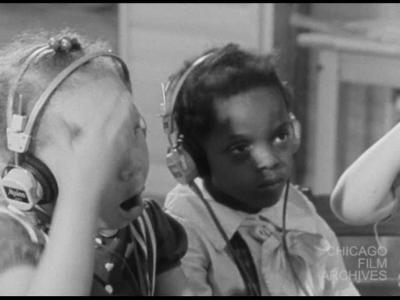
Children in a classroom, special children, special classroom, this is a brief glance at the gifted child program as it functions at the elementary level in Chicago schools.
A group of children of unusual promise were selected after considered testing and observation for special programming with the objective of providing them an academic atmosphere of high opportunity and encouragement.
To peruse the particular means for the particular child, to bring discovery to curiosity, challenge to energy, inspiration to hard work, vision to inquiry, creation to imagination, expression to talent, structure to precociousness, knowledge to intuition, cultural enrichment to every day, and joy to learning.
Big objectives, small program.
It is better yet to have a big program with big objectives, encompassing every last child.
For what child is without gift? What child is not special? But then, this is only the beginning.
I think as we went along, all these children were trying to get new techniques in presentation.
And this is very interesting because as we went along, they refined the techniques that were already used at the beginning and then they began to get newer and newer ones.
And then we came out with the booklets, Terrell and the booklets.
And when Pam Wojcik gave hers and she came out with the puzzle at the end, I think this was an attempt to do new things.
I think it brings out a certain kind of creativity and ingenuity of the child.
Right, and this is the sharing part of your research.
And I'd like to see if another time started even earlier, the emphasis on the evaluation.
Then last year we did this very interesting project on Shakespeare.
But you see, this year we broke away from that, even that tight a concept about this and let the children go on into areas of their own interest without our saying, now you must find an area of interest within the confines of this large broad topic.
I'd like to, I'm, hello, I'm your friendly news reporter from WQRE radio station.
Now I'd like to tell you about some new interesting facts about a discovery found off the coast of England.
They found some documents uncovering some very important facts about English history.
I was working on photography and it's a pretty involved subject so I was just working on the principles of it.
And to take a good picture you have to make sure your lens is focused and clean because if it's not focused you'll get a blur.
Now I was wondering about these new cameras that develop the picture itself inside the camera.
How do they do this? There's developing bulbs in there and when you pull it apart it pinches the bulb and develops your picture.
I think one of the reasons that one of our children did have so much success with the science project as Mrs.
Griffin told you in bacteriology was because we had the laboratory set up where she had the opportunity to have long benches and a gas burner and an opportunity to use a stove with the pressure cooker in the sink and do all the things herself.
And she worked, she was inspired really and worked hours and hours here.
She really spent a lot of time on that project, I think a year.
Right now I'm inoculating a tube with Escherichia coli, a type of bacteria that is found in the intestines of man.
We try to do this as much as possible.
We try to set up problem situations where the children can learn by discovering and by solving problems and in different ways to solve problems.
In other words there's not always one path to the goal.
I think this is very important for children to learn in science that there are many ways that you can get an answer and also that the answer is an answer for the time being in science perhaps but not for always.
And even failure is an answer.
I think this is an important thing that has to be brought out in science.
We have a favorable aspect in both math and science that when you don't succeed you've got to find another way of doing things.
This is very valuable.
I think failure is not always as bad as the word seems to be.
No room! No room! No room! No room! No room! There's plenty of room! Have some wine! I don't see any wine.
There isn't any! Imagination expended in teaching comes back in pupil performance, in a poem written by the child in a way to tackle a science problem, in the presentation of a social science theme, in a dramatic performance.
Who fell? Did you fall from there? Oh Annie, when she was outside, did Annie fall? Did Annie fall? Well tell me, Annie? Fell! Fell! Yes, Annie fell.
Down! Down! Down! Stop! Stop! Move! Move! Move! Big boy! Big boy! Come! Come! Push! Cry! Be quiet! Bad boy! Bad boy! Do you want to sit here and be the teacher and we'll get the face and put on the nose and the mouth? Do you want to do that and you be the teacher? You want to be the teacher? Yes.
Okay.
The handicapped child.
Blind.
Partially sighted.
Deaf.
Or hard of hearing.
Yet gifted with exceptional aptitude.
At Bell School, these children constitute 40 % of the gifted child enrollment, starting at nursery school level.
What are some of the questions you're going to answer to the group? Well, what I had in mind was that I was going to ask some questions that I have here.
I read some of them for you.
Well, one of the questions is, who would you...
Another came to me on parent interview day and she said, I don't know what you people are doing to Ava, but she's finally made up her mind what she wants to do.
I said, well, a lot of children don't know what they want to do, even when they're in college.
She said, but Ava thinks she already knows.
She would like to be a math teacher for the deaf.
Well, you see, and for Ava, this is quite a step because I remember in the hard of hearing class before she was integrated, how shy she was in the beginning, and I've been able to see her.
I found Nigeria good for you.
Now, where is it? It's far off the coast of Africa.
All right.
What coast? The West Coast.
Donald is one of those children that does have the ability in music.
He could just be an excellent beetle.
And now he's really inspired about the fact that he could do these research projects.
He can do this.
He likes that.
He learns as well.
He's fascinated by the things that have been said and done.
And then he's pure ham.
He has a not a lot of poison.
The blind child has Braille books, maps, and other tactile aids at his disposal.
But even more, he receives warmth and appreciation for his contributions to the classroom.
Children with sight and hearing problems are integrated with children who are not handicapped and participate whenever feasible in full group activity.
Exposure to the special needs of handicapped children develops an empathetic awareness in the others.
Bueno, ahora empiecen.
Mario, has Visto Enrique? No vino a la escuela ni vendrá por algún tiempo.
Por qué dice eso? Porque tiene una pierna quebrada.
No hombre, cómo se la quebró? Se cayó esquiando el sábado pasado.
This is one interesting thing about the special projects because the children get no grades for this work.
And it does not affect their grades in any of their other subjects.
And it's surprising the amount of work which they do just because they want to do it and because they have teachers who will help them.
And they're not working in this case for a grade.
We found that children will work hard on something that they're interested in.
And while they're working on something they think they're interested in, they're learning many other things.
How to read better, how to write better, how to talk better.
As you recall children, when we visited famous buildings downtown of the Chicago school, built in the 1880s, and visiting some modern buildings, we learned some basic things about the history of modern architecture.
One of the things we learned that the basic difference between what we call old architecture and modern is in the way it's constructed.
One where the wall is doing all the work, carrying the load of the floors.
And on the other one where the skeleton, the outside structure of the building, carries the load of the floors.
Most of all I think it has opened their eyes to a greater number of things than would have otherwise been possible.
I think their appreciation of the arts, appreciation of history, and of literature certainly has increased.
And most of all I think that maybe we are approaching something here that we talk about a lot in education.
I think I highlight to believe that they are learning how to think critically.
And in these times and the times that I see in the future, I think this is the most important thing we can do.
Have them know how to participate in a group, be true to their own ideals, evaluate other people's ideas and not argue from emotion but from fact.
All these things I feel will make them worthwhile citizens.
And if these are accelerated bright youngsters, then these must be the ones who have all these opportunities to be trained in leadership and become good leaders.
Last year I know that I enjoyed the trips to the Art Institute, but this year I found the trips more rewarding and educational.
Before I used to look at a painting and see what was there on the canvas, but now I've learned that there's more to the picture than meets your eye.
You have to think about the artist and about how he was feeling when he did his painting and what was going on at the time.
It really, one painting has a lot of background behind it.
These trips weren't really just educational.
I found them really enjoying.
We see the same thing, but our ideas of what we see are interpreted differently.
Each year in our Great Books program, we read books that range from the pre -Christian time into the 20th century.
After we finished reading the selection by Kant, Education, a report was given on German music.
And when we read Dewey's How We Think, we discovered that at that time the country people were singing...
...from California to the New York island, from the Redwood forest to the Gulf of Greenwater, it's done what makes me what you and me.
I think we have two purposes.
One, to learn the library facilities and get acquainted with them.
And two, to learn miscellaneous information which we gain from the topics which we make reports on.
I think that way the library program has a double advantage.
We've learned how to find new sources of information.
We've learned how to use the Reader's Guide to Periodical Literature...
...to find recent articles and magazines about our topic.
And we know how to find certain books and use other reference books.
And when we went to the downtown library, we learned how to use the microfilm machine.
When I did my Peace Corps report with Susie, we sent in to Washington, D .C., and we got a lot on the Peace Corps.
Well, after the report is given, we have a question period.
And after the questions, we have an evaluation period.
Who evaluates the report? The children.
The development of critical listening and the development of respect for the idea of a peer, although that idea may be radically different from yours.
I think it was summed up beautifully by a 12 -year -old girl when she was asked by a visitor, what have you gained from being in this program? And Michelle said, well, before I was in the program, she said, and I met someone whose ideas were different from mine.
And I used to just dismiss him as a cook.
And she said, now, when I meet someone, I try to think what experiences has he had, which leads him to his conclusion as opposed to the experiences I've had, which leads me to mine.
And I think that's it.
The woman who has closed the grain, who has nourished the cow, who has sung the lullaby, who has woken the priest, whose day is erased, who has married the boy, a man and a woman, who has embraced the girl, everything is broken, who has cut the cow, who has eaten the cow, who has found himself in the house that Jacques built.
I think it's a rich program because it does enrich the personal life of all the participants, including the teachers.
They certainly have had a marvelous opportunity to gain the insights of youngsters, which are so fresh and so penetrating.
I feel that we must do more to extend some of the things we've learned through the Demonstration Center program to all youngsters.
We started that this year at the fourth, fifth, and sixth grade level.
And it all begins with the child and the classroom and with people who are concerned.
The march is over.
The march is over.
The march is over.