He got a mayor now, his name is Richard Daley.
And his father, Richard Daley, one of the most famous mayors of America.
Tell us what the difference is in terms of the coalition and the way politics was back in the old man's time and his son's time, and use their names for us.
Difference between how politics were in Chicago under Richard J.
Well, I'll say back under Richard J., the father of the present mayor, it was more of a club.
In fact, he had a club called the Homburg Club.
And if you wanted to run for office, you had to get permission from these people to run for office.
You don't need that under this man.
This man here is right up to date.
When we go into the 21st century, he'll be all set for it.
If you want to run, run.
Let the best man win.
And that's the biggest difference between him and his father, as far as I can look at it.
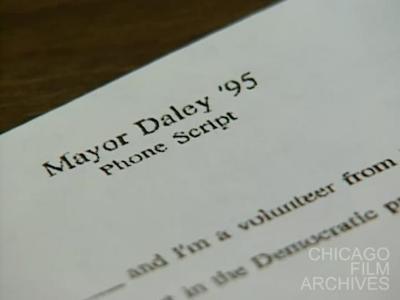
And he just does so much, like he showed on this script sheet over here that we give our phone, people on the telephone bank, a script sheet of the accomplishments the mayor has done in his last six years in office.
So when somebody says, well, what's he doing for schools or what's he doing? We've been working with the number of the aldermen who are up for re -election.
And they say that part of their job, the big part of the job is services.
Getting people here for services.
The other thing that they seem to be involved in and doesn't seem to be as much as it used to be is jobs.
They can help you get jobs.
That's also a powerful incentive to get involved in helping out.
Not anymore.
Not the way it was under Richard Jay.
Nowadays, you have quotas set up by the federal government.
You also have quotas for minority hiring.
You have quotas for minority contracting, meaning African American, also meaning Latino, also meaning women who fall into the minorities.
This man here has exceeded every minority percentage that he has.
But I've been to ward meetings.
I don't think there's anything underhanded about this.
But somebody will say, gee, you know, it's like I'm online to be a security guard at O 'Hare.
Can you do something for me? And maybe it's just a phone call to find out if the application got stolen.
That seems to be going on.
It just seems to be part of, it's another reason people are getting involved.
Well, it's not really the way it used to be.
Now you have to go out and fill out an application.
You've got to take a, what do we call them, you've got to go for a verbal down to a board and sit down in front of people.
How did it used to be? Like it was before, this is the most amazing part.
If you worked for the city, you worked for politics.
Nowadays, you say, hey, if you worked for the city or the county, whatever it might be, if you feel like working for it.
I think one of the biggest things is what is known in, I guess this is all over the country, the Shackman decree.
Where, hey, because you work for the city, you don't have to back the mayor.
You can back anybody you want.
That's your freedom to do it.
In the First Amendment.
In other words, he's trying to say, if you want to be here, you're here.
They were all here.
If you don't, nobody's to twist your arm anymore to be here.
I mean, it's...
Years ago, if you said, I'm not going to go help you, or say you did go help and you didn't carry your precinct, the next day they would do, quote, quote, and this gentleman here, V -I -C -E, you were vice.
You were out of a job and there was nobody there to stop you.
Nobody to protect you.
You couldn't go to a lawyer.
That's one of the biggest differences.
Now you have city, county, state employees.
They want to do it because they want to do it.
I would say, say a guy's got a job.
I don't care if he's digging a ditch.
Whatever he's doing, say he's happy with his job or happy where he is.
Maybe he says, well, I'm going to go help him during the election so I can stay digging this ditch.
I'd rather dig this ditch here than go over on the south side and dig a ditch.
You dig one ditch, you dig them all, right, Dutch? Go ahead.
Come on, Dutch.
I like the expression that you asked about the machine.
You know who started that expression? You fellas, the media.
Am I correct on that? Well, because anything worked very well and smoothly was considered a machine.
And the Democratic Organization did.
Well, you have to admit, we earned the title.
It was a presidential election.
They earned the title.
John Kennedy.
Oh, good example.
When the machine got kicked in, you're talking two weeks before an election.
We changed the course of history just by election.
We changed the course of history just by winning an election for John F.
Kennedy in Chicago.
I mean, with the turnout that we had and the number of votes that went to Kennedy in the electoral college, we elected a brand new president, John F.
Kennedy.
And I mean, like I said, when things get moving here, if you guys want to call it a machine, I just call it a good Democratic Organization.
That's what I call it.
I don't call it.
These guys are the older guys.
I'm a new, younger politician or a priest and captain or volunteer, whatever you want to call me.
You could go up to a thousand doors.
If you present yourself well and you say, hey, come on out, there's just a lot of people.
I'll tell you something.
You could talk to them as much as you want.
I think what we're dealing with today is a more educated voter that you cannot con anybody anymore.
You can't lie to them.
A lot of people, I mean, with the way the media is and the way newspapers are, people are kept up to date on a lot of things.
You cannot, you're not going to slide anything past anybody.
What you have to do is I think and what we have, what's so nice about this election, we have a great candidate.
We're not struggling to get this guy elected.
This man basically is getting himself elected through all the good deeds and all the accomplishments.
He's accomplished by being mayor.
And like I said, it becomes easier when you have a good candidate.
I mean, I know what you guys talk about the old politics where a guy could have been a sleazeball and everybody's out trying to get this guy elected again.
And I'll tell you, I have to admit years ago it worked.
I mean, you've got those captains involved by the time, you know, on election night.
You know, we have a lot of sayings come out of Chicago.
Vote early, vote often.
We have all those great little sayings.
I got a couple other ones, I can tell you.
They're a little dirty.
Well, there's another saying that there's a saying that your enemies, it's better to have them inside the tent.
Pissing out than outside the tent, pissing in.
So, you know, but like I said, we got a candidate here.
I really think that he has a coalition of everybody.
I mean, this city under this mayor has moved forward and has come together.
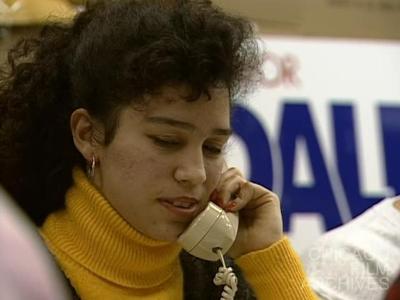
And like I said, you know, we're doing one thing, one particular thing tonight, this phone bank.
And you're calling and I guess you guys noticed that we have friendly, nice people that were here, all diverse in their ethnic backgrounds.
And like I said, you get a very good response by people that are calling up because they want to do this.
Hi, my name is John and I'm a volunteer for Rich Daily.
Could we count on your support for the mayor? You know, and a lot of times when I was on the phone, these people aren't even hesitating.
Like I said, yeah, no problem.
We'll be out Tuesday.
And like I said, come next week Tuesday.
When this primary is over with and finished, I think that Mayor Daley is going to win this decree.
Has changed things so much.
In the old days, we could elect somebody that was laying six feet down in the cemetery.
The machine could elect.
There was nobody the machine couldn't elect.
Everybody was electable.
Whoever they decided they wanted to run, ran them.
Nowadays, it's a different ballgame.
I think you've got much more intelligent voters, number one.
Number two, I think you have more intelligent and feeling candidates.
Do you ever miss the old days? Do I? For politics.
Not one little bit.
John, could you say that to what you just told us one more time? You said in the old days, could you start just a little bit more time? You mean with the graveyard? Yeah, yeah.
Well, in the old days, the machine could probably, without any hesitation, elect somebody who was buried in a graveyard somewhere that had been dead for years.
They could, like John alluded earlier, they had a lot of sleazeballs because they were somebody's friend or somebody wanted them in there.
And they were elected.
Anybody was electable.
Nowadays, like I say, the voters are, I believe, have more education.
You do, another thing you do have, you do have your TV and you've got your phone bank, which gets right into the house.
We can get into houses in neighborhoods that are really heavily controlled by gangs.
The gangs, the people in those neighborhoods, you give them a sign to put up, they don't dare.
If they put your sign up and the gangs don't want that person, the gangs will knock on the door and say, get the sign down.
Well, they're going to take it down.
But when you call into the house, it's one advantage of a phone bank.
Nobody knows that you were called.
Period.
End of notation.
Okay, that's it.
Sure.
John Calhoun? Which gives you your address too? 4826 North Linder, Chicago 60630.
John Calhoun, 6680 North Olympia, Chicago, Illinois 60631.
How do you spell your last name? K -O -L -O -M -A -Y.
Emmanuel Dudzinski, 2148 North Damon, and 60647.
Irish, huh? Definitely, definitely.
But I'm also a political missionary now.
And that's a question you should ask me to follow up on.
What does that mean? Ah, hooray, I got a podium now.
It simply means this, that you can't go into preaching as we did before, and as John would say, just hammer the people, come out, give them a couple of garbage cans, and say, hey, remember, I did this for you.
You've got to do more for them today.
They're more intelligent, and at the same time, you can't con them.
My parents came from the old country.
They had to protect their freedom here, and all they could do would be to make sure that they didn't step on any politician's toes, because that would mean retaliation.
And we were brought up in an atmosphere of family, unity, teamwork.
That's the reason why I've, this is not a sarcastic remark about changing from precinct captain.
I have it on some of my cards.
After all, didn't we have our own president start the new covenant? And by being a political missionary, I concentrate on, not like some of these gentlemen do, I concentrate on the opposition, the Republicans, convert them to democracy.
Without the ten points.
It's just my simple thought.
At my age, I can get away with a lot of these things.
I can always claim, well, my mind isn't working properly.
But I think the people I talk to can be the judges of that.
What's the difference? I was, well, we had a mother, a family store, a mom and pa store.
And many, many years ago, we wanted the street to be repaired in front of our building, because at that time, before the refrigeration came in, we had ice machines.
You had to have salt to put into your big box, and they gave you, you kept your ice cream that way.
The salt, after it melted with the water, had to be dumped out.
It was dumped out on the street.
We had a bad break in the street.
That would then go into the ground.
The ground would get saturated with salt water.
We lost about four trees in the neighborhood.
So we went to the local politicians and screamed about it.
I was just a little kid then.
My mother went to the politicians and did the screaming.
And she got a runaround.
They didn't want to do anything about it.
They didn't want to fix the street.
They kept saying, well, we'll see how you vote next time, and then we'll probably take care of you.
Well, I grew up with that atmosphere, saying, no, no.
My mother and dad should have had some service over here.
So I said, when I get into politics, and I love it, because I'm dealing with the public, being in business.
I grew up in the business.
I knew that I had to stay in it.
I can speak another language.
I can speak Polish.
And I said, no, I think I'll stay and see if I can straighten things out.
Well, my brother ran in opposition to a certain alderman at the time.
He lost.
He came in about fifth.
But he made his points.
At that time, it was a favor for a vote.
Remember? You do me a favor, and I want you to vote.
That's it.
They used to give out nylons.
They used to give out candies to come out and vote.
Now, today, you can't do that.
At least you shouldn't do that, right? I feel that if we lose our political freedoms, forget about your religious freedoms, no matter what your faith may be.
And when I say that I am serious about being a political missionary, I don't like the word captain anymore or community representative, because what can you do for some of these people, especially in our yuppie areas? You can't do anything for them.
You can't even talk about a garbage can.
Some of them want better services.
They feel they're paying high taxes for their property, so they should have better services.
Well, I tell them, listen, the leaves come, they fall.
Somebody's got to pick them up.
They expect us to service them in such a way that a machine comes by, picks up the stuff, and cleans it up for them.
And I just tell them, don't you know what a broom is for? And I don't care if I offend some of these people, because that's common sense.
You're going to wait for a politician to get a machine to come down and clean your own sidewalk for you or your own curb? I can see street cleaning at certain times, which is on the schedule to be done.
I think it's 27 days around the summer months in Chicago.
But a mixture of everything.
And we're fighting each other.
Let's start helping each other.
Simply as that.
None of this gold gridlocking in Washington.
One party does it when they're in, the other party does it when they're out, and vice versa.
They're fighting each other.
In the meantime, who's suffering? The Irish American.
Tell me, is this something that just happened in the old days, okay? Democrat is a Republican, or is it? Well, when I missed a meal as a child, it was embarrassing to my dad, because that was during the Depression, the crash.
And he told us that the Republicans were a party for the rich people, that they're the ones that took the money out of the banks.
When I had $71 at the Nolte State Bank at that time, and I was about maybe nine or ten.
And he said, the Republicans will always be a party for the rich.
They look out for themselves.
So it's a clique.
We shouldn't have cliques.
We should get together and work for the benefit of the whole country.
Corporations today have to pick out people.
If they're going to start picking out cliquish people, how far are they going to go? They look for the best talent.
And that's what we should do in politics.
Look for the best talent.
Not after you get them and say, oh, this guy slept with that broad, and this guy did that, and this guy did that.
Hey, check them out.
Simply check them out.
And there are ways and means of checking them out today.
That's great.
Man, you've got so many volumes of books here.
Yeah, you accumulate a lot.
A lot of law students can go in there.
The basement was full of congressional records now.
I don't know how often that comes out.
It was one year when we had that flood.
Oh, man.
What about the thing where we're shooting? Am I okay just like this? You are.
Away from it.
Yeah.
Okay, off.
And on.
Flash it on and off a few times.
I'll tell you.
I'll actually talk to you.
On.
Off.
On.
Off.
On.
Off.
On.
Off.
On.
Excellent.
Thank you.
My name is John Calhoun.
I'm a coordinator for Mayor Daley's phone bank.
My name is John Calhoun, and I am assisting Mr.
Calhoun with the phone bank tonight.
Good luck, Mayor Daley, Tuesday.
My name is Emmanuel Dudzinski.
I'm a volunteer worker.
Good luck to you again, Mr.
Mayor.
Okay, let's try that again.
And just basically, as soon as one person finishes, pick it up.
Don't look at me when you're done.
Oh, you just keep looking at the camera.
Okay, John.
My name is John Calhoun.
I'm the coordinator for Mayor Daley's phone bank.
My name is John Calhoun.
I'm an assistant to Mr.
Calhoun running the phone bank.
Mayor Daley, good luck next week Tuesday.
My name is Emmanuel Dudzinski.
I'm a volunteer worker for the Mayor's campaign.
Good luck, Mr.
Mayor.
Oh, good luck, Mayor Daley.
Next Tuesday? No, on Election Day.
Or just on Election Day.
Okay, whenever you're ready.
Just on Election Day? On Election Day.
Go ahead.
Okay, let's go.
You can use this for ten more years.
Right on.
Okay, John.
My name is John Calhoun.
I'm the coordinator for Mayor Daley's phone bank.
My name is John Calhoun.
I'm assisting Mr.
Calhoun in the phone bank tonight.
My name is Emmanuel Dudzinski.
I'm a volunteer worker for the Mayor's campaign.
Good luck, Mr.
Mayor Daley, on the next Election Day.
That didn't work out too good.
Not on the next Election Day.
Which is the next day.
No, no, no.
Just on Election Day.
Just on Election Day.
Good luck, Mayor Daley, on Election Day.
On Election Day.
Okay, ready? Can we just do that part? Sure.
Ready? One, two, three.
We need to do the whole thing, sorry.
Okay, John, you're blocking the D in Democrats, so kneel down on that seat there.
What, my shoulder? No, John, John.
Not John C.
John.
Still? John C.
Still? Yeah.
Just kneel that, yeah, yeah, move in the middle there.
That's great.
That's perfect.
Right there.
Okay.
All right.
I'm going to look four foot tall.
Okay.
Ready when you are, guys.
Okay.
My name is John Calhoun.
I'm the coordinator for Mayor Daley's phone bank.
My name is John Colomay and I'm assisting Mr.
Calhoun in the phone bank tonight.
My name is Emmanuel Dudzinski.
I'm a volunteer.
Mic, please.
Mic, please.
Sorry, it's my fault.
Okay.
John Calhoun.
My name is John Calhoun.
I'm the coordinator for Mayor Daley's phone bank.
My name is John Colomay.
I'm a volunteer for Mayor Daley in assisting Mr.
Calhoun in the phone bank tonight.
My name is Emmanuel Dudzinski.
I'm a volunteer for Mayor Daley.
Mayor Daley, good luck next week, Tuesday.
He ad -libbed that one again.
I don't know what this is.
Why? He told you.
All right.
That's acceptable.
All right, take 20.
What are we going to say? Good luck Mayor Daley on election day.
That's it.
And there's my call.
Screw this.
Oh, God.
Here we go.
My name is John Calhoun.
I'm the coordinator for Mayor Daley's phone bank.
My name is John Colomay.
I'm a volunteer and I also assisting Mr.
Calhoun in the phone bank.
My name is Emmanuel Dudzinski.
I'm a volunteer for the Mayor's campaign committee.
Mayor Daley, good luck on election day.
It's closed.
It's nothing.
That's a little bumpy.
Yeah.
Speed it up a little.
I'm going to need to get over in the other lane.
Go for it.
I hate that fucking windshield wiper.
Fuck.
That's it.
I'm going to need to get over in the other lane.
Go for it.
Go for it.
I'm going to need to get over in the other lane.
Go for it.
Go for it.
Go for it.
Go for it.
Go for it.
I'm going to need to get over in the other lane.
Go for it.
Go for it.
Go for it.
Go for it.
Go for it.
Go for it.
Go for it.
Go for it.
Go for it.
Go for it.
Go for it.
Go for it.
Go for it.
Go for it.
Go for it.
Go for it.
Go for it.
가서 maria pick staff




![Latino Ministers Endorse Daley [Cont.] / Daley Phone Bank 1](https://collections.chicagofilmarchives.org/media/cfa/images/7/4/13034_ca_object_representations_media_7435_medium.jpg)