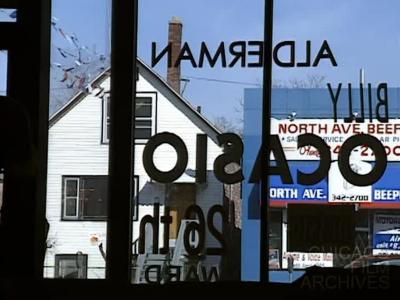
Ocasio HQ: Al Padalino Interview [Part 2]
I mean, I'm not a professional politician.
Any of the people you see that come here are not professionals.
A professional politician to me is someone who's in office.
That's the professional that he's making a living at politics.
See, most of the people in Chicago that are involved in politics are either volunteers who want to help out, I mean, whether it's a few hours on a phone bank or just to come in and pass literature or put up signs like you've seen all over the city.
I mean, you know, that's just my personal opinion how politics, I feel, should be.
Okay, not that I'm right or wrong, but that's how it should be.
Do you like politics? Do you like doing all this stuff? It's like a hate -love thing.
I mean, you know, really, no one really likes to get up at 7 o 'clock in the morning on Saturday or Sunday on your day off and come in here and try to go out and knock on doors and have our people come in and sign them.
But it's, I don't know, it's like a funny thing.
It's like you get a high from it.
I mean, you know, it's nice when you really do accomplish something or let's say there is an issue that you can help try to push one way or the other.
It really feels good when you can after doing all the work to see it culminate in what you really wanted to.
So where did you learn all this? Where did I learn this? Well, no, most people have it in bread and them.
I mean, really, it's just a matter of getting out and trying it.
I mean, most ethnic groups have that ability.
Irish, as you well know, are, you know, very heavy in the politics.
But most people have it in them.
If you like dealing with people is what it really is.
If you don't like dealing with people, then there's no use even trying it because it's not going to work out for you.
So why does politics, I mean, anywhere we go in the country, people say, ah, Chicago politics, they know about it.
Why does it have that reputation? Well, it's just a connotation of what the media brings forth to the other parts of the country.
People who are here know what Chicago politics is really all about.
But the media presents a certain view of what they feel politics is like in Chicago.
And people, I compare it to the Al Capone era.
I mean, you know, everyone thought Chicago was a gangster place.
I mean, there were no decent people in Chicago, but as we all know, it's not true.
What's the reputation of politics in Chicago? We like our politics.
I mean, you know, if we like a candidate, we're going to go out there and do the best we can to get that person elected.
Sometimes good, sometimes bad, but that's what it's all about.
I'm not saying it doesn't happen.
I personally, and the people I deal with, I mean, we try to keep very, very nice, even keel and deal with people decently and get honest information and pass it along.
I mean, not that it doesn't happen.
I'm sure somewhere along the line there are some disreputable people involved in politics.
What do you do here? In essence, what we do here is have people, have volunteers come in, and we assign them specific precincts to help out and try to pass out the information and get results on.
And hopefully try to get that candidate elected, candidate or candidates elected in that area.
What about the whole thing with pluses and minuses? We have a nice going on.
Can you tell us what that is? Yeah, that's what they call the walk sheet.
In essence, what we had was, I wish you had a copy or to show you of the old one.
We have registration sheets that show the people who are officially registered in that precinct and who are eligible to vote.
What we have, the walk sheet is basically the same thing, but it enhances it with a lot of other information.
For example, ages, how old the person is that you're talking to.
So before you get to the door, you know you're dealing with a 25 -year -old or a 55 -year -old, which makes a difference in the way you explain the political candidate.
You have an idea how this candidate has voted in the past, whether they go to primary elections or not.
Whether they vote in the primary and take a ballot or not.
So in essence, what that does is give you a key as to who you really want to go out and shake the boards for.
People who are pluses, if you go around and there are pluses, yeah sure, I love your candidate.
The great people I want to vote for, that's the person that you want a key on on election day to come in and cast a vote.
How you doing? Yeah, how many you got, Louie? Okay, nine of these people other than the ones I've normally had here? Okay, good.
So there are additional people for today.
Eugene Ski? Yeah, Eugene Ski, okay.
Okay, so not since they're coming over here and we're going to assign them to a precinct.
Okay, additional people we're going to have here today, nine more.
What are you going to be doing later on today? Later on? How much later? What's the next thing that's going to be happening? Next thing that will be happening is people are going to be coming in here and we're going to team them up in pairs of two.
The way they like us to work is people work in twos, not just for safety factors, I mean, which are very evident.
It's better to have two people there so in case there's a problem of some kind, at least there's a backup person.
We send them out in teams of two and they'll go around door to door with the walk sheet and talk to each person that's on that walk sheet.
And then they'll come in and we'll get the results and feed it to the headquarters downtown and they in essence can tailor make their campaign with those kind of figures telling them the plus or minuses.
That also has a lot to do with their literature and TV spots and so forth.
Louie, people coming door to door, can they all speak Spanish? No, specifically the ones we have here today, out of the five precincts that we're assigned, we have two that are Hispanic, mainly Hispanic.
Not that they speak strictly Hispanic, but we would like to sort of send Hispanic speaking people into that area, teamed up with another person to do the job.
Does it make any difference whether you're going to Irish, Polish, Hispanic? Not to us.
We work wherever we're needed.
We're volunteers so wherever we get a chance to go, whether it's any kind of ethnic group, we'll go out there and do what we have to do.
Are there a lot of ethnic groups in this district? It's in this district, yes.
But it's mainly this ward that we're working in, 26, is mainly Hispanic.
But there are other ethnic groups in there.
Can I take a pen from you? Or can you say, we're just hearing the click of your field, and not knowing how it works.
My personal opinion is, yes, it does.
If you know you're dealing with, let's say, for instance, Polish, Italian, or Hispanic, you have to tailor -make because the thinking is a little bit different.
There's a different approach you use to different ethnic groups.
The more you know about that person, the more you can help them vote the way you'd like to have them vote.
For instance? For instance? Well, for instance, if you would personally go to a door and that person is Italian, and you really couldn't connect with them, you wouldn't have too much of a chance.
Now, I can walk in there and speak to them in Italian.
I mean, I think I can get a lot further speaking Italian to an Italian person than you could.
And it happens in every other ethnic group, too.
If you can speak that language, you have another tie that you two can have a common ground on.
Well, you were telling me the importance of just that first contact.
I mean, again, remembering what you said, what's the difference between the importance of the person that asked for the vote and the importance of the candidate? Well, most of the time the constituent is not going to see the candidate.
They just see him on television or see their picture in the literature.
You are the person that's right there in front of them.
Three -dimensional person that they can either talk to, ask questions of, argue with, or complain to.
You're the person they're going to say, hey, you know, I'm not getting the service I need.
And you, as a person going around as a precinct worker, can help get the service that they need.
So if they like you, can you sell almost any candidate? It's quite possible.
I mean, in essence, if that person can be swayed by TV spots or by literature, you can sway them.
I mean, they might not particularly care for a candidate for some specific reason.
But you are the person who tells them, well, look, even though they have these drawbacks, these are the things that this candidate can help you accomplish in your area.
And that's the basic selling point is what can that candidate do for you? That's what it's all about, really.
This seems a little bit, I don't know, old -fashioned in the age of media.
We're old -fashioned kind of people.
I mean, the people I'm associated with, we are not modern as far as going door to door.
Personal contact is the best way to try to get that person's vote.
I mean, the media affects the volunteer.
I mean, if you have a personal contact, I'll give you an example.
If you have a real personal contact with the area you work in, that person knows you.
They've called you in the past for other reasons.
They've had a problem and you've helped them rectify it.
The TV can't help them do that.
But if you don't have the personal contact with them, then the TV and media can sway them in their line of thinking.
How long is it for you? Another one? 26 Ward.
Who's sending these guys? What? Who's sending these guys over? These people are coming from the other headquarters on the Foster Avenue.
These are excess people, you know, or other ones that they're going to shift over and try to help us out here, since we had some bad weather last week.
And really didn't get the kind of turnout we wanted.
We're going to take advantage of the weather this week.
So where does TV fit in? TV versus a precinct cap in an old -time precinct? Well, the thing I don't like about TV, the main thing I don't like about TV is the fact that they can project who the winner is going to be 10 minutes after that poll opens.
I mean, you know, if you're listing in and you're saying, well, this candidate is going to win, we're projecting this person to win, and you like the other person, what are you going to do? I mean, they're telling you, the media is telling you they're projecting that person as the winner.
In essence, your activity is that they're going to be futile if you believe what the media says.
But it can also work as an incentive, you know, on the reverse, saying, well, wait a minute, you know, hey, I know this guy's a good candidate.
I'm going to make sure I'm going to go out and vote for my guy.
So personally, that's the one thing I don't like about the media.
They just have a tendency to over -effect people right away.
I think they shouldn't do that until after the polls close, then they should give the projections.
But even during the campaign, I mean, you told us something about TV being, you know, the best precinct captain there is.
Can you tell us that again and explain what that means? Well, we're not going to listen to our questions.
Can you start by saying TV is the best precinct captain there is and explain this? Well, I really don't like to use that word.
As far as TV being the best precinct captain, I mean, it's just the way your opinion is.
I mean, it can be the best precinct captain if there is no one else around to help people get services.
If the area you live in, let's say there is no representative that comes out to, you know, hi, how are you? My name is so -and -so, introduce themselves and try to sway you on the particular good points of a candidate, then TV can be a precinct captain.
It fills in the void when there's nobody there.
But in essence, nothing is better than having a person come to your door live one -on -one and discussing the issues with them.
That's the best person you want to deal with.
When you go out door to door, you must get two things.
You must get a lot of doors slamming your face with rejection.
Or you must get people complaining.
Is that what happens? You get the full gamut.
When you go out, you have to expect everything from hello, how are you, to hit the road.
You'll get it when you go out there.
And you have to learn to deal with it.
You're not out there to be argumentative.
You just say have a good day, good morning, ma 'am or sir, and just go on your way.
And don't let it bother you because it's going to happen.
You can't hide in the hole because someone doesn't like you.
How do you deal with that rejection? You're lazy.
Go on to the next door and ring the next doorbell.
You have to put rejection behind you and keep going.
Otherwise, after the three or four rejections, you're liable to just get in your car and go home.
And ruin how terribly people treated you.
And that's politics in Chicago is a little tougher than that.
I hope you cut all of this stuff.
But that's how I feel about it.
I'm not saying that that's how everybody is, but that's my own personal view about politics.
I look at it a little bit differently.
I might not be right, but that's me.
And that's what makes politics interesting in Chicago.
The people can really feel and do what they want to do.
I mean, it's as varied as how many people you have going out there ringing the doorbell.
Each person, each ethnic group brings their own little things with them.
And that's what's fun about Chicago politics.
We've never seen, I think, so many people as excited about politics as that last week we spent here.
You know, people who love to talk about it, they love to tell stories about the campaign they worked on in 1971.
Chicago politics, it's always been interesting.
I can't think of any campaign that we've worked on that's been boring.
Because there's always something happening, always something changing what's going on.
Someone's adding something to catalyst to make it different every day.
I mean, you pick up a paper, you'll see a little tidbit that makes it more interesting.
That's why I think that's what makes Chicago a little bit different than anywhere else in the whole country.
Even in a year like this, which seems rather quiet.
Chicago politics, when you're talking the mayoralty, especially the mayor of the city of Chicago, I mean, I think we can go back to a few years back where it's been quoted that some people would rather be the mayor of Chicago than the president of the United States.
That's how important politics is in Chicago.
We take it very seriously, to say the least.
Do you think people think that serving in local office sometimes is more important than serving in national and state office? Not so much as more important.
I mean, the way, let me give you a quick little, my idea of how politics works with a person who's interested in politics.
When you are interested in politics, you don't run for the mayor of the city of Chicago.
What you do is you get involved in the community.
The name of the game is get involved in the community.
Usually if you look back into the backgrounds of most of the political people in Chicago, I feel that's where they've had their start.
Community group of some kind, senior citizens, you name it.
You get involved in that and like I say, you like doing things, accomplishing things, like doing a little good for people.
And it just keeps progressing to the point where people notice that you're pretty good and pretty soon they're going to ask you to run for office.
We just noticed that there's sort of a tradition.
You send somebody to Congress first and then if they're real good, they elect you to city council.
It's kind of the reverse in a lot of other places.
Just approving run in Chicago is the aldermanic.
I mean, if you want to get anywhere, obviously you have to be an alderman first and then you can go city clerk or God knows from there or go into state politics.
But usually that's a stepping stone.
You know, city council, state offices, and then if you really get well known, then you go into a federal office.
Why does everybody want to be an alderman? I'm not sure they do.
Personally, I think that is the biggest headache job that there is in the city of Chicago.
For the money recently, they've gotten a half decent salary, let's say, but in the past, most anyone made more than an alderman.
I mean, in all the aggravation that they had to put up with phone calls at two o 'clock, four o 'clock in the morning, I mean, seven days a week.
I don't understand where anyone would want to have that kind of job and get paid what they do.
It's so little for what they did.
So I don't really think it's everyone wants to be an alderman.
That's the roughest job there is.
Yeah, we'll get you talking to the other guys.
The group that they're sending in now, it depends if these guys get here first.
These are people who have not come through this office before, but they've worked up at the fostering office.
So in essence, I'm going to try to team them up logically, because so far I don't see any Hispanic names on here at all.
I'll just put them in an assignment somewhere where there aren't too many Hispanic people.
These are all good men, though.
I've dealt with most of these people in the past.
When you're in an organization, it's like the same people get involved all the time, really.
Once in a while you get some new faces, but mostly it's the same people all the time that are interested or willing to give their time and come out a few hours on Saturday and Sunday and do the job.
We've noticed that some of the guys who are volunteering here, they also have jobs related to the city.
I'm not suggesting they're working on the city time, but they obviously feel that it would be a good thing to continue to help out a little bit.
Well, today it's really not an arm -twister kind of a situation anymore.
If a guy really doesn't want to do any work, it's real simple.
There are a lot of people to fill in the ranks, believe me.
For every person who tells you no, there are 10 or 15 that are willing to come out and help.
But in essence, it boils down to the individual saying, yes, I want to do it.
If he really doesn't, I don't think we would like to have a person involved.
If they really did not want to be out here, obviously they're going to do work that's shoddy.
They don't care about what they're doing, so why have a person out here to be counterproductive? I'd rather have five men that are very happy in doing what they're doing and give you a few hours, and they have 50 people who really don't care and are not going to accomplish what you want them to.
What was it like in the old days? Well, I mean, I can't speak myself.
I mean, I can only go back so many years, but I'm sure, I mean, I've heard it as much as anyone else, that that was part of the requisite.
If you were involved in city politics, if you had a city job or a position, maybe in those days that's what you had to do in order to garner your position or improve yourself.
But today, it has changed today.
I don't think that's a requisite anymore.
It's mostly on a volunteer schedule.
If the man wants to go out, he's going to go out.
If he doesn't, he's not going to do the job.
The areas in Chicago, it's not a walk in the park.
So, you know, we do have women involved, but, you know, we team them up with a couple of fellows to keep an eye on what's going on.
But that's anywhere in the world today.
I mean, with the mode of transportation today, people, you know, there is no such thing as I live in a good neighborhood anymore because someone that doesn't live in a good neighborhood jump in a car or public transportation and be at your doorstep.
So, I mean, in essence, most of the information you use is right on these charts.
It tells you who they are, where they live, and so forth, and their address, and you go from there.
I mean, but it's nice if you have, like what we call the lay of the land, if you know the area a little bit better, you know, Humboldt Park area or whatever, you know what you're dealing with.
I mean, do you have to be on the alert, whatever shows up out there? It could be anything.
Is this the last weekend for absentee ballots as well? I'm pretty sure.
I think the 23rd or 25th is the last day for absentee ballots.
Can you explain to us just what that is in terms of...
An absentee ballot? No, no, no, no, just what people are going to be doing, trying to get people...
Why is it important? Why is this an important weekend? This is like the last weekend to get absentee, so why is it important? Well, no, I mean, it's important, and every day that you campaign is important, but as far as absentees are concerned, in essence, it gives you the opportunity to make sure that a person who is incapacitated, an elderly person, a person who is away at school, a person who is in the military, every vote counts.
So every vote that you can find out there, that you normally, let's say, if you waited till primary day and you said, gee, why didn't this person show up, and you find out at that time that they're in school or in the military, now you've lost that vote, in essence.
But with the absentees, what you do is you ensure the fact that they receive a ballot and they're able to cast a ballot and hopefully go your way.
The person that you deal with, Felipe, anyone else, I've dealt with other wards and I've helped other candidates, but everybody's different.
That's really the fun thing about it, the excitement about Chicago politics.
There's so many different people involved in electing the same person.
I mean, it's not all Mayor Daley, it's not all Irish that are going to elect Mayor Daley.
Let's face it, blacks, you've got everything from A to Z.
Every ethnic group is going to help elect that man to mayor.
That's what really, in essence, what you asked about Chicago politics, that's really the thing that keeps you going, really the upper about it.
It's so many diverse people that get together to elect a specific candidate.
Is the coalition that elected Mayor Daley's father different than the coalition that's going to elect him? No, not really.
I mean, the situations might be different, but I feel it's the same ethnic groups all over the place.
It's a collaboration of all these ethnic groups and diversity that's going to elect a mayor, just like they did his father and any other mayor before him.
There is no one nationality or ethnic group that can elect any one person.
It's got to be a combination of blacks, whites, Hispanics, Chinese, you name it.
Do you think that a good precinct captain and a good door -to -door person can sell almost any candidate? It's possible.
I mean, personally, if you're asking me if I could sell any candidate, I would have to have a very good reason why I'd want to have a person, let's say, that really didn't care for that candidate.
If I really didn't like it, if I couldn't believe in that person myself, I think I would have a hard time selling him.
I don't know about someone else, but I couldn't do it.
I have to be in to the person saying, yes, there are redeeming qualities about everybody.
Nobody's perfect, but obviously you have to look for the good qualities in people in order to help them get elected.
But in a close call, do you think you might be able to sell somebody who wasn't quite as good as the other person, but that person, you know, the people door -to -door trust you because you're a good precinct captain, because you're a good door -to -door guy? It's possible.
Like I say, I personally have to have something redeeming about that individual, something that I can believe in in order to sell him.
If I really disliked a candidate and said there's no way I would vote for this man, I don't think I could do it.
Holy crap! You know what happened? You know all the buttons? I got a whole bag of buttons in the gun.
Yeah? The three fucking days old.
How you doing, Ed? Come on, come in.
We got a whole bunch of guys coming today, Phil.
I got the regulars plus about another nine or eleven coming from the other office.
Okay? So we'll try to team you up with the same guy.
Would you have with you last? Joe from Central.
What's his name? Quail? Quail.
Joe Quail? He could have been.
Has he been here? No, you're the first one.
Well, you had your personal stuff.
I'll see if I can team you up with him.
Now here, I got to ask you something.
I'm missing some sheets on that precinct you had.
I'll give you the front half like where you had so you can get some of these new homes that from last time.
An old car or something like that, right? I just split it in half.
Hey, you got to be spatted here too.
Six, seven, I'll give you update pages eight and then I'll give the other pages, the rest of these to another group.
How does that make sense? All right.
I'll give you half the pages and the other half I'll give to a different group.
Markets, walk sheets, one through, one through eight.
Oh, well see, I never, I had never answered the phone.
It's not a totally Hispanic one, so I'll just give you any one that comes in.
If Joe comes in, you'd rather have him? All right.
Grab a seat so they get a partner for you.
You know, they told me to go to what show called.
Where, the other one? I've been there.
You know what they want to do today? They wanted to fill all the slots up there first and then whatever extra, they're going to slip here and then we'll rip them and walk you in.
Should we be able to register for a general? Yeah, we'll have one.
Yeah, should be able to register.
As soon as they come in, we're in business.
At ten o 'clock in the morning.
What you can do is go back to that house.
The new registration, we were notified about that.
We'll be sure to get this under review.
Anybody you get new that's just moving in, make a list of everyone after this election then you can go back out.
So you're saying get an absentee ballot for her old board? Yeah, get an absentee ballot for her old board.
So that she can vote and doesn't have to go back through the whole precinct.
Instead of going back and forth because if she lives in the 26th Ward right now, she used to live in the 35th.
Why are you going to make her do all that travel? This way you make it convenient and easier for her.
Then that way, the next time it's for registration, you go 26th Ward.
Right now, she used to live in the 35th.
Why are you going to make her do all that travel? This way you make it convenient and easier for her.
Interview (continued) with Al Padalino, district water foreman with the Department of Water Management in Chicago. Padalino discusses his involvement as a volunteer in the Billy Ocasio campaign in Ward 26.
Precinct Captain Carmen Cruz Martinez sits at her desk in Billy Ocasio's headquarters with campaign worker Frank Rodrigues.
![Ocasio HQ: Al Padalino Interview [Part 1]](https://collections.chicagofilmarchives.org/media/cfa/images/7/3/15551_ca_object_representations_media_7396_medium.jpg)