Can you talk for a sec? Sure.
Make sure both white lights are lit.
Yeah, they both are and they're both the same.
I'm going to roll and I'll say slate and you slate it.
Slate.
Take one.
You gotta hold your finger up.
Slate.
Slate.
Take one.
Take one.
Take one.
Okay.
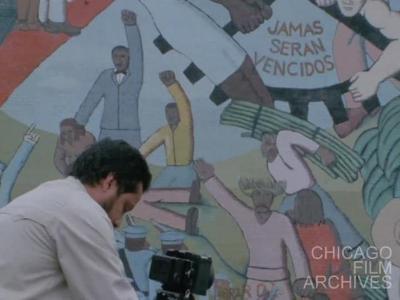
We're at Migration of a People mural with Ivan.
This is just non -sync so I'm going to go ahead and do a little bit of a sound.
Okay, this mural is about Migration of a People and what I like about this one is that it reflects the way we live.
I mean the struggle that we go through every day and for me and for many people when we talk by it's like something is telling us to remember where we're coming from, for how long we've been fighting or struggling to get over the problem that we have and that's what I like about this work.
It's something that people can see every day.
It's like a newspaper but it's something that is there.
It really tells us what's going on.
Migration, you can see the painting, you can see people fighting for their jobs and it's something that is really happening, something that in the Caribbean, in some of those countries you see that it's still going on where people try to organize to have a union and they can't because the government is against that and here in the United States even though it's not the same but we have to fight to maintain ourselves.
It's something that every day we have to do something in order to let people know that we're here to stay and that's what I like about this mural.
It reflects our ways of what we are.
It's nothing fancy.
It's not something that you're going to see in a museum.
It's something that you're only going to see in the neighborhood.
Not that many neighborhoods want this in their neighborhood.
Do you read that for me and tell me what it means? Obreros unidos jamás serán vencidos.
That means workers, organizers.
It's like getting people together.
If workers get together they can get to where they really want.
They can organize unions and being a union member does not necessarily mean that you're from the left, that you're a communist.
It's something that, especially with immigrants, even if you were educated, you're not going to get the job that you really want to.
You have to be with the people that are probably not your class.
But since you have to make it here one way or the other, if you can see those couples that say to USA, that's reality.
Just go to the airport and you're going to see people coming with only one way ticket.
And they're coming here looking for something, for a better way to live.
You see a child there in the mirror, you see people.
They're reflecting our lives.
Is that what it was like for you? Does that remind you of when you...
Yes, if you see the picture, the way I see it, it's like this happened in our countries.
I mean the soldiers killing, the farm workers struggling to work.
And finally, there is no other place to go but to USA.
Because we believe that here in the United States is where we can make it.
Even the people that are here, that are suffering, that are hungry, if they come to our country, they're going to start telling us lies about the United States, how well they live here, even though it's not true.
The majority of these people around here, they're on welfare.
But when they're going to visit their family, they will tell them that they live and how well they live.
And for the people that are there, they only think about coming here.
So do you think that was misleading, that there really isn't the opportunity here? Oh no, the opportunities are here, but not the way they...
I mean opportunities...
we had to realize that these countries, the opportunities are here.
But it's not the way they're telling us they are.
It's like even when you're watching movies, you're watching one of those movies, you don't see poverty.
And when you see poverty in the movies, it's because that guy from the ghetto is going to make it to the top.
And that's not reality.
A lot of times it's not reality.
But that's what I see here.
So what's the overriding message you think, when someone just walks by, what hits them the hardest about this mural? Well, the shooting, the killing of the soldier is something that you see.
This work had been here for, I don't know, for 20 years.
I mean, not for 20 years, since 1972.
So it's been here for many, many years.
And it's still here.
I mean, the people just pass by and it's a remember.
It's something for them to remember, not to forget about who they are.
And they had to struggle every day to survive here.
That's the problem here.
Housing.
It's like they want to move out of here.
They came here looking for something better and they came to move out of the neighborhood.
And there's so much in this work that you really had to know about your background, about your history, in order to understand a lot of the murals that are around here.
I mean, you may see a mural here and another one that's black.
But if you don't know about history, about the history of some of the minorities that make Chicago, you will not know.
You just look at a mural like something else.
Like people just painting on the wall.
But there is a message on this mural.
And it's for everyone.
Why take a picture of the mural? Because I'm afraid that something may happen and it won't be around.
Because you won't see it on the mayor's newspaper.
You won't see it on the Sun Time.
You won't see it on the Tribune.
So it's something like, you may see graffiti now, but it just happened recently in this type of work.
But I don't know if the building is going to be around because developers are taking over the communities.
I mean, no one wants to live here, but they're building more, new houses.
But it's not for the people who live around.
So when I come and take pictures, that's one of the reasons that I want to maintain the work.
Even though I don't know the people who put it up.
I don't know the people who paint the murals here.
I don't know them.
But I like to take the pictures because I would like to keep those with me.
And I'm afraid that something happens and it won't be around.
Also, the message, you don't have to...
it's clear.
In most of them, I just drive by, I just walk by.
And there are times that I see something and the next day I come and I see something different.
And they haven't done anything to the paint.
It's a different message every day.
And you're looking at the same picture.
Who, just one more question about who in the mural or what image in the mural do you relate to the most? I believe to all of them.
Because as a worker, I see the unions.
Coming from the Caribbean, the so -called banana countries, it's something that you hear on the news every day.
Soldiers killing people.
And I'm not talking about left or right.
Because the majority of the people who are dying in those countries, they don't want nothing to do with politics.
They just want to work and live in peace.
And you hear about this country, USA, and Russia, fighting for these small countries.
And it's something that, when I see everything here, because I know what's going on in a lot of people, you don't have to be educated to know what's going on in our country.
Because you just watch the news every day, and you hear about Panama, you hear about Nicaragua, San Salvador, Haiti.
So you know what's going on.
But me, since I come from the Caribbean, it's easier for me to, even though I'm coming from Puerto Rico, which is, we don't have that much problem, but we're still fighting, people are still fighting for their independence.
And this is something that is, something that is like, it's from home.
You're going to do that, and then you're going to give a good loud clip.
You have to be going.
I am recording everything.