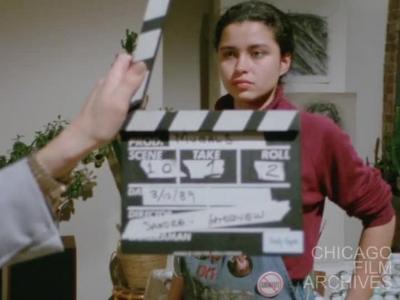
Yeah, we're going to roll off a little bit here.
Let me put a slate and then we'll be quiet.
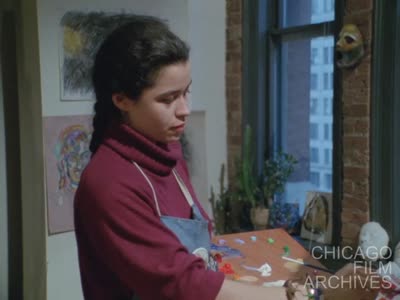
This is Wild Sound in the darkroom for Ivan's darkroom section.
We'll roll off about two minutes here.
We've got a little bit of a clamp down.
There we go.
All you have to do is just stand there.
Let's have you put the negative thing in and pull it out.
This is negative holder in larger.
Let me pull this.
Go ahead and act as if you're putting a piece of paper in there.
Okay, we're rolling again.
Okay, this is going to be assorted noises.
We're going to start with the paper thing.
This is going to be opening the paper thing and closing it.
See that purple piece of paper? Go ahead and actually slide it in.
Okay, now go ahead and put it into this divider.
Go ahead and do that again when you slide it in again.
Okay, that's good.
You all have to say this really loud, Susan.
What I'll do, Susan, is say slate.
So you want me to read it first and then click? All right.
Slape.
Sanda, interview.
Date? No.
Scene one, take one, roll one.
Okay, Sanda, if you can go ahead and tell us a little bit about your art.
Well, basically my artwork has a lot of pain in it.
It influences pain a lot because I realized when I was younger, I would always have a lot of things in my life that would get in my way or I'd have a lot of problems I'd go through a lot.
So my artwork has a lot of that influence in it.
And for example, I have a lot of hand gestures in my drawings emphasizing strength or growing or power.
And in the eyes, when you draw in the eyes, when I usually paint, the eyes have an intense feeling or the expression on the face is...
When people look at it, they can tell that there's something wrong with it, that there's pain inside of it.
That's mostly what I work with.
Very good.
Stop.
I guess so.
I mean, I hate to have you stop every time.
Stop today.
I don't know.
Okay.
Yeah, okay.
Hello, people.
How's that? Okay, it's Sandra.
Scene two, take one, roll one.
Okay, Sandra, if you could tell us...
Okay, now.
Oh, I'm sorry.
Tell us about how you first noticed the murals and how they changed.
Well, I've always lived around 18th Street, and 18th Street, that's where I see most of the murals.
So when I used to live on the north side, no murals.
I would barely see anything.
When I started to move to 18th Street, I started noticing murals and seeing what they were about.
Except I didn't know why they had so much pain inside of them.
I noticed that a lot of the murals, it was like struggling, people struggling, people fighting, swords or poor people holding babies, things like that.
I always wondered why it was like that.
Now, that was before, that was like six, seven years ago.
Now I notice that the murals aren't like that as much.
Now the murals are more happier or more simple, or businessmen with suits, or you know, that's the kind of things that I see now.
I don't see as much struggle.
It seems like if things are getting better, that's what the community seems like.
When I first started painting murals, it was hard for me because I was used to painting in the small area.
I was afraid of drawing on a mural.
I was always afraid to pick up my pencil or my paintbrush and draw big.
I always thought that it was going to come out wrong.
But when you do it, you realize that you draw the person inside of your mural.
You make them look at it and want to walk inside and join you.
And that's part of why I like it so much, just the fact that I can work large, I can show people more expressiveness, more things about myself or about the mural itself.
And you just draw people inside, and that's basically what I like about it the most.
How did you feel the first time you painted a mural? The first time, I was so scared.
I was used to painting with oils that used to be part of me.
And I started painting with acrylics.
I thought it would be much harder in acrylic.
The fact that the mural was so large, it scared me.
It made me pull away from it, and I didn't want to.
So I was timid with it, and I didn't want to paint.
I was telling my teacher I didn't want to do it.
But once I started to do it, I got this sudden confidence inside of me, just the fact that it was coming out beautiful, so much attention.
It was a big difference.
I was scared, but now I like it a lot.
Stop.
Give me that.
All right.
By the way, do you know that you want to check the lay neck? That one.
I brought this one, Tina.
No, I brought this one, Tina.
Oh, okay.
Yeah.
I'm starting to look interesting.
I guess that must be moderation for you to play that.
And it'll be, you know, it's one of those things where it'll be a fraction of a second later.
Okay.
So you want me to wait until you tell me to ask a question, okay? Uh, snake.
Sandra, scene three, two, one.
You take one, roll one.
If you could tell us about the messages in your murals and why those messages you've chosen.
Well, one thing with me was I grew up in a neighborhood where there were lots of gangs.
And that was a big influence on me.
My artwork when I was in eighth grade, seventh grade, had to do with boys smoking or guys in gangs with tattoos and everything else.
And I didn't realize that it was a negative influence.
I thought, wow, this is great.
You know, my brother's in gangs.
All my friends are in gangs.
So I just thought about it.
Well, it turns out that the more I realized that gangs were just ruining things, that they were beating up on people or beating up my brother or threatening my life, threatening my family's life, I started to put my artwork against gangs.
I started to change my artwork completely.
It was like a sudden change.
It just popped out of nowhere.
My artwork started to say, you know, get out of gangs or just, well, this was really cartoon -like things.
And my friends started getting pregnant.
Half of my friends got pregnant.
So my artwork just was saying, you know, just let's cool down on this and realize what life's more about.
So I would do things against, what do you call it, against incest, against child abuse, against everything.
So I guess what was turning out was I was realizing more that not to hang around with that kind of a group and notice that your friends are like this, your peers are like this, and maybe you don't want them to be that way and just try to talk to people to get away from it.
That's what mostly my artwork was about.
That's what I mostly am influenced on.
And can you describe how the murals affect people, the messages? Yeah, because I didn't think that they affected people that much.
I thought they would just look at it, oh, that's nice, that's interesting, until I worked at Jose Clemente Orozco.
I worked on a large mural, I think it was 5 by 11, and it was just a nice scene, sort of from Paris.
It was taken from Paris.
And the thing about the mural was I didn't think it would make that much of a difference on people because of how calm it was.
But when I went to the office a few weeks later, people were more calm, more happy, more cheerful.
At least that's what I had noticed.
And if I look at a mural in the street and if I see how it has something to do with against gangs or against homosexuals or whatever, anything that it has to do with, it does influence me.
Just by looking at it, it makes me think, and I'm sure it makes other people think.
I'm pretty sure it does.
I stuttered there.
Slate, no.
Oh, I'm sorry.
Is it actually fine, Paul? I know I changed it.
Okay.
Sandra, scene four, take one, roll one.
And, okay, starting with your favorite things in murals.
The thing about murals that attracted me, or the certain murals that would attract me the most, were the type that had a lot of activity in them, that had lots of people inside of it moving like crazies or holding up flags and just that they were pretty active.
Those are the kind that would attract me.
To me, they had earth tone colors and the colors were kind of bright in a way, something about them.
And those are the type of murals that would always catch my attention and make me stare at them for a long time.
And when I would go to the north side a lot, I would see a lot of murals with the greens, earth tone colors.
So that would remind me a lot about Puerto Rico.
I want to learn more about Puerto Rico.
I want to paint more about it.
I want to paint more about my country or about my people.
And it was hard because I was raised in a background of Puerto Rico.
So what I'm trying to do a lot with my artwork now is, well, I'm trying to gather as much information as I could to know more about it and to, in my artwork, to express it.
And maybe one day I'll be exhibiting things about Puerto Rico on the north side or, because right now I'm exhibiting a lot around here in the Pilsen area.
And I'd like to go different places.
I'd like to exhibit in Puerto Rico.
But I wanted to do with my country.
That's all I could come up with.
I just suddenly forgot everything.
I don't know.
No, I forgot.
I forgot what I had said.
I'm like, oh, no.
What's happening to me? What else did I say? You should read that.
I don't remember.
I don't see it.
Unfortunately, I didn't mark down.
There's a lot about...
Oh, this light, okay.
Sandra, scene five, take one, roll one.
So begin with the art versus the message and how you balance that in your own work.
Well, basically, I normally work with my technique the most.
I think that's what I study the most.
When I work with technique, I feel that the person, it attracts their attention more than the subject itself.
So that's really important to me, the technique that I use.
Of course, the subject too.
But I just like it.
I just like the feel of the pencil or the paintbrush, just the strokes.
I love strokes a lot.
And that's what my artwork is mostly about.
If I use a person inside of it or if I use an object, I'll try to make it as, even if it's a dull object, I'll try to make it as powerful as I could by my technique or things like that.
What kind of feedback do you get? Criticism, compliments? Oh, I get a lot of that.
I get compliments, but then again, I get the negative parts.
And it used to hurt me a lot.
I used to just lock myself up in my room or just think about it.
Geez, I wish they wouldn't have told me that way, you know.
Maybe I did something wrong or maybe they don't like my technique or they'd say that it was too scary or it was too, my mom especially would get scared of my artwork because sometimes I draw evil things.
It was just the mood I was in.
It wasn't because I had this evil person inside of me.
It was just the mood I was in.
But I'd like it and I'd like all my artwork and people would just come and say, well, no, you should just, you should change that, Sandra.
And I just, I didn't like people telling me that doesn't look right or things like that.
But from that, I learned.
Now I can take that criticism constructively and I can just, I can, from what they say, I can paint something even better, you know.
It's up to what they say.
I let myself go with other people, what they think of my drawings, and that's what's going to hopefully help me in the future.
Before it used to hurt me a lot though, and now I think I can handle it.
The pain and the evil that you say comes out in your artwork, where do you think that comes from? Is it influence of the community or are you angry? Well, yeah, I think that's what you would say.
I think it's a mixture of both the community and what I went through as a younger person or when I was younger.
What would happen was in my community, it was so bad.
I didn't like it.
It was, I'd walk around and there were just gangs fighting with each other.
I'd walk with my mom and gangs just fighting or with knives and just screaming out all these gang symbols.
So what I would do is just, I'd stay at home.
I wouldn't like to go out.
If I'd go out, I'd just play some sports or something.
But it came to a point where I was threatened by a guy with a knife.
He threatened me because I was my brother's sister and he was in a gang.
And it was getting out of hand.
My brother's best friend got shot and he just fell on the floor and was just bleeding, whatever.
He died.
And it was a lot of anger in me, and I just wanted to get it all over with.
So at that point, that's when I started creating all these, the paintings, they started getting more evil.
And then just to think of everything that I've gone through and everything that people go through.
And I just didn't feel that.
I felt, why do we have to go through this? Why is life so rough? And that's what my artwork was about.
It was just everything all put together in one.
And that's when it would get powerful.
And that's when people would criticize it the most.
So if I were to draw something real nice and elegant, like real soft, then people would say, oh, that's beautiful.
But that just wasn't what I was about.
I wasn't the type of person to be all soft and all happy all the time.
That just wasn't real.
Sandra, scene six, take one, roll two.
You talked about how the murals brighten the community and beautify the community.
Can you tell us about that a little? Well, yeah.
I feel that they do do this.
Just start again, say the murals this time.
Yeah, we're not going to use my question, so you have to get the word murals in there.
You have to answer.
I pretend that you didn't say a thing? Yeah, pretend I didn't say anything, because we're not going to hear me.
Okay, ask that question again.
About how the murals brighten the community, beautify the community.
Our murals do brighten the community, because whenever I was walking down the street and I would see a mural, it was a happy sight.
For other communities, like when I would walk down Archer Avenue, I really don't see any murals down there.
I see nothing, as a matter of fact.
And you just walk down the street, it's not as exciting as when you walk down 26th Street, for example, which is where I live.
When you look around you, there's murals everywhere.
They're just always brightening up the community.
And I felt that when gang members would always write their graffiti on the walls, if you would put a mural on that certain wall, you would paint over it.
They would respect it.
There would be the sudden respect for the mural and the sudden respect for the artist who painted it.
And they just wouldn't touch it.
They'd back away.
Maybe they'd go to another wall, but if you were to paint another mural there, they'd back away too.
And it would just make everyone a lot more looking at it.
I would feel that it brightens things up.
That's what I felt.
I felt that people would look at it and suddenly be happy.
That's how I felt, at least.
So I think it would brighten up the community.
You had talked before about your Puerto Rican heritage and wanting to include that in your art.
What is it about Puerto Rico, that heritage, that you want to communicate or you feel close to? I think just the strength of it.
I would say the strength of being Puerto Rican.
I would say to let people know that we're fighting or let people know what's happening right now and just show them my opinion in just an artistic way.
That's what I would really want to focus.
The only problem is I have to know more about it.
I'd like to go down there to travel in Puerto Rico, look at their mural paintings, just look at the sites.
It's so beautiful.
You can draw beautiful landscaping.
I need to know more about it.
That's what I felt.
My artwork should have more of Puerto Rico involved inside of it.
What is your personal ambition when you look to the future as an artist and as a muralist? What do you want to accomplish? What I've always wanted to accomplish was to be known already by the age of 26 or 27, to be known, to be asked from different countries.
They call me just to go over there and paint or make a workshop.
That's what I've always wanted, to have my name in books published or to exhibit in museums that only the best artists exhibit in.
I would want that.
I would want children to look up to me.
I would want them to look at me and actually want to be with me or actually want to paint like me.
For me to be such a big influence that suddenly I'd stop when I'm really against gangs.
Maybe I'd make a big influence on that.
I just want to really be set somewhere financially, for one, and just have people know me.
I just want to be known.
That's what I want to do in the future, hopefully.
If you could paint any mural, any place, pick any place and paint any mural, where would it be and what would you paint? Where would it be? I don't know exactly where it would be.
I've always wanted to go to Africa to paint, but probably I'd take some of Africa's ideas and bring them in.
It's something about it.
Maybe I'd stay in Chicago because I think that it's not that great.
It's just a fabulous city, but some parts of it is not that great when the gangs are around or when the people are around.
Maybe New York because New York is a place where I think they would need a little bit of...what's the word I'm looking for? Maybe they need someone to help them out or something.
Maybe I would do it against abortion or something, against incest.
That's something that I'm really against.
I just draw little things like that.
I paint a big mural, and that's what I would have to do about it.
Can we stop for a second and look at this? I forgot about these next couple of things.
Sandra, theme one, take one, roll two.
Lead into the curing mural.
When we first started the curing mural, which was last year, it was in the summer of last year, around there, it was a new idea that my teacher, Ms.
Matthews, had come up with.
She wanted to paint a mural to hang up and let it have to do with the youth, what the youth does right now.
I'd flood the road, but she wasn't hurt when she was.
Do that again and get into it faster, like last summer.
Let's do Curie again.
Last summer we worked on a mural at Curie, and we've been working on it for a while.
It has to do with the youth, what the youth does, maybe dancing or listening to music.
The teacher had just asked us to do something with that, and we just came up with drawing things about going to parties or eating at McDonald's.
It's just simple things that we do in our everyday life, like going to school or driver's ed, et cetera, and that's what we had just led into at Curie.
Okay, could you do the same thing with Cooper? How did you get into that and lead us into the Cooper mural? At Cooper, during the summer of last year again, the principal wanted just a huge mural just to put in the office, so I started thinking of a different idea, something having to do with Paris, and I just started working on it over the summer, last summer, and it was pretty successful.
It was a nice mural, had to do with Paris, and it was in acrylic.
It was a nice mural.
Do you want more on that? Or else, you want something long or just? No, I think length is okay because we've got all the other stuff, so it's just kind of a bridge.
Good, I'm trying to cut it all down.
Sandra, scene eight, take one, roll two.
Tell us about Cooper.
Jose Clemente Roscoe, we decided to paint a mural.
Dr.
Michael asked me to paint one, a mural five by 11 feet, and I decided to do it, something having to do with Paris.
It was a very successful mural.
It was beautiful.
I thought it was a great mural, and it cheered the place up.
It was great.
That showed enough.
At Curie High School, Miss Matthews wanted us to paint a mural to put up so all the students could see it.
She wanted it to involve the youth, so we all got together, and we started thinking of things like guys or girls going to dance parties, a lot of pregnancies, a lot of drug abuse, or just gang -related or drinking.
It was, in a way, a good mural, but then people started asking questions about it and asking why we had done it that way or why we kept including negative things.
But it's just part of what it was.
It was just part of the youth.
That's part of us, and that's what we wanted to draw.
That's what we just decided to paint.
Is that better? Sandra, scene nine, take one, roll two.
You talked about how your artwork has changed.