Okay.
Scene six, you're rolling.
Scene six, take one, roll two.
It's for the branches.
Yeah, the, you know, the drop of the tree and everything.
Scene seven, take one.
He said we should, uh.
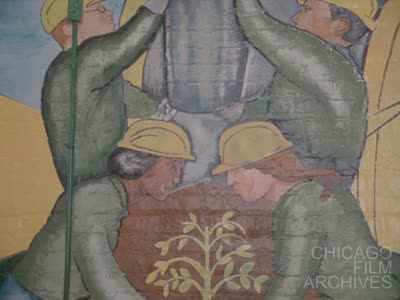
What are we going to name the mural after he finished? Oh, yeah, we have to come up with a name.
So I had one where he said everybody put, done, and we put them in a bucket and we take it home.
I thought of putting it up there on top of the dumpster.
What do you think? Well, no, to the honor of their working class or the working men of part of the district, because I remember these are all our traits and how would you say, labor.
Unity and people.
You could put like a banner up there and then write whatever it is.
It must be written in the banner.
In the banner, yeah.
Maybe somebody hold a banner.
It's an idea.
Put Casalgazipalcos.
A Reiss Post -Union.
Something like that? That'd be good.
How you can place it almost anywhere? Well, you can place it anywhere, but the idea is that this is the center of the picture.
It would be nice to be on top of it.
When everybody look at it, can read at the same time what is, what the signs are from the, you know.
Like I said, you can keep working over and over on this stuff because it all needs to be like the can and everything else needs to be retouched again.
You got holes and we're going to make the lines.
And then the symbols that we're going to put up on the top there like a snowflake or whatever.
When I say we, I don't mean me.
I mean, you know, I have to because anybody listen to we.
What is it? We'll give you a paintbrush.
We'll give you a paintbrush.
It's good.
Well, most everybody can.
He's brushing his hand one time or another in this little.
Even Escudero went up there in Iceland.
Dennis.
You still got to do the windows and then put some trees on there, you know, like it's supposed to be.
By the way, where is Dennis? Dennis, I left them outside.
We should bring him in because he's part of the mirror.
He may as well bring him in and all those figures got to be like, you know, retouched to give more dimension.
When you say dimension, what are you telling me? Explain.
Not to explain.
All right.
That sounds like 3D.
The school of key.
I'm looking at it.
It's pretty.
There we go.
Hey.
Ready? Okay.
Scene eight, take one.
You have to tell me that you're also watching the time.
I have to say that they get in so much.
But take off your hat because they're going to say, hey, this one is watching the time.
You can see what happened.
Come on, Hector.
No, but first, I looked at that corner and I couldn't see anything else.
You're going to talk in Spanish.
You got to look at him because I don't understand.
When I look at the handle, I just say, what is that? But then you have to throw it.
And then you can grab the concept of the truck.
Remember, you used to tell me that's the truck.
That's the truck.
You only see the handle.
Because I knew that was the handle of the mower.
That's why I got up there.
Maybe you put two back up lights there.
Definitely.
It's got to be done.
Because when you look at it, you cannot grab it.
But then when you get more attentive, then you can get it.
If you put the two lights in there and make it more distinctive, that it's a truck.
And then some lights up there on the top of the roof.
That's what he was talking about.
Because before, I just looked at the handle and I knew that was the handle of the truck.
But I could see the truck.
What is that? What is that? Boots.
Boots.
But that's too wide.
He wanted to take that off because when they were painting it.
If he was painting it, he would take it off.
He stopped by the plant and said, you said that, come on.
Because when you...
When you trip, you trip it and you fall out.
You go there.
And if you just want to hear it, don't go all the way to no limit.
Actually, Susan, you don't even have to do it in front of this face.
I can just get you right there.
You can do it in front of your face.
Alright, that's a good idea.
Jose Guerrero, reel two, scene one.
Look at the government flag.
Just once.
No, that's enough.
Okay, anytime you guys are ready.
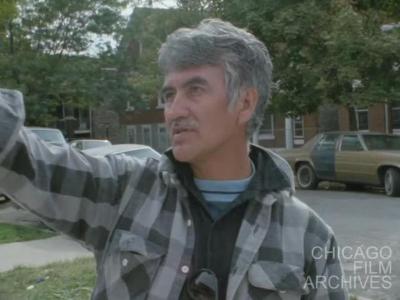
Jose, I thought maybe you could tell us a little bit about what this mural means.
Well, the mural is, like I said, we're using a lot of symbols there, see? And instead of using actual figures of gangs and generals and diseases or whatever, we used a storm on top of the dove there.
And as you can see, it's part dove, it's a dove, but it's also like a thunderbird, you know, with the sides.
So it wouldn't look so timid, you know.
Sort of like dove and eagle? More aggressive doves, more like it.
As opposed to the regular peace dove that everybody uses.
So can you tell us how you started this mural and what steps you've been through? Well, what we did was, you're talking about from the beginning, we primed the wall, we wirebrushed it first, see? After we wirebrushed it, we put the base paint, and then we start doing the geometrical lines.
You know, like crisscrossing circles or whatever.
And then we start, whatever figures we got on the sketch, we figure on a way of putting it alongside the lines that are already on the wall.
Using the lines because then they will fully cover the whole wall, see? And take a lot of space.
And then you cover it in the, you use different colors to fill in the space.
As opposed to a lot of figures, you know, what I was saying.
And why are you doing that? What's your idea about composition? The composition, I don't worry about the composition because once I do the lines, I can see where everything goes, see? And then, like putting to the side doors, we put one figure on one side and then a boy.
And then the girl on the other side.
Okay, now, it's not to use so many figures, we use the girl that's doing away and burying, you know, like the old order.
You know, the reactionary politics or whatever.
She's done that already.
And then on the other side, this boy here is supposedly playing in a clear, more serene environment, free from the storm, as we call it.
How did you decide on the colors? Well, the color, we start playing them out on paper.
And then, since it is a building, you got to figure out how the colors look like from maybe four blocks away.
So you're coming down the street on 28th Street, you can see certain colors already popping out.
You can figure out what the figure's about, but the closer you get, then the color starts to make sense.
The darker colors, then the lighter colors, the darker colors meaning, you know, the turmoil, and then the lighter colors bringing things into a brighter surrounding.
How did you decide on having the dove sort of behind the door, embracing the door? Well, because the door stands in the way, so we were going to use those white pillars there, so it could be another part of the dove.
But then we decided not to do that.
Instead, it's behind the door.
And the reason it's behind, because that's the only place we could put it.
You know, when we did the circle for the head and then the lines, that's about the only place that would fit in.
Then, of course, I had a lot of technical advice from, like I said, Duarte and Demian.
He's very familiar with using the lines and geometric figures.
Was there a group of you that were planning the mural, or was it most of you and Ipdo? No, I started.
And then I always do this.
When I start a mural, I always start it.
And I don't mind seeking help from other people, coming to see it and saying, well, you should do this or do that, you know.
And usually, following the advice, it comes out pretty good.
I don't mind listening to other people.
Why don't you guys talk a little bit about the meaning some more, you know, kind of what it means, the overall meaning to the community, impact, that kind of stuff.
Well, as far as the community, you know, like there's a lot of gang violence in this area here, like in any other area in Chicago, I suppose.
But this is mostly like an area where a lot of the young kids get involved in.
So the meaning of the mural means, what I said before, the storm on top, you know, means the turmoil and whatever's happening here.
But not only here, you know, the storm indicates even international politics, you know, the threat of the Third World War and the threat of more drugs coming in.
It interprets in that a storm can be anything.
So the name of the mural will be, we will stop the storm, meaning the younger people, because a lot of the older people, you know, they kind of shy away from that, you know, from doing anything.
But the young people are the ones more daring to either get involved in a negative thing or a positive thing.
And I believe that they will get involved in more positive things in order to try to stop the storm, you know, like do whatever has to be done to stop the Third World War or stop the drug traffic into the U .S.
And I think that's the reason why the mural is being supported by the, which is, you know, actually nobody's doing anything about it because it's being supported by the system.
The contrast is bringing drugs in and people profited from it, so nobody wants to do anything about it.
So what kinds of responses have you gotten from people as you've been painting? Do people come by and say things to you? Well, yeah, the people, like when we were working on this morning, a lot are more interested in the kids getting involved in the art, you know.
So they would ask, where do we teach art or can they join in and help? And of course we tell them, yeah, because it's a project for the community and there's about eight kids working on it.
You know, since I just got back, but then by tomorrow they'll probably be helping out.
And then we get two or three kids to be working at a time because you can get them on the scaffold because they might, you know, fall off.
Which should happen one time.
But it wasn't a kid, it was somebody else.
So do they come over and ask you if they can join in? Yeah, most of the time, yeah.
Or they just, you know, say they want to paint.
We tell them what areas to do and they just do it.
Like you see, we use a lot of flat areas so that they would have no trouble, you know, mixing paints or anything.
If there's any mixing to be done, you know, the guy that's more familiar with it will do it.
Me or whoever directs on the project.
Do you think everybody can understand the message pretty easily? Well, the idea is to make it simple enough.
In my case, we try to make it simple enough so that they can relate to it.
You know, the dove, anybody can relate to the dove, you know.
Anybody can relate to that.
And of course they see the storm and everybody knows that something's wrong, you know.
That it's not a pleasant, it's not like a sunny sky or nothing like that.
And that the dove is black in it.
And then they ask, well, what do the colors mean? Well, the colors means that it gets brighter, things get brighter.
But it's up to the younger people to, you know, whoever's daring enough to get involved in stopping the storm, you know.
And on the other side with the girl, what kind of symbols did you use to portray her message? Well, the girl, she's standing on top of a grave, you know, actually, you can see.
And then you use swastikas, you know, swastikas are still very much in vogue now.
So I work over there in the north side and I see a lot of swastikas and a lot of natigraphy, you know.
So a lot of people say that's an old symbol, and it's not old, you know.
It's brand new, as far as I'm concerned.
Because you got the parade over there by the clan and all that.
So in her case, the symbol is, you know, racism, the swastika.
Which originally it wasn't meant for that.
People were using the swastika for other things, you know, the Indians were using it for something else.
But then we got the, like the gas mask, you know, we got daggers.
We got the crucifix, which is not to put down Christianity, you know.
That's not the case.
The cases that cross is loaded with money inside, as you see in the picture.
And it talks about the prime time religion, you know, as opposed to old time.
Like on TV they're making a lot of money out of it.
So that's why it's about, she's burying all that ignorance, you know, of whatever oppression the people are now.
And the cross is loading out all the money.
It was actually a hollow cross, not a real.
Some people say, well, this is putting down Christianity with a cross being put down like that.
And I said, well, no, it's not a real cross actually.
It's hollow inside, you know, you can see it's nothing inside, you know.
No, it made no difference, no.
It could have been the boy, just that it happened that I saw a drawing, it looked like a girl's drawing, that's what I put there.
Yeah.
And is the boy reaching for the sky? Is that the idea? Well, the paint is not finished yet.
And one of my colleagues, Valadez, started working on it and he's got some ideas he's going to put something up there.
I don't know what.
But the kid, mostly he's just playing, see.
I mean, he's playing in a clean environment, you know, with no pollution or whatever.
That's it for the film, but if you guys want to keep talking to him, you can.
I'm going to put in another reel so I can get the murals themselves, because we can still use them if you don't want to.
Do you have a couple more things you want to talk to him about? Sure.
We could talk about the other murals too? Yeah, sure.