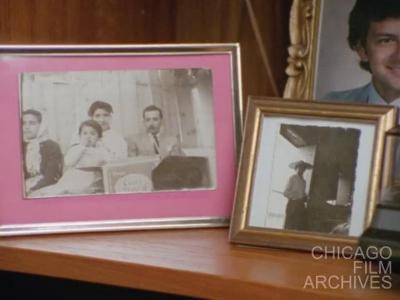
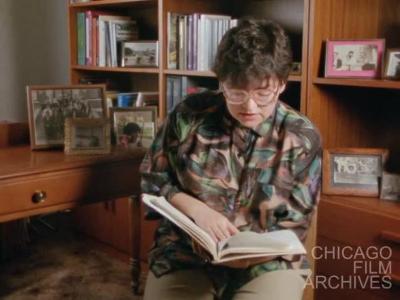
Scene ten, take one.
So try to think back what it was really like coming to this country, your initial impressions.
The contrast? A lot of my reminiscence.
I think it was the first time I had ever been in a country where I had nostalgic memories have to do with places at this point in my life.
The contrast, I'll try to illustrate it.
The region where I spent my childhood, Ayutla was a small town.
I think at the time there was around 2 ,000 people spread over a pretty wide valley area.
It was surrounded by mountains and there was two rivers, major rivers passing through.
I spent some of my time with my father's parents and there was even more in the rural section, more isolated, less people.
What I recall is again the feeling of the mountains, the air in the morning with the morning dew.
We usually had fog, it was like clouds.
I remember enjoying so much.
What appeared like the heaven had come down to the mountains so we had this fog covering the top of the mountains.
The sun coming through so there was this silvery glow to the mornings.
The other things I recall are the smell after rain.
Streets were dirt roads and just that smell was something that I enjoyed.
Until this day I enjoyed especially being around the parks or the smell of grass and the earth after rain.
The other thing was the clearness of the environment.
There was no fog, there was no smell of smoke.
One of my earliest memories of Chicago was when we drove into Chicago coming by way of the Skyway and seeing this reddish -blackish glow covering the city.
Which is a premonition of some kind of doom or gloom.
I was a pollution of Chicago but it had these other meanings for me.
The neighborhood where we did live in a different house for a while but I don't recall that time.
The apartment where we lived, the one that I recall was the one where we didn't have any space.
There was the alley, it was concrete and garbage and the sidewalk all concrete so everything was concrete.
We had a tree which I loved, that tree next door, the only thing that I could connect to.
Different architecture.
My grandmother on my father's side, her house was built of adobe.
Also that memory of the smell of the house after rain was pretty much a smell of earth.
Here there was the concrete that Samantha would, different way of designing.
These were one family homes with usually a space for a garden and very open.
Lots of windows and our apartment didn't have that.
It faced the back so there was very little light coming into our house as well.
Emotionally the memories just clashed and elicited a sense of homesickness that at this point I even resist eliciting in myself.
I think that this was an experience that my parents as well as other family friends had.
As a result of that we had little processions to Grand Park and to the Lake because these were places where a little bit fragments of home could be nurtured and carried within ourselves.
Okay, thank you.
Speed.
Scene 11, take one.
Wait a minute, wait a minute.
Okay.
Scene 11, take one.
Now I'll wait for my cue.
Okay, whenever you're ready.
To give you a sense of what it felt like to a young girl or teenager living in the neighborhood that I did, just a few years, I think it was three or four years after I'd come into the United States, one of my teachers...
I thought you were going to grab, I tell you what, you could do it over and if you could take...
Speed, we have an airplane also.
Wait.
Yeah.
It was so quiet.
Okay, so...
Scene 12, take one.
This is something I wrote...
Just once, okay, wait, now, okay.
This is something I wrote when I was I think 16 or 17, which expresses some of the feelings about growing in that neighborhood.
It's in September and it starts, today we celebrate Mexican Independence Day.
Who is independent? Who is free? The city is so noisy.
There are so many sounds.
Car wheels screeching, horns blowing, sirens wailing, radios blaring, loud TVs spearing out meaningless sounds that sound like human talk.
I hear my neighbors arguing or celebrating.
Preachers preaching, Jesus people out, saving people, crying, repent.
Vote for me.
This is the way.
Everybody's talking.
No one says anything.
Let there be silence.
I can't hear myself with all this noise.
Everybody's afraid in the city.
We fear ourselves.
We cannot face what we are.
We fear each other.
We hide behind a dial.
Our doors are securely locked to keep intruders out and keep our wealth within.
We cannot walk about the city streets freely.
There are certain areas that cannot be trespassed.
White does not live in Black Street.
Black cannot live in White Street.
Birds of a feather must flock together.
Look out.
They're out to get you.
Don't go there alone.
Always look behind you when you walk the streets at night.
Somebody was raped.
Somebody was killed.
There are worse fates.
To live and be afraid.
We all wear some type of armor to defend ourselves because we are afraid.
We surround ourselves with walls to keep intruders out and keep ourselves within.
We are afraid.
We are feathered by fear.
But today we will celebrate our independence.
And speed.
Scene 14, take one.
Okay, when you're ready.
Thinking back, my exposure to the murals, which opened the rest of the world, for me, they were a source of inspiration for me.
That the curiosity that I had, anyway, that I could trust it.
And in college, where I was exposed to different cultures, different peoples, all of that continued to nurture.
I don't know if it's an urgency, but the desire to, as an individual, be more open to my experiences, break loose from the sense of isolation that I experienced as an immigrant.
And...
Do we have more time? I'll open you and how you're in a different place now.
In part because of the murals.
Scene 15, take one.
Okay, when you're ready.
The murals provided the inspiration that allowed me to nurture the curiosity so that I took paths that my family had not taken before.
I went to college and then decided to go to graduate school, went into medicine.
And after that, psychiatry.
I feel that all these things are connected in that, in a sense, I became the translator.
I continued my role in the family, but in a way that opened up murals, if I may use that word.
That were not, and that perhaps are not there still for my own family that are not available as options, as ways of living.
Or...
And the one desire, I think, is that more people in my community, in my own family, also experiences breaking out from the, perhaps the protective walls that we also have built around ourselves.
Was there one more thing you wanted to do? They kind of helped inspire you to the things you've been able to attend.
Scene 16, take one.
Okay.
The murals provided inspiration which allowed me to break from that, the constrictions that I felt.
These were invisible constrictions, in a sense.
And so that I took paths that my family had not in the past.
I finished high school and went to college.
And then decided to go into medicine.
And finally, psychiatry.
And in a way continued my role, but in a way that opened worlds for me.
Both as far as concepts and geographically, too.
And...
Thinking back, my hope is that...
That sort of, that sense of inspiration also would become available to not only other members in my family, but also to other members of the community.
So that they perhaps be inspired to also open up to experience, to other experiences.
Scene 17, take one.
Okay.
For an individual to grow beyond their...
Themselves, beyond their boundaries, they must dream.
In a sense, they have to dream up themselves, what they will become.
For a community, I think that at a certain level the murals provide this process of being the dreams of the community.
That allows the community to grow beyond itself, to evolve beyond itself.
I think I recall the...
That was pretty much what you said.
Scene 18, take one.
Okay.
One moment here.
Okay, anytime.
For an individual to grow beyond themselves, to evolve, they must dream.
They must dream themselves.
A community, the process in this process of growing beyond itself, murals are or can be used on a certain level, not conscious, as these dreams that allow the community to see what they might be and what they can become.
Okay? Okay.
Alright.
This is scene 18, take one.
Presents also.
Could you guys in the kitchen be quiet just for like 60 seconds so we can get presents? Okay.
You can talk.
Thank you.
We have...