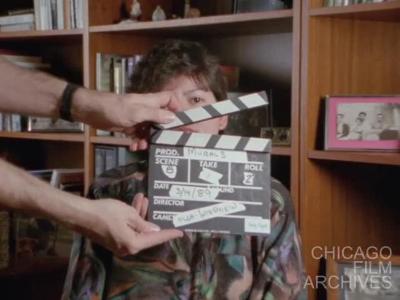
Olga 3/14 Inter. RL #1 / Murals

Transcript (Download)

Scene one, take one, roll one.

Okay, so if you could tell us a little bit about Ayutlal coming to Chicago.

Well, I grew up in a very small town in Necola, Ayutlal, Jalisco, which was around 2000 at that time, but it was pretty much spread in a valley, lots of mountains.

And at the time that I was there as a child, they had just built a dirt road that went through there.

This town happened to be on the way of a very popular place called Talpa, which is where a virgin was supposed to be doing miracles.

So it was actually an exciting place to be at, and that's probably why they built that road.

Pretty rural people made their living by planting corn.

They had their own cows and had their own gardens and things like that, fruit gardens and vegetable gardens.

That was in contrast to Chicago, where the house I remember where we moved to didn't have even a yard.

It was one big apartment building, and my mother was very concerned about safety, so we spent most of the time inside the house, which was a two -bedroom where there was usually three or four kids, and we got up to eight people, so it was quite crowded.

The coming, the change, the switch was quite shocking.

When I was used to going hiking up the hills by myself or just with another kid, even at the age of eight, we usually accompanied our cousins going hiking, or we went to the river to wash clothes.

Here we couldn't go out at all, so the restrictions, the limitations, and that sense of fear, too.

We didn't know many people around in Chicago.

Over there we knew everybody.

The other things was, again, I was so used to the mountains, and we had two rivers that sort of framed the town with mountains on the other side, and so I missed it terribly.

I missed that.

The weather was completely different.

Different climate over there was usually in the 70s.

We had our dry season and rainy season here.

We came in the fall, so winter was quite a surprise.

With the snow, I was curious initially, but after a while it was just too cold.

It was very different.

I'd forgotten the flavor.

I tried very much to forget the emotional flavoring of this big change, rather big change.

I am picking you up pretty good here, Ron.

Oops, sorry.

Here it's still a little bit.

Same two, take one.

It's a lot quieter now.

Okay, Sue.

Okay, so if you could tell us a little bit about the background of the problems in the community and the coming of the murals.

Okay.

As a child and a teenager, there was a strong sense of isolation, of being different, and not in a good way.

The difference was negative.

There were few people like me in the neighborhood, and we didn't have the same kinds of shelter, the same kinds of food.

Everything was very different.

There was also a lot of sense that we couldn't do anything about the isolation, the problems, which were a lot of gang violence, city services not being provided, et cetera, et cetera, just a lot of things.

So we started going to Howe House, which in the early 70s became Casa Aslan, which was a place for immigrants to go and find services and find about information.

And it was going to Casa Aslan, especially after they started painting murals, that I think the community, as well as myself, broke from that sense of isolation.

Okay, very good.

Scene three, take one.

Okay, Sue.

So tell us a little bit about the murals at Casa Aslan.

For a child's eyes, or even a teenager's, when you are feeling, again, very isolated, seeing these giant figures on the wall of people that looked like you, of people that you read about as you were growing up, people that my grandfather used to talk about.

He didn't know how to read and write, but he could tell us stories about the revolution.

It was like bringing memories of home, memories of home.

So they had a special coloring, emotional coloring, besides the vibrancy of the very murals themselves.

And they became a way that I felt as a community, we were expressing our memories of home and our hopes for the future.

Some of the murals at Casa Aslan, the initial ones, again, were pretty much of sort of a revolutionary theme, which is what we needed.

And then, one day, we felt that we had a break free, something had to change in the community.

And the fact that these were paintings of people who had successfully changed things, that was very important.

And so there was layer upon layer of emotional impact, so that going there was inspiring overall.

We'll come back to anything you think we're missing.

Scene four, take one.

I think what the murals provided the observer, and that's people in the community, was with a visual image of integration, or at least transition from past homeland to present home.

And you will find in a lot of the murals, either skylines of Chicago, and skylines are usually a rural place, or maybe like an island, things like that.

So it brought, in a sense, generations together, because, for example, in my house, we talked about, oh, this is the way it was, and that's the way it was back home.

And that was integrated.

Usually, or at least some of the murals provide with a transition, a transition, visual transition, where you're here in the new home.

Certain murals that have more of a pessimistic, or at least a realistic, depiction of what was going on in the neighborhood, then go from the heroic past with temples of the Aztecs, and then to depictions of the city, where there's crime and gangs and pain and suffering, and the optimistic ones, the ones that I think sort of go beyond just a realistic depiction, then offer a solution, a way out of that.

So it unified generations.

Parents could tell their kids about the past and their roots, which they felt proud of, and offered, in a sense, hope that the future could also be glorious.

Again, the themes, there was a lot of glorious past heroic events.

And so it's not surprising at all to see Indian symbols, historical Indian themes, together with new things that are going on in the city, here in Chicago, mostly.

Thank you.

Thank you.

Do you know more about this item?
If you have more information about this item please contact us at info@chicagofilmarchives.com.