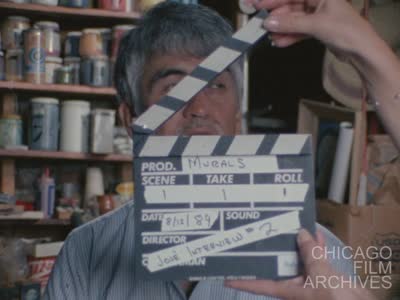
Okay, scene four, take one, roll two.
Okay, whenever you're ready.
Okay, we were working at this factory, National Video, doing TV tubes.
You know, like at that time, that was about the only factory doing TV tubes.
But we wanted to get another union in there.
So in order to get another union there, we had to do organizing, you know, get other people.
So we had this group called PGR.
We took it from the song of a guy who was singing it called People Get Ready.
Okay, so we called it PGR and the paper was called People Get Ready.
So basically it was mostly in writing, like informative letter, no illustrations.
So I started doing the illustrations for the People Get Ready pamphlet.
It was actually a pamphlet.
And we would discuss cartoons and this and that and different things happening.
We would mostly discuss what was going on in the factory and how the organizing was going along.
So it was during that time that I met this other Chicago artist who was already doing a lot of artwork.
And he was a very famous artist, I would say, whose name is John Weber.
And from then on, we went to Indiana.
I think it was Gary, Indiana, where they had a meeting dealing with miners, you know, that had gone on strike in one of the mines, I forgot where.
And they were discussing the situation there.
And we were discussing the situation in the city.
So eventually, by discussing with the miners, and which were mostly from that particular area in the south, I forgot which part of the south it was, John and me were discussing this thing with the people there.
It happened that John had got some space at the UE Hall to do a mural.
So he asked me if I would be interested in learning the technique.
So I agreed to work with him.
So we went in there, and that's when we started doing the mural.
It took us close to a year to do it because we would work and then do other stuff on the outside.
He had other stuff to do.
And plus, I was working, so I had to do it whenever I had time, you know, Saturdays, Sundays, or in the afternoons.
As it turned out, it turned out to be pretty good because we could make changes in the mural.
And we were at liberty to express ourselves more politically because the people who ran the United Electrical Workers had been involved in class struggles many years ago in the 30s, during the McCarthy era.
A lot of them had gotten in trouble, you know, and a lot of them were still around.
And of course, you know, we discussed things with them, and they agreed on certain things.
They said, let's go to the factory and do sketches of the workers as they're working, which John did.
I couldn't go that day, but John did some sketches, but then he brought them back, and then we put some sketches on the wall.
I had some sketches that I had done, sort of most of the sketches about the Klan, the reactionary forces.
And at that time, it included also the thing that happened in Chile because the mural was painted in 73, around 73.
So we included different things dealing with the situation in Chile.
But also, the stronger points were made about the workers, you know.
And Artes Cupanos, not necessarily from the elite, they come also from the working class, but not just the working class, the advanced working class, because we can't be all together because there are workers who are backward, you know.
Or they might have different kinds of politics.
So I would say there's a group of workers that even though they work, they were advanced and know about politics.
They know about art.
They know about the situations that surround them, you know.
So me and many other painters who come from the working class do this work.
We want to do it well and we learn from other people, you know, from the Mexican masters, Sequeiros and the rest of them, from the artists that are here too, you know, that come from Mexico, that come from Europe, or other artists who are doing mural work, and all of them are doing political work.
None of the murals are just painted for the hell of it, you know.
All of them have to deal with specific situations.
And like we have said before, maybe some, well in the 21st century, you know, people, other people will learn from us too, and they say, well at least they contributed not only to the art community, but to the working class, you know, to the working class movement.
Because working people don't just work, go to the factory and come back, you know, they do a lot of things.
They read politics, they discuss politics, you know.
In my case I discuss politics and also do art.
It really is.
It is, it is.
Okay, scene five, take one, roll two.
Like Carlos Cortez, Ray Vasquez, and me and the other artists, and myself, we tend to say that we are mostly cultural workers, you know, because artists seem to have an aloof look to some people, you know.
They say, you're an artist, you must have a big studio, you must live in a fancy place, you know, or you must have some special talent, you know.
We don't see it as that, we don't see it as a special talent or whatever, you know.
We see it as something we're doing not only to educate ourselves, but to educate also the community.
Like when we're painting, we're artists.
People see us as, that's the artist, or that's a muralist, or like the kids in the neighborhood, some people say, that's a mural man.
But in that situation they say mural because we're close to the mural, we're doing artwork.
But if I'm at work, a lot of people don't see me, you know, as an artist, they see me as somebody doing a job, you know.
So if we have to do a clean -up job, then I'm going to say, where's the artist, or where's the mural man, they say, where's the garbage man.
So over there I'm known as a garbage man.
And if I'm close to a wall painting, I'm known as the mural man or an artist.
Depends on what kind of brush I got.
If I got a brush in my hand painting, I'm an artist, or if I'm picking up brushes we just cut, you know, from the bushes, then I'm a garbage man.
There you go.
But basically we are people who, we are cultural workers.
I mean I would prefer that, as other artists prefer it.
But there's nothing wrong with people who want to be called artists, or whatever, you know.
It's all right with me, just that I myself am more comfortable being a cultural worker, like Cortez or like Marco Rayas, like many, many other artists.
Okay, scene six, take one, roll two.
Okay.
Mural painting has been around for many years.
When the cavemen were doing it, then later on people would say that these people were backwards, that they were dumb, that they were like animals and this and that.
And just recently they've been saying that they weren't as dumb as they think, you know, because they were using shading and they were using different techniques.
Some do better work than some of the others I know.
Anyway, I believe that this type of art, as they were doing it, they were doing it for a purpose, they weren't doing it just to decorate the walls.
We are not doing it just to decorate the walls.
So I figure that along the way, you know, even into the 21st century, even if the murals do deteriorate to some extent, they will say, well, these people that were doing it, just like they were saying about the cavemen, weren't dumb.
They knew what was going on.
And they took politics and then they formed their own ideas.
And then even though they're not here, the mural service is something that was hurled at them so they could see it and try to figure out and try to understand the situations that were happening then.
And they will say, well, these people really meant business.
They weren't just decorators.
They were involved in politics.
They were concerned with what was going on around them, you know.
What was going on in Central America.
Hopefully, by that time in the future, when people are looking at it, things will be different.
That the people in Central America won't have the death squads or they won't have, you know, a company like the United Food Company or foreign investors dictating the way they should live, you know.
And we hope that when they look at our murals that people have documented, they will say, well, these people had the right idea, you know.
We should continue to record this prosperity or whatever they have.
Then they will continue to continue to do murals, public art, in other words, so that many people can always see it, always see it, you know.
Just as people know about the caves, they will know about our murals in the 20th century.