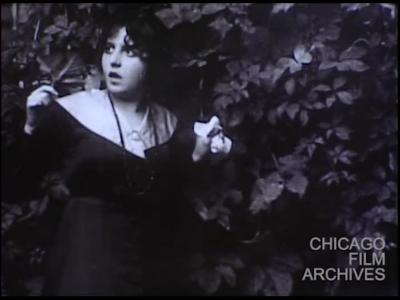
Beverly, I've been meaning to ask you for so long to tell us something about the olden days at the S &A studios.
Oh, my dear.
Well, at the drop of the hat, I can talk about that.
Because it's quite a remarkable bit of history.
You see, the S &A studio in Chicago was one of the finest in the world.
I believe the first studio that Pathé did was in the 90s.
And of course, they had all the equipment, everything was brand new.
It was an entirely new technique, the way of making films.
So everybody was fumbling a little bit in the dark, but endeavoring to really do an excellent job.
And I can remember that we had tremendous, cleaved lights overhead, great big things.
And below that, they would have what they called an arc light that burned carbons.
And if you worked anywhere near those arc lights for a half a day, say, you would go home at night and your eyes were sunburned.
You'd wake up in the morning, be as red as your dress, and in great pain, and your eyes would water.
So maybe the next day you didn't work.
You had a vacation because you couldn't be seen, you know.
And it was a very painful deal.
But finally, they got better lights and more sensitive and a curious thing.
At this period, they wouldn't allow a shadow on your face, a shadow on the floor.
Everything had to be pure, bright, white light.
And we had from the tripod of the camera two white ribbons that went back to about 18 feet distance back there.
And you had to do all the work within the confines of those lines.
And you weren't half out.
You would have to retake the scene if you were.
And Mr.
George K.
Spoor, that SNA meant Spoor and Anderson.
You remember Bronco Billy Anderson? Of course you wouldn't.
You're too young.
I do.
I probably would.
I do.
But anyway, he would come into the studio every day looking so dignified and elegant in his humbler hat and always had a beautiful Havana cigar.
Oh, and he would come over and watch us at the set.
And we were very respectful of the big boss, Mr.
Spoor.
But he was very kind and very dignified and charming.
Anne, please, upside down.
Upside down.
OK.
Very good.
Yeah, I got you.
Hi, Anne.
Speak.
Scene two.
Take one.
Sound two.
Look at me.
Beverly, please tell us something of the people that you worked with.
Well, there were a lot of interesting people, the beginners in the movies, the pioneer days, you know.
There was, oh, Luella Parsons, by the way, took care of all the scripts, you know, that she would read them over and accept or reject them.
So she was a very important person.
And there was Richard Travers and, oh, Ben Turpin started as a property man.
What about Chaplin? Was he with you? Oh, yes.
Well, I was getting to that.
Chaplin, of course, came.
And there was a great deal of excitement about him because he always had his set enclosed, you know, with screens and wouldn't allow anyone in there.
And he would take, actually, a day and a half just to go in and out of a door, maybe with a great ladder or a old wet mop or something.
And as he would swing through the door, he would knock somebody else that was coming into the room down, you see.
So it had to be very precise with him.
He just watched it every minute.
And of course, the rest of us who were legitimate actors, not comics, we were very much offended that we only had a day to probably do half a picture.
So anyway, he was responsible for our getting a better time schedule with our directors.
They were thrilled, you know, to not have to condense their stories into a very short time capsule.
But the interesting thing was, did I say this? We're not taking it, are we? Oh, I'm so sorry.
Cut.
I'm sorry.
Oh, I'm so sorry.
Have you killed Tom? Okay.
I didn't do anything.
No, that's fine.
Oh, can we take it from the...
We're going to start it over this way.
Tell me about blondes.
You were talking about blondes, that they do not photograph well in the early day.
Tell me about...
No, not you.
Ten, excuse me.
Yet, when you come to your question.
Okay, Eleanor.
Beverly, tell us about some of the interesting people that you worked with at the old SNA studio.
Well, there were quite a few.
I bet.
Oh, for instance, Luella Parsons, you all knew her column in the Los Angeles paper.
Well, she was in charge of scripts at the SNA, and it was a very important position, you know.
And she afterwards became a...
Well, handled Mr.
Bushman's fan mail.
And, of course, Francis X.
Bushman was one of the big stars, Richard Travers.
Oh, by the way, Ben Turpin started originally as a prop man, and afterwards did a very fine picture, a comic, you know.
I suppose Charlie Chaplin was there, too.
Oh, yes, Charlie came there, and of course there was a great deal of mystery about him.
And he required such meticulous pains.
Every scene was rehearsed and rehearsed, you know, time after time.
For instance, I think he took a day and a half.
This caused great consternation in the studio.
He took a day and a half to do one scene going in a swinging door with a ladder or an old mop, wet mop or something, and he turns around and hits somebody else in the back of the head and knocks them down.
And, of course, we were the legitimate actors, you know.
We weren't comics.
And, of course, the idea was that here we were confined to such a short time, and he was taking all of this, that we felt very unhappy about it.
But as a matter of fact, it worked to our good, because the directors finally had more time to do their scenes.
But he was entirely encased with screens all around him.
Nobody could look in, and he was czar while he played.
Well, oh, yes, Gloria Swanson.
Gloria Swanson, yes.
She used to go up after school in the afternoons or Saturdays and try to get a ballroom scene or an extra part or something like that.
And, oh, yes, Wally Berry came.
Wally Berry had been in carnivals and circuses and everything, and they gave him a series to do in which he played a blonde, well, I was going to say cook, but anyway, a white woman, all dressed up in a gingham dress, and he wore shoes actually this big, like they do in the circus, you know, that flop when he walked.
And he was very funny.
He was a very jovial person, lots of fun.
And Gloria became enamored with Wally and used to come quite frequently to the studio.
And pretty soon we heard that Gloria and Wally were riding in his Bearcat Stutz, and they were out evenings dancing or whatever.
And very shortly after Wally accepted a big contract with the Keystone Cops in California, the MacSenet Studio, about six weeks later, Gloria and Mama went to the coast and they were married ultimately.
Scene 11, take one, sound 11.
Beverly, please tell us about working conditions in those days, and were you represented by a union at that time? No, we didn't have unions in those days, but they came later.
But it was, well, of course, everybody was fumbling around in the dark, so to speak, you know, the directors, the cameramen, everybody.
It was a new technique entirely.
And each day we tried to improve all our scenes as much as we could and learn by previous days' rushes, as we call them.
We'd go in at night and see the rushes that we'd taken that day.
And of course, we weren't allowed, the producers wouldn't allow you to show a shadow on your dress or on the floor from furniture or objects that were there.
You had to have complete white and dark outlines for your body.
And you know, they had big cleat lights and then broads, they called them, they were about like this, that had carbons on them.
And if you did a scene working, we'll say a half day, with those close to your eyes, even though you weren't looking directly, they'd tell you, don't look into the broad.
You would go home at night and your eyes were burning and tears were running down your eyes.
You could hardly sleep all night.
And the next day, of course, you might not be able to work at all because your eyes would be bloodshot.
And...
Beverly, didn't you tell me the other day that brunettes photograph better than blondes? Oh yes.
As a matter of fact, I went up to the studio the first time with the most beautiful blonde friend.
Her eyes were sky blue and perfectly wonderful blonde hair and slim and beautiful.
And the director took me instead of this dear friend.
And it worried me terribly because I didn't want her to think that I had cut her out of an opportunity.
But you see, with these very vivid lights, the blondes, their eyes faded.
So you hardly saw an eyeball at all.
And if they had blonde hair, it photographed white.
So you looked like an old lady.
So...
Okay, cut.
Very good.
Thanks, babe.
Call it, Toby.
Scene 12, take 1, sound 12.
Hold on.
Same thing, go ahead.
Scene 12, take 1, sound 12.
Beverly, the other day you told me that brunettes photograph a lot better than blondes.
Oh yes.
Good.
Sorry, I got to do...
That's okay.
I couldn't read it anyway.
Wait for my word action though, Beverly.
Okay.
Scene 13, take 1, sound 13.
You know, it's so funny.
People look at a silent movie today and they see all of these big gestures and everything.
They think, oh, what hammy kind of acting that is.
But this is the way we had to do.
Hey, Loretta, will you go with me over yonder? And you take their hand and you go.
And it looks so silly today.
But we only had gestures, you see, to tell a story.
And as a matter of fact, when we did at Metro years ago, Romeo and Juliet, we said every line of Shakespeare's script.
And it was considered a great, great feat to have told the story in gestures of the beautiful language of Shakespeare.
And I know that the E .H.
Southern Company and all the Shakespearean artists in New York sent their companies to see our production.
They didn't think it could be done in gestures, you see.
And the wonderful thing was that the School for the Deaf all over the country sent their people to see Romeo and Juliet because they could read the lips.
And it was wonderful.
So dear, if I do all of these things, let's go up and go to bed.
Sort of silly, you know.
But that's the way it was done in those days.
It seemed like to me that in the olden pictures that they used to go a lot faster.
Oh, yes.
Well, that was because they had fewer film slots, you know, picture.
16 to a foot.
And of course, if they ran those through quickly, you look as though you were doing all of this, you know, like a crazy person.
But.