Plant Oddities

Transcript (Download)

Here is a curious plant, which is commonly called the hair plant.

It has been named because it seems to live.

While it has, these ruts merely serve to attach the plant to some firm support.

The leaves are thrown away when they catch and hold rain water, and the plant is only found in tropical and semi -tropical regions where the rainfall is abundant.

Our next plant oddity is the pitcher plant, which prefers a more balanced diet than the hair plant and supplements the nourishment supplied through its root system by catching insects.

To accomplish this, the leaves grow in the form of pitchers, which collect rain water.

The plant then produces a fluid which sweetens the rain water to attract insects.

Some of these plants have bristle -like hairs pointing downward, which aid in trapping crawling insects.

It is interesting to note that insects are rich in nitrogen value, and that nitrogen is very scarce in bogs and swampy places where these plants grow.

Here is a different pitcher plant with an umbrella -like hood, which keeps out the rainwater.

The plant itself produces all the liquid, which fills a long, slender pitcher to a depth of two or three inches.

The surface around the opening to the pitcher is very smooth and slick, and is completely free from any hairs.

The plant also has a decidedly intoxicating effect upon insects, which finally tumble right in and are forced down into the liquid by the bristles, which do grow on the inside near the base of the pitcher.

If one of these pitchers is cut open, the entrapped insects are clearly seen, and in this case numbered almost 100.

For those who collect miniatures, here is a much smaller species of pitcher plant, similar to the one just previously shown.

Other types of tropical pitcher plants present unusual and grotesque shapes of pitchers such as this.

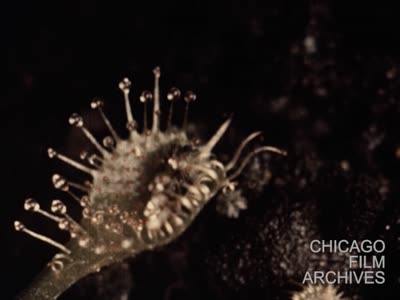
Another fascinating insect -catching plant is the sundew.

This plant is very small and is here seen through a magnifying lens.

From the center of a rosette of leaves emerges the flower stalk with a curious, uncurling motion.

Its leaves are covered with hair -like tentacles.

At the end of each of these is a drop of sweet, sticky fluid, which glistens in the sun and attracts insects.

When an insect touches one of these drops, it is caught fast, and then a most interesting process begins.

By means of time -lapse photography, we speed up this process, and here see the tentacles of the sundew pass the insect toward the center of the leaf, which then envelops it.

The sweet, sticky fluid changes to a sort of gastric juice, which enables this plant to assimilate the food value contained in the insect.

After approximately ten days, the leaf opens again and is ready for another meal.

This is truly a remarkable plant, but the strangest of all plant oddities might be considered the Venus flytrap, which also grows in wet, marshy places.

The Venus flytrap has a cluster of small white flowers, but the most interesting part of this plant is the trap on the end of each leaf.

On each flat surface of the trap are three tiny bristles, which, when touched, act like a trigger and spring the trap, which quickly snaps shut.

Now we see a fly approaching dangerously close.

Watch it.

Ah, got him.

The plant also seems to produce a nectar, which acts as a bait and attracts the fly right into the center of the trap.

There we are.

Bingo, another fly for dinner.

This plant is called a sensitive plant, and in this time lapse picture we see the leaves fold each night as the plant goes to sleep.

Returning to normal speed, we also see that the leaves are very sensitive and quickly fold if touched by some object.

After they are once closed, it takes five or ten minutes for them to slowly open again.

If a leaf is singed with a flame, the shock is greater, and the leaves not only fold, but the branches collapse.

The shock is then transmitted through the plant's nervous system to other branches, which first collapse and then fold their leaves, one after another.

A curious thing about the sensitive plant is that if administered ether and placed in an airtight compartment, it may be anesthetized so that it no longer shows any reaction.

While it is still under the effect of ether, even the flame of a match does not affect it.

However, after being in the open again, it soon begins to react in its normal way.

Other plants, too, react to various conditions, and here we see seedlings straining to adjust their leaves to absorb as much light as possible.

Here is a primrose wilting from lack of water, but when given a drink, it quickly revives.

And the following picture shows through time -lapse photography the effect obtainable on plants by controlling the light, temperature, and moisture.

.

Do you know more about this item?
If you have more information about this item please contact us at info@chicagofilmarchives.com.