Claes Chi Bat
Identifier
F.2005-08-0266
Date Of Production
1977
Abstract
Claes Oldenburg's "Batcolumn" sculpture is dedicated on April 14, 1977, outside the newly built Social Security Administration Center at 600 West Madison Street in downtown Chicago. The 100-foot tall steel structure was commissioned for $100,000 as part of the General Services Administration's art-in-architecture program, which aimed to place contemporary American art in and around newly constructed federal buildings.
Description
Begins with scenes of tourists touching and photographing the Liberty Bell and a bronze statue of Abraham Lincoln.
Now in Chicago, journalists talk to Swedish-American artist Claes Oldenburg, and his 100-foot tall baseball bat sculpture is moved into position (a humorously understated "LONG LOAD" sign is attached to the sculpture as it is driven to 600 W Madison St). Workers in hard hats attach the latticed sculpture to hooks on a crane, and it is hoisted upright. A crowd applauds as the massive screws are tightened at the base. A small group of protesters can be seen holding signs that say "EXPENSIVE JOKE" and "SILLY, ISN'T IT?"
Next, Oldenburg speaks from an outdoor stage, followed by Second Lady Joan Mondale (who was nicknamed 'Joan of Art' for her arts advocacy). Guests on stage include interim Chicago Mayor Michael Anthony Bilandic, baseball player Ernie Banks, and Michael Straight, Deputy Chairman of the National Endowment for the Arts. When Mondale is done speaking, she, Banks, and Oldenburg release red and white balloons into the air around the Batcolumn. Afterwards, Oldenburg signs autographs and speaks with the press (Chicago filmmakers Tom Palazzolo and Allen Ross can be seen holding camera equipment). Workers are seen breaking down the event once it is over, packing potted plants into a truck and collecting cables.
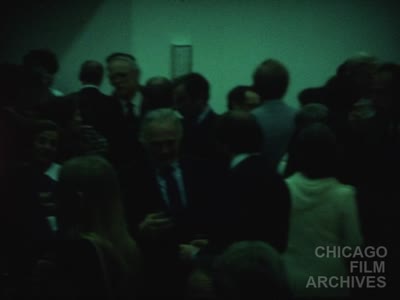
The film concludes with a Claes Oldenburg exhibition elsewhere in Chicago, followed by a banquet which includes an appearance by Art Institute curator of 20th-century painting and sculpture A. James Speyer, and a sit-down interview with Oldenburg and his wife and collaborator, Coosje van Bruggen.
Now in Chicago, journalists talk to Swedish-American artist Claes Oldenburg, and his 100-foot tall baseball bat sculpture is moved into position (a humorously understated "LONG LOAD" sign is attached to the sculpture as it is driven to 600 W Madison St). Workers in hard hats attach the latticed sculpture to hooks on a crane, and it is hoisted upright. A crowd applauds as the massive screws are tightened at the base. A small group of protesters can be seen holding signs that say "EXPENSIVE JOKE" and "SILLY, ISN'T IT?"
Next, Oldenburg speaks from an outdoor stage, followed by Second Lady Joan Mondale (who was nicknamed 'Joan of Art' for her arts advocacy). Guests on stage include interim Chicago Mayor Michael Anthony Bilandic, baseball player Ernie Banks, and Michael Straight, Deputy Chairman of the National Endowment for the Arts. When Mondale is done speaking, she, Banks, and Oldenburg release red and white balloons into the air around the Batcolumn. Afterwards, Oldenburg signs autographs and speaks with the press (Chicago filmmakers Tom Palazzolo and Allen Ross can be seen holding camera equipment). Workers are seen breaking down the event once it is over, packing potted plants into a truck and collecting cables.
The film concludes with a Claes Oldenburg exhibition elsewhere in Chicago, followed by a banquet which includes an appearance by Art Institute curator of 20th-century painting and sculpture A. James Speyer, and a sit-down interview with Oldenburg and his wife and collaborator, Coosje van Bruggen.
Run Time
0:17:34
Format
Super 8
Extent
265 feet
Color
Color
Sound
Mag Stripe
Reel/Tape Number
1/1
Inventory Number
Stamets 282
Has Been Digitized?
Yes
Element
Reversal Positives
Genre
Form
Subject
Preservation Sponsor

Related Collections
Related Places
Main Credits
Stamets, Bill (is filmmaker)
Participants And Performers
Oldenburg, Claes (is participant)
Mondale, Joan (is participant)
Ross, Allen (is participant)
Palazzolo, Tom (is participant)
Banks, Ernie (is participant)
Bilandic, Michael Anthony (is participant)
Straight, Michael W. (is participant)
van Bruggen, Coosje (is participant)
Speyer, A. James (is participant)
Do you know more about this item?
If you have more information about this item please contact us at info@chicagofilmarchives.org.