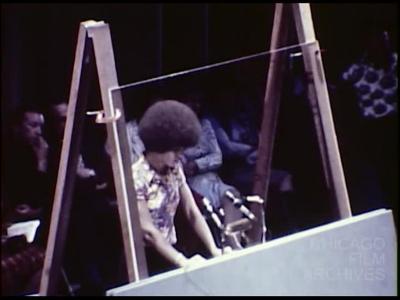
Today we are pleased to have Sister Angela Davis, the noted scholar and freedom fighter, and Lou Palmer, a well -known Chicago journalist, and Alice Pitts, one of our journalism students, to interview Angela Davis.
Angela, I'm delighted to have this chance to chat with you for a few minutes.
The first question that comes to my mind is what brings you to Chicago? Well, I'm in Chicago specifically to speak at a rally this evening, which has been organized in order to develop support for the candidates of the Communist Party who are running for president and vice president, Gus Hall and Jarvis Tyner.
Up until the date of the elections, I'm going to be speaking at numerous rallies in various parts of the country.
In how many states is the Communist Party permitted on the ballot? Well, as a result of massive petition campaigns and a lot of work done by members of the party, as well as the Young Workers' Liberation League and others who are not in the party or the league, the party is now on the ballot in 12 states plus Washington, D .C.
Of course, there are other states where Gus and Jarvis will be on the ballot as independents, although the Communist Party as such, because of all of the anti -Communism which persists in the legal structure, the party can't be on the ballot.
Why is the party, obviously the party cannot win a victory in the presidential election, but why is it engaged in a presidential campaign in this country? Well, we feel that the elections are extremely important.
We feel that it is extremely important to bring a message to people throughout the country which will expose both Nixon and McGovern for what they are, because in the last analysis, both Nixon and McGovern, both the Republican Party and the Democratic Party, are beholden to the interests of monopoly capitalism in this country.
And we feel that the reason for the existence of exploitation, racism, and the war in Vietnam, the sabotage against liberation movements in Africa, all of these things are directly related to monopoly capitalism.
Therefore, the campaign around the elections is a way in which we can talk to people in this country about the need to challenge fundamentally the whole system and bring about eventually a Socialist Revolution.
What kind of response do you get, both from the people and from the press, in terms of the Communist Party presidential campaign? Well, throughout the country there's really been a massive response, because we're living in a period where people, especially black people, and Chicanos and Puerto Ricans, Asians and Indians, and exploited white workers, are not going for all of the lies which come from the government.
They aren't going for the speed -up in all of the ways in which the monopolies are now trying to increase their super profits on the backs of workers.
And they realize that something is fundamentally wrong with not just the government, but something is fundamentally wrong with this whole system.
And so, as a result of this emerging consciousness, young people throughout the country are really listening to what we have to say and are really beginning to think concretely about building a Socialist movement.
What about older voters? Older people as well.
I say young people because the whole new thrust in the black community, as well as within the labor movement, is coming from young people.
I mean, you take the labor movement, who's challenging Meany and Fitzsimmons and all the rest of the class collaborationists who really aren't anything more than bedfellows of Nixon.
I mean, they're coming from young workers who refuse to go along with this.
What about the press? I noticed a little piece about this big announcing, the rally tonight, in one or two of the Chicago papers.
Across the country, what kind of press do you get in this campaign? Well, I mean, we understand where the establishment press is coming from and whose interests they serve.
Of course, they aren't going to attempt to make it any easier for us.
And of course, the coverage of the party campaign isn't anything like the coverage of the Democratic or the Republican campaign, but I mean, they're our enemies.
We know which side they're on.
What about the black press? Deal with them that way.
There's been a really very good response among the black press.
The Press, Gus and Jarvis have been traveling now for about eight months.
And they've done a lot of interviews with the black press and other minority press.
Buddy, I don't want to monopolize the question.
Why don't you get in here? Okay.
In the different factions of today's society, there are people that are saying that blacks should not participate in this upcoming election and others are saying that our futures depend on this upcoming election.
Just how do you feel that blacks should deal with this political system the way it's set up today? Well, of course, I believe that ultimately there has to be a socialist revolution because that's the only way in which we're going to eradicate the basis for racism and the basis for the oppression that we are suffering.
In terms of this election, I think it's very important for black people to have a voice.
Not very important for black people to vote for Nixon or McGovern, but it's very important for black people to be able to make it understood to whoever is elected that we want something different from what the Republicans are talking about, because we know what Nixon's stand on racism is.
We know that in the campaign, all the most racist, most reactionary Wallace -type forces have gathered around him.
McGovern's position may be a wee bit different, but he's come out with some really racist positions.
For instance, his support of Louise Hicks in Boston.
She's the worst kind of racist there is.
So we have to be able to make it understood that we want something different.
We want something else.
To boycott the elections is to give the impression of political apathy.
And that's why I, for one, and members of my party are trying to bring the message of socialism to black people.
And see, regardless of how the elections turn out, it'll make a big difference.
If there is a large vote for the Communist Party, if there are ways of directly expressing opposition and resistance to the established political parties and the interests that they represent, then they will not be able to continue to do all the kinds of racist things they do without a second thought, because they all know that they have an organized force to deal with.
Angela, there are some black people, at least, who are not convinced that the American Communist Party is seriously interested in the liberation of black people, that it uses black people for its own ends.
What do you say to that? Now, you talk about the Communist Party as if it's something that's separate and apart from black people.
There are a lot of black people in the party.
The chairman of the Communist Party is a black man who spent years of his life in prison, and is blind at this point because of the grossly inadequate medical treatment he received in prison.
I think that if you would seriously study both the policy of the Communist Party with respect to black liberation and the history of the party in terms of its activities within the black liberation struggle, then it wouldn't be possible to make that kind of statement that you're making.
Do you think it's possible that the American Communist Party has not carried on a sufficiently adequate public relations job to the masses of black people, or has the American capitalistic system carried on an extremely effective job on our minds? Well, I mean, we know who controls the media.
We know who controls all of the instruments of propaganda in this country at this point.
We haven't developed sufficiently to the point where we are a massive political force, and I'm not talking about just the party.
I'm talking about all progressive forces, black people, Chicanos, and all progressive forces in this country.
And we have to understand that they are going to do anything that they can, first of all, to break any kind of unity between progressive forces, because the more we are disunified, the easier it is for them to continue to exploit and repress us.
One of the very subtle ways of trying to disrupt the movement and to make people think in anti -communist concepts is, I mean, the kind of thing that the established media engage in.
And they aren't doing it, because they're any more interested in black liberation or any more interested in anything else.
I mean, and for us to fall prey to that type of thing really points to an inability to understand the ways in which the enemy functions.
You may have answered this question already, but let me put it anyhow.
There are also some people, at least in Chicago, who have raised the question whether you as an individual, after having won your acquittal, whether you are more concerned with the building of the Communist Party than you are with the struggle of oppressed people, the black masses.
Can you respond to that? I hear this quite often.
In fact, one woman sent me a letter indicating that this was one reason why she was resigning from the Chicago Angela Davis Defense Committee.
What's your response to that? Well, I think it was very clear from the very beginning of the case that I was a communist, because I feel that this is the only way in which we are going to ultimately liberate ourselves as black people.
I would not be in the Communist Party if I felt that the interests of the party were in any way opposite to the interests of black liberation.
And certainly, I don't know anything about the case you just mentioned, but my experiences since the acquittal have pointed to precisely the opposite kind of reaction among black people.
Not too long after the trial was over, I spoke in Detroit, and there was a really interesting rally.
About 10 ,000 people were present.
A lot of them couldn't get in, and we had not expected that kind of massive turnout.
And then also having been in jail for the last couple of years and having been isolated to a certain degree from what was happening on the outside, I was sort of searching for the kinds of things to say, you know, that people would react to.
And I hadn't necessarily planned to talk about communism or socialism, but as soon as I mentioned one thing about the need to challenge the whole monopoly capitalist system and to talk about socialism, there was an incredibly fantastic response, a roaring applause.
And these were black workers who were there in Detroit.
There were a lot of black auto workers, and the whole stadium was filled with black auto workers primarily.
What you're saying, I take it then, is that it is simply impossible to separate the activities of the communist party from the activities of the black liberation movement.
Is that what you're saying? What? Certainly.
I mean, otherwise, as I said before, if I felt that the interests of the party and black people conflicted in any way, I wouldn't be a member of it, because I'm interested first and foremost in the liberation of my people.
And I feel that the policy of the party, as well as the practice, has been the only consistently correct approach to black liberation.
See, I don't think that we can talk about black liberation without overturning the system, overturning the root cause for the oppression of black people.
The only way we can do that, I feel, is through a socialist revolution.
And that's going to involve not only black people, but all oppressed people in this society.
Ms.
Davis, it has been said that if the blacks were in this revolution to go communist, the same thing would happen to them, which is now supposed to be happening allegedly to the Jews of Russia, and that they would be treated in about the same way.
How do you feel about this? What's happening with the Jews in Soviet Union? From what we've heard, the Jews have been greatly oppressed.
Heard from where? From the media, which we...
And we also hear from the media that black people really are not oppressed, and black people have made incredible advances over the last years.
I mean, you have to, first of all, ask yourself who is reporting this situation? And of course, it's the media which is controlled by the ruling class in this country.
And then you have to ask yourself what are their motives? And obviously, first and foremost, the monopoly capitalists' interests in this country are interested in preventing any kind of progressive political ideas and organizations from emerging, which would challenge their power.
Now, I mean, take the Soviet Union.
There are Jews, some Jews are leaving the Soviet Union to go to Israel because they have been made to believe that the situation in Israel is better for them as Jews.
I mean, a lot of Jews, I think, have been deceived by Zionist ideas.
When I was in the Soviet Union not very long ago, I saw quite a few letters that were written by Jews who had left the Soviet Union, had gone to Israel, and had seen what capitalism was like, and had seen the oppression and the exploitation that Jews in Israel also experienced, as well as Arabs.
And they were writing to ask to come back.
Now, you talk about socialism and the present effect of socialism on people of color.
You look at the Soviet Union.
The Soviet Union has large areas populated primarily by Asians, by people of color.
I visited, while I was there, the Central Asian Republic of Uzbekistan.
And I was far more impressed by what I saw then than I had expected to be because there was a situation in Uzbekistan, in Central Asia, where prior to the Socialist Revolution in 1917, they were living under the worst kind of feudal oppression and repression imaginable, the women in Uzbekistan.
Because the traditional religion was the religion of Islam.
The women, like in many other Arab countries, other Islamic countries, wore long robes and horsehair veils.
They weren't allowed to show their face to any other man except their husband.
And if their husband suspected that another man had seen their face, that was reason enough for him to kill her with impunity.
I mean, that's the kind of situation which existed there.
And now you see women in Uzbekistan participating fully in political, economic, social life, high positions in the party and the government.
The chairwoman of the House of Nationalities, which is one of the two bodies of the Supreme Soviet in the Soviet Union, is a Central Asian woman from Uzbekistan.
Just a couple of more words about the relationship of socialism to people of color.
We were in Cuba.
And in Cuba, of course, there are vast numbers of black and brown people.
And if you compare the situation before the revolution in 1959, when there was the worst kind of racism promoted and encouraged, perpetrated by U .S.
imperialists, to the situation now, there isn't any point of comparison at all.
I think that if you ever visited the Soviet Union or Cuba or any other place where there are people of color in socialist countries today, you'd have a totally different perspective on it and a totally different notion of what socialism is all about.
But see, they don't want black people to learn about socialism.
Imperialists don't, because in the world today, who is growing stronger? Socialism, the National Liberation Forces, and anti -capitalist, anti -imperialist movements in capitalist countries.
Who's growing weaker? Imperialism is growing weaker.
Look at the situation in North America.
And they don't want us to relate to this worldwide movement because they feel that we might become a little bit more confident about our ability to win, and we might be a little bit bolder, and we might start doing more things that would challenge the power of the monopolies here.
But things are going to change because there are more and more black people, more and more people of color in this country today who are thinking very seriously about socialism, about Marxist land, and fundamental revolutionary transformation of the whole society.
Could I just shift the focus of discussion for a moment and talk about you.
How are you? People are concerned.
How do you feel? How are you after this ordeal you went through? You doing okay? I'm here.
You know that.
I'm healthy, I think.
What are your plans? I imagine the next couple of weeks are going to be pretty tied down.
Some talk about going back to your old job.
Have you come to any conclusion about what you're going to do? Well, yeah.
I pretty much decided what I'm going to do.
There was no question about what I was going to do in general.
I was going to be active in the movement for liberation.
What we're trying to do now is to build an organization, a national organization, around the demands to free political prisoners and also in order to launch a more consistent, systematic attack against the prisons in this country.
You know, I assume, about all of the various committees that developed and emerged around my case when I was in prison.
And of course, when the acquittal came, we felt that it was very important to try to keep this structure and keep the people in order to continue to demand the freedom of other political prisoners.
So primarily what I'm going to be doing over the next year is working on building this organization.
This organization should be a very, it's going to be a very broad kind of organization in terms of including people of all various political orientations.
We learned a lot of lessons from the mass movement that developed around my case.
And we have to use those lessons in order to build further movements and bring more people into a political struggle.
One of the things that we, one of the most important things that we learned was that when you talk about building a movement around political prisoners, around political prisoners in general or something that affects large numbers of people, you have to avoid all forms of sectarianism.
You can't say that in order to defend me, for instance, that it was necessary for those who got involved in the movement to also agree with my politics, to also agree with communism.
And the reason why it's so important to build those kinds of movements is that repression today does not really discriminate systematically.
There are political prisoners who are on all points in the whole spectrum of radical thought and radical political activity.
And we feel that it's very important to create a movement which will not be, which will not emerge as most movements around political prisoners emerge, namely spontaneously in the midst of a crisis situation, which means that you have to start from scratch every time there's a major case involving a political prisoner building a whole movement up in order to deal with him or her.
You have to create a sustained organization that has the ability to take on whatever cases emerge as they emerge without having to do all the groundwork all over again.
Because what usually happens is that you have a movement and then right after, if there's an acquittal, then the movement collapses because there's nothing else to do.
And we feel that a movement around political prisoners is extremely important today as a part of an anti -imperialist movement, too, because as I was saying before, the most important thing I feel is to create an anti -imperialist consciousness.
That's one of the things that I became much more aware of during the trip.
Sometimes when you're in a situation all the time, you lack overall view.
You become sort of provincial and becoming all caught up in problems and becoming frustrated when you experience a setback.
But when you look at it from the point of view of a world struggle and you know that there are people all over in the socialist countries, our sisters and brothers in Africa are struggling, in Latin America.
And when you see our struggles as being intimately intertwined with their struggles, therefore if they win a victory, if the Vietnamese win a victory, that's a victory for us.
And they see us also as carrying out their struggle here within the very heartland of imperialism.
And I became aware of the fact that we as black people, as other people of color, as people with progressive ideologies, communists, radicals, have a very special responsibility to people all over the world.
Because the U .S.
government and the monopolies it represents, they are carrying the banner of imperialist exploitation and oppression all over the world.
Can you see a growing awareness among particularly black people here in this country in terms of the need to recognize the international aspects of our own struggle? Yeah, because there's some very real reasons why that's the case.
I mean take the development now of multinational corporations.
And what's happening is that as it becomes more profitable for them to move whole plants to other countries abroad, to Taiwan, to other places where cheap labor can be, then they just dismantle a whole operation here, leaving primarily blacks unemployed, leaving them in a situation where they have absolutely no economic security.
And I think that's one very real reason why internationalism is important.
That's another reason why I think there is a growing consciousness of the international character of our movement.
I mean we were just in Cuba and Chile.
You know you hear about Guantanamo base, but to be there and see that the United States military actually illegitimately occupies a part of Cuban territory.
And while we were there they took us to a point where we could look through some powerful binoculars and actually see what was going on.
It was really a strange sensation to be standing in socialism with our feet on socialist territory and seeing US cars and people and planes and all the things that they have just a few hundred yards away.
I think that more and more countries that are subject to imperialist attacks are looking towards us as being their major allies because of the strategic position we have right here.
Us being? When you say us being? They're allies.
I mean us meaning...
Well see while we were in the socialist countries we talked about the other United States of America which includes black people, Chicanos, Puerto Ricans, all people of color, students, workers and all those whose interests are opposed to the interests of imperialism and monopoly.
When you say us you don't mean U period, S period, you mean US, us.
I mean us, all of us.
Alright, we together.
And we talked about the other United States of America.
I was just going to point out that one of the very surprising things that happened on the tour was that the Cubans presented me with their highest state decoration which is called the Playa Girona Award, the Bay of Pigs.
It's an award commemorating the Bay of Pigs invasion.
And the significance of that was that they weren't giving it to me as an individual obviously.
They were giving it to all progressive people in this country through me, black people and all of the other progressive forces here.
And it was an indication of the important role they see us as playing in the global struggle against imperialism.
I think we have a very deep responsibility to live up to that.
To go back to the political thing, and more basically to one person in particular, President Nixon.
He has stated he is anti -communist, but in the last two years he's traveled to Peking, Russia, and he's had these talks and now he's thinking about ending the war.
And so far from the way the media has covered it, to drop his friendship shall we say with the premier of South Vietnam, or the president of South Vietnam, what do you feel? Well see, look, we talked about imperialism declining in power.
The fact that Nixon went to Peking and went to Moscow indicates that imperialism is now on the defensive.
They have to deal with socialism.
They have to deal with the nationalism.
Angela, I'm so sorry.
We've got to signal that the time is up and I hate to interrupt you.
Maybe we can carry on after we get off camera.
Thank you so much.