I'm sorry, I'm not sure if I can help you.
I'm sorry, I'm not sure if I can help you.
I'm sorry, I'm not sure if I can help you.
I'm sorry, I'm not sure if I can help you.
I'm sorry, I'm not sure if I can help you.
I'm sorry, I'm not sure if I can help you.
I'm sorry, I'm not sure if I can help you.
Delegates and fellow Americans, tonight and throughout the next three months, the magic word is choice.
A choice...
The Republican Convention opened on Monday, August 5th, 1968.
...and a party with a record of peace...
It started out quietly and maintained almost the same decibel level all the way through.
...which debases the dollar...
...and a party which defends it.
If there's a third ballot, he might pick up.
Miami Beach is an island world, a strange and improbable place in this burning age of turmoil.
All plush red and sparkling glass on the inside.
Red, blue and sand -colored stucco on the outside.
It seemed to me a perfect place for a Republican Convention.
...and public participation in the emergency...
What we need is a great big dose of Republican geritol on election day.
First today, I'd like to introduce to you a Nixon paper dress, a Nixon straw hat, one of our Nixon necklaces.
It's gold and it has a Nixon elephant on it.
She's also wearing an elephant.
Bracelet.
And here's something for the favorite son in Miami Beach.
Sunglasses.
Nixon's the one.
Why is it that so many people look on the Republican Party as a party of the rich, the selfish, the satisfied, those just seeking to preserve the status quo, who really aren't interested? And out of the crowd emerged the famous old faces of the grand old party.
Everett McKinley Dirksen, senior senator from Illinois, now acting as chairman of the Republican Platform Committee.
Barry Goldwater, the 1964 presidential nominee, now running again for senator in Arizona.
William Scranton of Pennsylvania, who opposed Goldwater in the 1964 convention.
Leonard Hall, Senator Hugh Scott, Meade Alcorn, and William Miller of New York, Goldwater's 1964 running mate, now supporting Rockefeller.
And a few relatively new faces as well.
Mark Hatfield of Oregon and Governor John Volpe of Massachusetts.
Eventually even the Reverend Ralph Abernathy.
He seemed a long way from a Republican.
Heading the Southern Christian Leadership Conference since the tragic death of Dr.
King, he brought his Poor People's Campaign to Miami Beach, leading his mule train past the posh hotels, and asked for representation for the 51st state of hunger.
He was courteously seated in the Spectators Gallery.
Richard M.
Nixon had been a congressman at age 33, a senator from California at 37, and vice president of the United States at 39.
After eight years under Eisenhower, he set out in 1960 to win the presidency, but lost to John Kennedy by a small margin.
He then ran a bitter, tense, and irritable campaign for governor of California, and lost.
Always staunchly partisan, a Republican jungle fighter through and through, he was now here in Miami Beach in 1968 to collect the political debts of those he had helped in 1964 and the off -year elections of 66.
He had sent Romney packing in the early primaries, and had since built an impressive record of vote -getting.
Nelson Rockefeller, the governor of New York, had run for the Republican presidential nomination in 1964.
He had done well in the primary elections, only to be shouted down at the convention in a display of rudeness since then only matched in America by the provocateurs of the new left.
He had refused to enter the 68 primaries, and had not joined this race until after President Johnson's withdrawal.
Now he came across to Miami Beach, talking of new leadership against the old politics, as a spokesman for an eastern liberal establishment that just couldn't take Nixon.
Every statistic of Republican delegate preference showed him to be a loser, but at the same time, every poll among the voters showed him to be running ahead of Nixon.
The Rockefeller flurry was really only just that.
And as the Wednesday vote approached, the rocky organization's only hope was for some kind of far -out help from Ronald Reagan.
Six feet tall, sun -tanned veteran of 40 movies, he had come to Miami a potential candidate for the presidency after only 19 stormy months as governor of California.
Though at one time president of a Hollywood actors union, he had since moved to the right and occupies a position in the party in American politics, only challenged by Barry Goldwater and George Wallace.
The Rockefeller forces felt somehow that his strength among southern delegates could be used to stem an early ballot Nixon win.
But Nixon quickly made an accommodation with these southern states, and the symbol of this was Senator Strom Thurmond of South Carolina, wearing his Nixon hat on the convention floor.
The real hero of the Republican party turned up on the podium Tuesday night.
Barry Goldwater, the 1964 nominee, received by far the greatest ovation of the convention.
It was hard to tell for a while if this was simple nostalgia or the beginning of some kind of regressive landslide.
It reminded me of that night in 64 when he had been introduced to the convention by Richard Nixon.
The real Iraqi demonstration developed, but the days when a convention could be changed by this were clearly past.
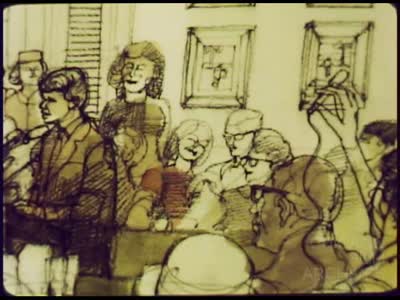
I made this drawing of a Wisconsin delegate, standing there with his Nixon button, quietly wondering what had gotten into these folks.
Reagan and his friends were standing there, and the crowd was just so excited.
Reagan too had faltered as the south was slipped out from under him, and the predictable became even more so.
I shall recommend to the convention that it nominate for vice president on the Republican ticket, Governor Agnew of Maryland.
Then the convention came to life as young people in the audience expressed opposition to Agnew's selection.
Signs had been passed out to fortify the celebration.
These kids tore them apart and created their own protest material.
They clearly preferred someone like Percy of Illinois or Lindsay of New York, someone who had expressed concern for the people of the ghetto in opposition to the war and the draft.
But this incipient revolt was put down when Lindsay rose to make a seconding speech for Agnew.
So it ended as it had begun, more of a coronation than a convention.
And as it ended, word filtered across Biscayne Bay.
Three men were dead, and the National Guard had been called into a place in Miami called Liberty City.
The Democratic convention opened in a city under siege.
Chicago's Mayor Daley had yet to recover from the fires of April when the electrical workers went on strike, bringing convention communications to a standstill.
He had no sooner settled this on a partial basis than the cab drivers struck.
Now there was talk of hippies and yippies and a hundred thousand young people buttonholing their delegates and marching for peace.
Mayor Daley asked for the National Guard and put the police on overtime.
Eugene McCarthy had asked most of his supporters to stay home, but not all the peaceniks were McCarthy people.
The Democratic argument began early.
Where the Republicans had only one serious credential challenge, the Democrats had near a thousand.
Platform and credential controversies lasted for a week and finally ended on the floor when Julian Bond of Georgia came to get his seat and those of his constituents and the governor of Georgia went home.
Hubert Humphrey, vice president of the United States, came to the convention in odds unfavorable to win among the delegates, but saddled and hard -ridden by the policies of the last six years.
His loyalty to the president through these last lean times surely recommended him to party regulars, but Senator McCarthy and the late Senator Kennedy had demonstrated an active resistance to the Vietnam War on the part of many voters.
Humphrey's support of his president had also cast him in an unaccustomed role, defender of conservative policies.
In reality, he had been the prime champion of liberal causes for 20 years, fighting the good fight for Social Security and federal housing in the Peace Corps against those whom his good friend Adlai Stevenson had characterized as having been dragged kicking and screaming into the 20th century, the ancient powerful league of Southern senators and their Republican colleagues of the North.
Eugene McCarthy knew he was beaten before Chicago, though no candidate in history had had a more ambitious schedule of primaries.
He had never publicly seen his candidacy as more than fulfilling a responsibility to those who supported him.
And he came onto the Democratic convention scene with the same diffidence he had exhibited throughout.
He was content to personify the issues and to incidentally accept the presidency.
The Kennedy forces, controlling some delegate votes in Indiana, Nebraska, and particularly California, needed a candidate and rallied around George McGovern, Senator from South Dakota.
The three candidates hustled from one delegate hotel to another, trying to build their support, and finally ended up in the California debate.
Humphrey was the hot candidate, McCarthy the cool.
McGovern, the newcomer, did well among these Californians.
Though long an opponent of our involvement in Vietnam, he nonetheless vowed to support any Democratic nominee, something McCarthy refused to do.
Wednesday afternoon I went to the park.
There were all kinds of dissidents there, peaceniks and beatniks and hippies and yippies and housewives and clergymen and children.
Some sat quietly listening to the speeches, others just milled around.
The speeches really were pretty bad, and the police had handed out a paper saying these folks couldn't march on the convention.
So there was trouble in the air.
I noticed the flag at half mass, then down all the way, and a woman, one of the demonstrators, was struggling with a young man.
She tore his red flag away from him, but the next thing we knew he'd run up his undershirt.
The police moved in and stood next to the flagpole for a while, and then pulled back.
Suddenly there were stones and things in the air and a giant puff of what I took to be a smoke bomb.
The police charged across the park.
I could see their baby blue helmets above the heads of the crowd and the billy club swinging.
Those who were seated couldn't see them coming and were soon overrun, and the grand park benches upended.
The police moved back again.
The students with bloody heads were treated by medics, and the speeches went on.
I left to make a phone call.
That night at the convention, I sat in a TV network control room.
It took about an hour to make this drawing.
In that time, the whole sorry affair took place before my eyes in a kind of macabre comic strip.
There was Julian Bond of Georgia talking of peace and freedom.
Then came a commercial and the balloons and the hoopla of nomination night.
When suddenly by delayed tape, pictures from the front of the Conrad Hilton, police rushing demonstrators, billy club swinging.
Now Mayor Daley was commenting on what we could see.
I felt that even the guys there pushing the buttons were as astounded as I was at the way the crazy thing unfolded.
As I left the control room, Wisconsin delegates were talking to floor reporters about a move to stop the convention.
They caucus just off the convention floor.
There was John Kenneth Galbraith and Paul O'Dwyer of New York and other McCarthy, Kennedy and McGovern supporters incensed over what they called the police state methodology of the mayor and his Democratic National Committee.
Besides the happening downtown, delegates and reporters had been arrested and roughed up on the convention floor.
First man from this group was Abraham Ribakov of Connecticut.
He was nominated McGovern.
He tossed away a script and cut loose at Daley.
Daley stood 15 feet below him and cut loose right back.
The average age, maybe 21, 22.
Maybe you're too old to watch, but I just, I see a lot of kids getting their heads broken open.
And I don't see them, you know, you're aware of it and you give us some kind of support.
But is it enough? It takes political effort.
Marching in the street just makes people say, well, Daley was right all along.
Political effort was tried with the McCarthy campaign and it's pretty obvious it hasn't worked.
I mean, you couldn't put in more political effort than was put into that McCarthy campaign and it's going to lose.
So there's your political effort for you.
White America is beginning to be treated by the police the way Black America has always been.
And white kids for the first time are realizing, you know, what Black America is up against all the time, you know.
We're the new generation.
We have to win.
We're going to outlive everybody else.
When we do, there's going to be a lot of changes.
When the cats give up their shoes, they lose.
Because from there we take it.
We're going to have it now.
We're not going to wait until we're 50 years old to take power.
If you want to work with the system now, you're going to have to wait four more years before you can elect another president.
Now four years is an awful long time to wait.
We had delegates last night in that hotel.
The people were supposed to be representing us.
And there were policemen lined up so that we could not get to them.
In Cuba, Castro is able to walk through the streets of Havana with no protection whatsoever, without being afraid.
In America, you know, this bastion of liberal democracy, none of its major leaders can walk around, you know, without being protected from his own people.
Next night, under the statue of General Logan, they sat and listened to Dick Gregory invite them over for a beer.
It goes over 21.
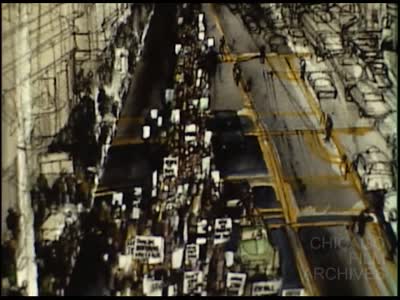
About a thousand marchers took him up on the offer and headed south toward his house and just possibly the convention.
No one was sure if he had checked first with his wife, but by the time they reached 18th Street, the police were there and the National Guard.
Gregory and the delegates with him were arrested and put in the paddy wagons.
When there was no more room in the paddy wagons and the demonstrators persisted, the guard moved in and tear gas filled the air.
Next day, McCarthy went to the park.
He had begun in New Hampshire, gone into Wisconsin, Indiana, Nebraska, Oregon and California, personifying the issue of the war and carrying it to the people.
He had believed that he could develop this dialogue within the democratic system, and so had the young people who flocked around him.
Now they had seen their delegates arrested in convention, kids beaten in the streets.
Even McCarthy's headquarters had been raided.
And now many of his kids thought that their only hope was to join the crowd in the streets.
McCarthy went across to make one last plea for staying within the system.
Meanwhile, back in the Hilton, Humphrey had inherited a fractionated party.
He had stood by his president in support of the war in Vietnam and driven off the young people and the intellectuals.
This was his greatest dilemma, how to chart an independent policy overseas and still not bring down in tatters the domestic programs of which he'd been so much a part.
George Wallace is a feisty little guy, a banty rooster of a man.
Formerly a democrat, he had been running since February as an independent and was now gaining strength.
As governor of Alabama, he had interposed himself between the university and federal law.
And later saw Northerners by the thousands come to Selma and to Montgomery to protest the racist customs of the South.
Now he has come north to Milwaukee and Cicero and Los Angeles and Flint to reap a kind of biblical vengeance on his tormentors.
I go to Los Angeles, I go to Birmingham, I go to New York and a group of anarchists lay down in front of your president's automobile.
It's going to be the last automobile that ever want to lie down in front of me.
He never once talks racism, but always law and order and communism and big government and bureaucracy in a simplified kind of states' rights politics, which has brought him popularity in the South and some in the North.
With all that had gone before, the New Hampshire McCarthy Challenge, the March capitulation of the president, the death of Dr.
King, Robert Kennedy's campaign and assassination, with all of this and the conventions and the Chicago turmoil, by mid -October all seemed anti -climax and for most Americans thankfully so.
But in this day of instant communication, the magic picture stays in the eye and the din of politics pervades the inner ear.
And in 1968, no American could escape it.
The candidates crisscrossed the country, Nixon cool and cautious, running above the fray, content to leave the low gut fighting to his vice presidential running mate.
This was the triumphant beginning of his campaign and the first day of what came to be called the Nixon format.
A headline making confetti and balloon motorcade, followed by a regional telecast.
These are the people that I call the forgotten Americans.
And these forgotten Americans have been quiet over the past few years, they haven't been speaking out, and now they're stood up.
And they're fed up.
The telecast was a grand success.
Seven carefully picked citizens put relatively tough questions to him, and he answered in his new effective forensic style.
In the early stages Humphrey was a desperate and harried campaigner.
And I was an underdog many, many times in the United States Senate when I led the fight for such programs as the Peace Corps and Medicare and Food for Peace and the Nuclear Test Ban Treaty just before we won.
Short of funds, he scurried from one local TV and radio station to another, from city to city, trying to piece together the remnants of an old ethnic labor union that had been in power for a long time.
A coalition which had served and been served by the Democrats in the past.
The big news was George Wallace.
Trouble for Nixon in the South.
Out to get Humphrey's blue collar vote in the North.
And the chance that the election might go into the House of Representatives.
The early polls and surveys showed Nixon ahead.
Humphrey, the optimist, felt all that was needed was time.
Statistics gave Nixon the crowds and Wallace saw acres and acres of folks.
But what every candidate knows is that after all the hoopla on the balloons and the confusion in the confetti, after all the airport arrivals in the motorcades and the TV shows, and after all the stories have been written, there are still people out there he hasn't seen and who haven't seen him.
It's axiomatic that Democrats talk to Democrats and Republicans to Republicans.
And whether there are 2 ,000 or 12 ,000 people in front of you, many times that number don't even know you've come to town.
And right down the block are people who couldn't care less.
So why not vote it? Let's get it out in the open.
If you're racist, let's know.
If you're racist, tell us.
I'm a racist.
I'm a bigot.
If you're not, let's find our sides.
It doesn't make any difference whether you're segregationist or integrist or you're black or white or young or old or rich or poor or male or female.
Right now we're interested in restoring law and order in this country.
And it doesn't have anything to do with race.
You better leave that cat where he is, man.
You don't need him for no president.
You must be insane.
You're a national guard in your backyard and in every corner, man.
Black people, remember the last hundred years we haven't even been fully represented in the law -making body, man.
We haven't had a representative in Congress or legislation or whatever have you, man.
Okay, for another point, if you throw them out, they can't cut it off.
If you vote them out, they can't cut it off.
And that's the secret.
You gotta vote them out.
You can't talk about it.
They don't control the machine if you don't vote for them.
You're talking about voting, Daly talks about counting.
Daly counts them the way he wants to.
Hey man, don't you know Daly got people on this voting list, man, that have been dead for the past 20 years, man? But that stuff can be corrected.
It's been corrected in other cities.
That shit ain't gonna never be corrected, man, cause y 'all don't know about it.
I think Rockefeller had more support.
Yet at least Nixon did win the primaries.
Humphrey didn't win any primaries.
God bless Social Security.
You're right.
And God bless President Johnson and this administration.
I've lived better.
I'm four months from 80.
And I'm standing up as a man, as American citizen.
I wanna know why the North Vietnamese went down to South Vietnam anyway.
They got their own country.
Why do we have to help them? Why do we have to stop a war that was begun without our help? Why do we have to go over and interfere when we are not wanted? Why did we deny them a free election after the Geneva Conference of 45? Why? Vietnam now, then where do we stop helping anybody who needs help? You draw the line of Vietnam or do you stop them in Chicago? Now where do you wanna stop them at? If I found it necessary, I would use anything that we could dream up.
Anything that we could dream up, including nuclear weapons, if it was necessary.
All General LeMay has said, and I know you fellas better than he does, because I've had to deal with you, he said that if the security of the country depended on the use of any weapon in the future, he would use it.
But he said he prefers not to use any sort of weapon.
He prefers them to go share.
And if you support him, then you're a fascist.
You are.
And you're gonna have a fascist state.
Because somebody doesn't have the guts to say we were wrong, everybody can be wrong.
And it would be a great thing if this country would stand up and say, we were wrong.
We're in it.
We gotta get out of there somehow.
Why do you worry how we got out, whether we look so pretty as we think we are to? I don't think it's so important.
I think humanity is much more important.
Who's gonna be the President of the United States? As far as me, I wouldn't want to be.
I have a headache what's coming next year.
Next four years ain't gonna be no fun to be President of the United States the way this country is right now.
This country is pretty close to a depression.
It's more better to unite the American people as one body, then we can stand the inflations that are probably coming.
You got something there.
In the end, a decision must come.
The voter at last brings his simple gift, an act of faith and hope in one man.
And not only in one person, but hope for the nation and faith in democracy itself.
Tis the gift to be simple, tis the gift to be free, tis the gift to come down where we ought to be.
And when we find ourselves in the place just right, it will be in the valley of love and delight.
When true simplicity is gained, to bow and to bend we will not be ashamed.
To turn, to turn will be our delight, till by turning, turning we come round right.
Tis the gift to be simple, tis the gift to be free, tis the gift to come down where we ought to be.
And when we find ourselves in the place just right, it will be in the valley of love and delight.
When true simplicity is gained, to bow and to bend we will not be ashamed.
To turn, to turn will be our delight, till by turning, turning we come round right.
Thank you for watching!