The mother in this family recently died.
Though missed by her family, they are adjusting to the loss, except for the son, whose recent behavior often has vicious overtones.
The doctor and school authorities recommended institutional life, but he was always such a good little boy.
Now certainly this is a home.
It is in an upper middle class suburban neighborhood.
The father is on his way to play golf with the boss.
But wait, his son has a problem.
Will you help me, dad? I can't get the chain on.
I'm in a hurry now, son, but I'll fix it tomorrow.
He said that yesterday and the day before.
His wife tries to understand him.
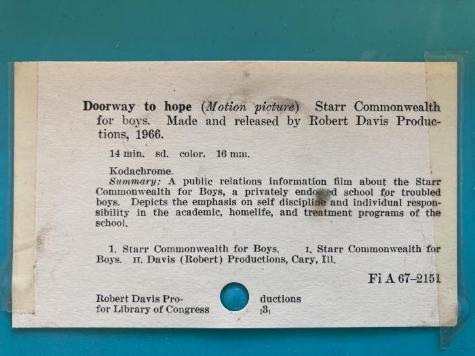
Why can't the boy? Three families, three different environments, three potential candidates for Star Commonwealth for Boys near Albion, Michigan and Van Wert, Ohio.
This doorway to hope stands ajar for the selected boys of your community who are in trouble at home, at school, or with the law.
Their behavior, reflecting some youthful hurt or an unbearable situation in their early lives has made society reject them, and they have rejected society.
Each is a mentally and physically normal boy whose record and personality prompted the juvenile court judge or interested person to commit the boy to Star Commonwealth instead of to a public institution for incorrigibles.
Officials who deal with the troubled young know Floyd Starr's motto, there is no such thing as a bad boy.
For more than 50 years, his philosophy of love, acceptance, and individual treatment have been available to thousands of socially and emotionally maladjusted boys.
Without the benefits of a home filled with love and attention to their special needs to guide them to maturity, these boys will become problem parents, producing more problem children.
Each generation, a link in a chain of delinquency.
Floyd Starr has established a doorway to hope to help break this chain and provide a boy with another opportunity to become a good citizen.
Beyond this doorway, a campus and farmland of 2700 rolling acres and over 28 buildings have been built through the generosity of patrons of the philosophy of Floyd Starr.
Old English type cottages and general education buildings are all on the main grounds.
More boys demand more housing.
As funds are donated, these ranch style homes on the north campus are completed.
There are no bars, no guards, not even fences.
So rebelling youngsters who want to run away find it easy to go truant.
This doorway to hope provides a boy with a nicely furnished home and pleasant surroundings.
Each home has a house mother and sometimes a house father.
It is their duty to know where their youngsters are at all times, to supervise the television programs, and to keep group discussions at a healthy level.
These sessions, though well flavored with opinions and grievances, tend to promote cottage loyalty.
Each boy must learn to take responsibility.
He is assigned monthly duties and is made to feel responsible for the way he carries them out.
These duties are not punishments.
Every boy participates and does his share, putting into action the name of the school, the commonwealth of living.
His opportunity also includes learning courteous and respectful behavior, acquiring the ability to serve a meal properly, to enjoy a balanced diet, to master table manners, to feel at ease in a jacket and tie at dinner, and at the end of day to expect clean pajamas and a clean bed.
The boys range in age from 10 to 16 years, so they must attend the accredited school program for grades 5th through 10th.
STAR teachers are required to have extra training in special education as well as unlimited patience, understanding, and discipline.
These attributes, applied in small classes, sometimes makes it possible for STAR boys, frequently behind in their schooling, to reach their normal grade level in a short time.
Not all boys, however, can be helped that quickly.
Emotional problems often block the boy's ability to learn, so each must be taught with consideration of his special need.
It takes time, time for old wounds to heal, time to express oneself without fear.
The campus museum and its varied collections have been donated to stimulate a boy's curiosity.
The museum director tries to extend the boy's interests from the classroom to studies of early cultures and to works of contributing artists.
Consequently, some boys are stimulated to become more creative.
Many entertainers perform for the boys to broaden their horizons and inspire them.
Prominent lecturers and visitors enlighten the boys in sex education, law enforcement, safety, vocations, and travel.
Participation in band, shop, and the physical fitness program also provides therapy.
Each requires mental discipline, muscular control, and reveals the necessity for rules.
No one really wants to hit the sour note, make a crooked table, or fumble the ball.
Do they fight among themselves? Of course they do.
They are full of resentment.
They strike out against the world and the blow falls on whomever is closest.
If the infraction is serious, they will lose a privilege.
Good behavior merits all privileges.
Misconduct restricts.
It hurts to see the bus leave for town with its happy load when a fellow has lost his right to go along.
A favorite privilege is an off -campus pass for a shopping trip, sporting event, or a visit home.
Passes and vacations are valuable to the STAR program as a testing period.
They condition the boy to return to his former life.
Will he adjust to the pressures of his family, or will he revert to his old bad habits? If these lessons are hard to take, there is always the understanding social worker waiting to help him at STAR Commonwealth.
The opportunity of having someone to talk to who really cares is greatly appreciated by the boys.
When boys return, they are asked to evaluate their vacation.
Were the other kids glad you were home? How did you fit in? Their subsequent behavior is a criterion of how they are developing and in which area more counseling is needed.
The social worker knows that when a bully torments his classmates, he is trying to prove something to himself.
The social worker also realizes that the fear of losing his old way of life can make a boy continue to steal.
He doesn't want the things he takes, but his life is void of love and security, and it's an empty feeling.
The social worker knows that destructiveness is a manifestation of too much pressure.
Most boys find it difficult to believe that they will be loved in spite of their behavior.
An overweight boy sometimes has special problems.
He is counseled by his social worker, checked by the athletic director who prescribes a diet and arranges special workouts.
His house mother gives him constant encouragement.
As he gains self -confidence, adjustment to his environment becomes easier, and he becomes happier.
More counseling is needed in some cases than in others.
Intensive help is given to boys who come to star confused in their concept of right and wrong.
A treatment team of a psychologist, social workers, and a consulting psychiatrist tries to direct each troubled boy to better understand himself and to develop a more outward -looking philosophy.
If this is achieved, the boy will begin to show maturity and will take part in group therapy sessions where boys discuss their problems with one another to gain new insights.
The social worker also evaluates a background of knowledge from former home records, present school reports, informal observations, cottage, and infirmary information.
To help measure and explain the problems of the boy, periodic conferences are held on the campus.
When a cooperative relationship exists between parents, boy, court worker, and staff of Star Commonwealth, a greater insight results for all concerned.
On visiting Sundays, relatives must accompany their boy to the chapel in the woods for the nonsectarian church service.
More than 20 religious backgrounds are represented among the boys, so only the best -known hymns and the book of common prayer are used.
Through evening devotional readings and prayers, the boys are further encouraged to have faith in God.
Most of the time, Star's program is successful.
It's a happy occasion when the staff believes a boy is ready to leave and awards him a certificate.
Their promise to him of an opportunity to become a good citizen has been kept.
As he leaves through the doorway to hope, he has a new set of values.
He can assume a new place in his old society.
Indoctrinated with high standards and motivated by self -respect, he and other Star graduates are more capable of finding tolerance for themselves and others.
Using these attributes, they have already started to forge the first link in a new chain of strong and reliable generations to come, an ideal for which Floyd Star has devoted his life.